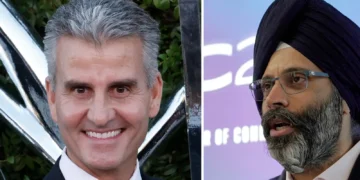
In a dramatic escalation of one of the media industry’s most consequential takeover battles, Oracle co-founder Larry Ellison has personally pledged $40.4 billion in equity financing to strengthen Paramount Skydance’s bid to acquire Warner Bros. Discovery (WBD). The pledge was disclosed in a regulatory filing from Paramount on Monday and is designed to respond directly to concerns raised about the financing backing its proposal.
Paramount’s revised offer remains an all-cash bid of $30 per share, valuing the company at approximately $108.4 billion, but now includes Ellison’s “irrevocable personal guarantee” of a large portion of the equity needed to complete the purchase.
The move adds new drama to a competitive showdown that also includes a separate deal backed by streaming giant Netflix, and underlines how high-profile and consequential the contest over Warner’s expansive content library has become.
Paramount’s bid had been widely criticized by Warner Bros. Discovery’s board for lacking clear and sufficiently secure financial backing particularly because prior financing rested largely on an Ellison family trust rather than direct personal commitments. Critics worried that a trust vehicle could be changed or revoked, leaving Paramount’s offer vulnerable.
Larry Ellison’s personal pledge of $40.4 billion aims to erase those doubts. Under the terms, he has agreed not to revoke the family trust or transfer its assets while the transaction is pending, and Paramount has voluntarily disclosed the trust’s holdings including roughly 1.16 billion Oracle shares and its liabilities.
By offering an irrevocable guarantee covering most of the equity financing, Ellison puts his own wealth among the largest fortunes in the world squarely on the line to back the deal. It is a rare step in modern merger negotiations, signaling not only Paramount’s determination but also Ellison’s confidence in the strategic rationale for consolidating Hollywood content under a new owner.
The Broader Battle for Warner Bros. Discovery
Paramount’s latest move comes amid a fierce bidding war over WBD’s future. Earlier this month, Warner’s board rejected Paramount’s previous offer, citing concerns about its financing and instead expressed a preference for a deal with Netflix that values studio and streaming assets at around $82.7 billion in enterprise value.
Netflix’s proposal combines cash and stock, and excludes certain WBD assets notably its cable television networks in contrast to Paramount’s $30-per-share cash bid, which covers the entire company.
If Netflix’s bid succeeds, it would dramatically bolster its position in the global streaming wars by adding Warner’s huge content bank including franchises like Harry Potter, DC Comics, and Friends to its platform. Paramount’s bid, by contrast, would create a new Hollywood powerhouse with an enormous portfolio of movies and television but faces questions about financing and regulatory risk.
To further align its offer with investor expectations and competitive terms, Paramount also raised its regulatory reverse termination fee from $5 billion to $5.8 billion the same level offered in Netflix’s competing bid and extended the deadline for its tender offer to January 21, 2026.
The regulatory reverse termination fee is a financial safeguard that compensates the target company if the deal fails to clear regulatory hurdles and is terminated; increasing it demonstrates Paramount’s willingness to match Netflix’s risk-sharing commitments.
Paramount also offered expanded flexibility on interim operational issues, such as debt refinancing arrangements and day-to-day governance during the interim period before any transaction closes. These revisions are intended to reduce friction and uncertainty for Warner management while the shareholder vote looms.
Following the announcement, Warner Bros. Discovery shares rose modestly in pre-market trading, as investors reacted to the renewed vigor of Paramount’s bid. Paramount’s own stock also ticked higher, reflecting renewed optimism among some market participants that the company could persuade shareholders to reconsider.
However, Warner’s board has so far remained publicly supportive of the Netflix offer, arguing that it remains the superior path for shareholder value and long-term strategic success. Some analysts contend that even with Ellison’s guarantee, Paramount’s chances of prevailing are not substantially improved unless it raises the per-share price or addresses broader governance concerns.
The outcome of this bidding war has implications far beyond the fate of Warner Bros. Discovery itself. If Paramount succeeds, it could create one of the largest media conglomerates in the world, with assets rivaling legacy entertainment giants like Disney in terms of scale and content reach.
But winning regulatory approval for such a combination would not be guaranteed; antitrust authorities in the U.S. and Europe are already expected to scrutinize any deal that reshapes the media landscape so dramatically. The risk of mandates like divestitures or operational restrictions could complicate final approvals regardless of which suitor prevails.
Meanwhile, a Netflix-led acquisition though smaller in overall value would emphasize the continuing power of streaming platforms to consolidate content libraries as traditional studios struggle to maintain market share.
A Turning Point in Media M&A
Larry Ellison’s personal commitment of $40.4 billion is a bold gambit in a high-stakes competition for global entertainment assets. Whether it will tip the scales in Paramount’s favor remains uncertain, but it underscores just how fiercely prized Warner Bros. Discovery has become as traditional media and tech-driven content platforms jockey for dominance.
The outcome still months away and dependent on shareholder decisions, regulatory reviews, and possible counteroffers could reshape the structure of Hollywood for decades to come.