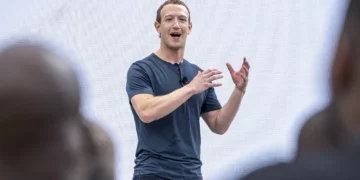
Few figures in Silicon Valley attract as much attention—or criticism—as Mark Zuckerberg. The Meta CEO’s decisions around social media, his push into artificial intelligence, and his vast landholdings in Hawaii have all stirred public debate. As a result, Zuckerberg is often at the center of cultural and political storms, making him a frequent target of public frustration.
That visibility has translated into extraordinary security measures. According to a Financial Times review of corporate filings, the combined security budgets of ten major technology firms exceeded $45 million in 2024. No executive, however, receives more protection than Zuckerberg, whose safeguarding costs Meta more than half of that total.
Meta’s Record Spending on Protection
In 2024, Meta spent $27 million on security for Zuckerberg, a sharp increase from the $24 million allocated in 2023. The company’s approach goes beyond personal guards, covering his residences, family, and travel.
This extensive coverage reflects Zuckerberg’s unique position. As both Meta’s cofounder and CEO with majority voting control, his identity is deeply tied to the company itself. Any threat to him is effectively seen as a threat to Meta’s stability and reputation. With public anger around privacy concerns, misinformation, and mass layoffs still fresh, Meta appears unwilling to take chances.
How Zuckerberg Compares With Other CEOs
Although security budgets are rising across the board, other tech giants still spend far less:
- Nvidia spent $3.5 million protecting Jensen Huang, up from $2.2 million in 2023, as his global profile rose alongside the company’s dominance in AI chips.
- Amazon allocated $1.1 million to safeguard CEO Andy Jassy, while founder Jeff Bezos continues to receive $1.6 million annually for personal protection.
- Apple spent $1.4 million on Tim Cook in 2024, notably down from $2.4 million the previous year.
- Alphabet reported $6.8 million in security costs for Sundar Pichai.
- Tesla disclosed just $500,000 for Elon Musk. Analysts stress this is only a fraction of his true protection costs, as Musk relies heavily on his own security company, Foundation Security.
When combined, the total spending of Apple, Nvidia, Amazon, Alphabet, Microsoft, and Palo Alto Networks reached around $20 million in 2024—still significantly less than what Meta alone allocated for Zuckerberg.
Private Security Industry Behind the Scenes
The Silicon Valley security landscape is dominated by private firms staffed by former law enforcement and military specialists. These firms do far more than provide bodyguards. Their services range from risk assessments, intelligence monitoring, and 24/7 protective details to cybersecurity, anti-stalking measures, and secure transportation with armored vehicles.
They also prepare for extreme threats, including deepfake blackmail, kidnapping, and assassination attempts.
Well-known companies in this space include Hamilton Security, founded by a former FBI agent, along with Gavin de Becker & Associates and LaSorsa Security & Associates. These firms provide comprehensive protection for figures such as Musk and Bezos.
Visible Protection for Controversial Leaders
Some executives embrace highly visible security. Palantir’s Alex Karp, whose company’s defense contracts have attracted protests, reportedly employs up to four bodyguards at a time as part of a constant security detail.
Nvidia’s Huang also saw his security budget rise as his fame grew. With a soaring net worth and constant public attention—sometimes to the point of being mobbed by admirers—his need for protection increased sharply in 2024.
Tragic Events Driving Higher Spending
The sharp rise in security budgets has also been influenced by recent violence against corporate leaders. The assassination of UnitedHealthcare CEO Brian Thompson in December 2024 shocked the business world, underscoring how real the risks have become.
In response, many companies introduced new measures, including:
- Removing photos of executives from official websites.
- Enforcing travel restrictions, such as mandating private jet use for CEOs.
- Strengthening cyber defenses to ward off online harassment and hacking attempts.
- Investing in advanced home protection systems, from hardened perimeters to surveillance technology.
These changes highlight how companies now view executive security as a business necessity, not a luxury.
Why Zuckerberg Is in a League of His Own
Zuckerberg’s case remains exceptional. Unlike other tech leaders, his identity is inseparable from the company he built. Meta’s platforms reach billions of people globally, amplifying both his influence and the hostility directed his way. His personal wealth, his role in shaping debates over privacy and misinformation, and his controversial land acquisitions in Hawaii only add to the risks.
For Meta, ensuring Zuckerberg’s safety is not simply about protecting an individual—it is about safeguarding the company itself. That logic has made Meta comfortable with allocating sums far greater than its peers, even as security costs across Silicon Valley continue to climb.