Satya Nadella just pulled off one of the biggest plays in the history of Microsoft. The chief executive of the tech giant announced a colossus $17.5 billion investment in India as the company’s single biggest commitment ever to any Asian country. This is not some corporate pledge but an absolute pointer that India is indeed the ground zero for the global AI revolution.
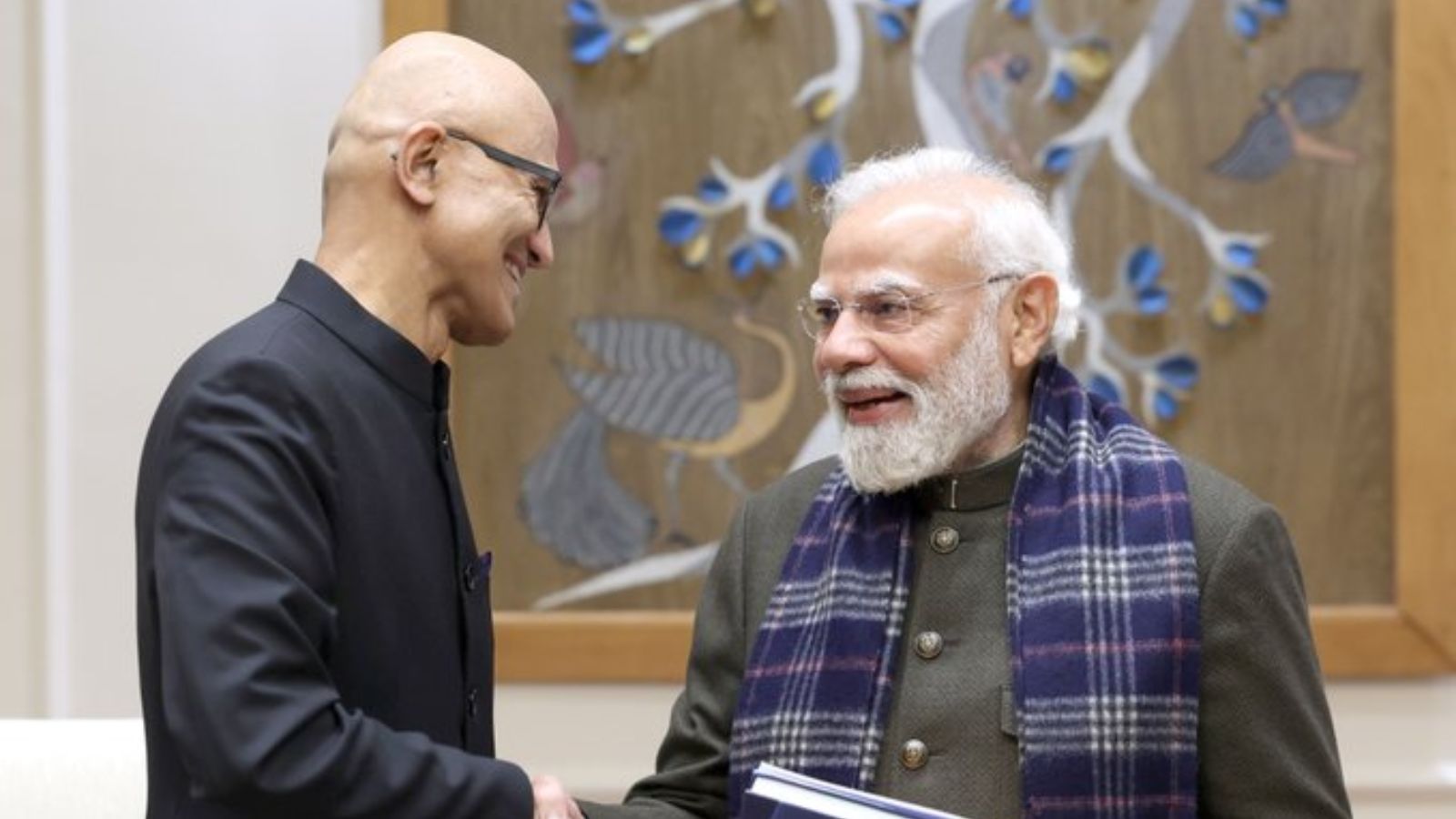
The announcement came on the heels of Nadella’s December 8-9 meeting with Prime Minister Narendra Modi in New Delhi. Taking to X, formerly Twitter, Nadella mentioned that he was excited about the potential of AI in India, singling out innovative platforms like eShram to demonstrate what the country was really capable of in terms of its digital prowess.
Modi, for his part, underlined how this investment would create opportunities for the country’s youth and place it at the heart of global optimism about AI.
The $20.5 Billion Bet of Microsoft, A Three-Pillar Plan to Transform India’s Digital Future
What makes this deal particularly significant is the scale. Combined with an earlier $3 billion pledge made in 2025, Microsoft’s total commitment to India now stands at a staggering $20.5 billion over the next four years. That’s roughly the GDP of some small countries, all directed toward building India’s digital future.
In all, the investment breaks down into three major pillars that touch every aspect of India’s tech ecosystem. First up is infrastructure-and Microsoft isn’t holding back. The company will establish its largest hyperscale cloud in India, with new data centers sprouting up in Chennai, Hyderabad, and Pune.
These are no ordinary facilities; they’re designed to be AI hubs capable of handling the massive computational demands of next-generation technologies.
Really exciting, however, is the introduction of Microsoft’s Sovereign Public and Private Clouds: specialized platforms for compliant workloads, which aim at concerns of data sovereignty and security that have been increasingly topping the charts of priorities for governments and enterprises alike across the world.
This is intelligent and wise, considering India, especially, has been raising crescendo demands for keeping sensitive data on national borders.
The second pillar focuses on people. Microsoft has committed to training 20 million Indians in AI skills-a number that’s hard to wrap your head around. That’s roughly equal to training the entire population of Australia.
This enormous skilling initiative acknowledges that infrastructure alone is not good enough; you need people who know how to build, maintain, and innovate on these platforms.
Tech Giants Bet Big on India’s AI Future
It presently employs more than 22,000 people in Indian cities such as Bengaluru, Hyderabad, and Gurugram. These teams are not only providing support but also engaged in product innovation, making India a true hub for Microsoft’s global operations, not just another market to serve.
The investment directly linked to the government’s ambitious Viksit Bharat-Developed India vision for 2047, as termed by Puneet Chandok, President of Microsoft India, was an “AI moment for India.” Trust-based innovation, according to IT Minister Ashwini Vaishnaw, sets the tone for India’s rise as a reliable technology partner for the world.
Microsoft is not alone in its recognition of India’s potential. Google recently announced its own $15 billion AI push into the country, creating competition that will likely go quite a long way for India’s tech ecosystem. When the tech giants start competing for market share and talent in your country, you know you’re doing something right.
Not a finer time could it be for India: a young, technology-savvy population; improving digital infrastructure; and government policies promoting innovation have put the nation perfectly in place to become one of the superstars of the AI era. This isn’t charity on Microsoft’s part; it’s a well-considered gamble that India would lie at the heart of technology in the future.
For many millions of Indians, this is more than corporate news: jobs, skilling programs, and the infrastructure required to be productive in an AI-driven world. Whether one is a student learning to code or a business looking to scale, Microsoft’s commitment changes the equation substantially.
The real question, in short, is not whether India would play a role in the AI revolution, but how big.