Nvidia just announced something that sounds practically too good to be true: an actual AI supercomputer in the palm of your hand. The DGX Spark, now officially on sale beginning today, October 15th, 2025, marks a dramatic move towards bringing high-performance AI within the reach of lone developers, researchers, and small groups of people who cannot be supported with large data centers.
It’s difficult to gaze at the DGX Spark and not see, er, a fashionable little Mac Mini. At 150mm x 150mm x 50.5mm and 1.2 kg in turn, this gold-plated device can comfortably sit on any desk without dominating your working area.
But do not be deceived by the svelte shape, it contains at least 1 petaFLOP of AI computing power, something that would’ve required an entire room’s hardware just some years ago.
The heart of the DGX Spark is Nvidia’s GB10 Grace Blackwell Superchip, which cleverly combines a 20-core Arm processor with cutting-edge Blackwell GPU architecture. The CPU portion includes 10 high-performance Cortex-X925 cores for demanding tasks and 10 efficiency Cortex-A725 cores for lighter workloads, ensuring the system balances power and energy consumption effectively.
And it’s the DGX Spark’s homogeneous memory that truly separates it. The system ships with a healthy 128 GB of LPDDR5x memory that’s equally divided between the CPU and GPU. That eliminates the necessity for data to continually move back and forth between distinct pools of memory, removing the large bottleneck that historically hampers workloads in artificial intelligence.
The system’s 273 GB/s memory bandwidth then ensures that both processors can be kept supplied with data at all times.
The NVIDIA DGX Spark for Developers and Researchers
Storage has also not been ignored. The DGX Spark comes with up to 4 TB of accelerated NVMe M.2 SSD storage with hardware encryption so that you have ample space to accommodate datasets, models, and apps and keep them all protected.
It seems Nvidia also envisioned the DGX Spark for running solo or in tandem projects. The unit features four USB Type-C ports, HDMI 2.1a output with support for 8K monitors, and 10 GbE Ethernet for rapid networking.
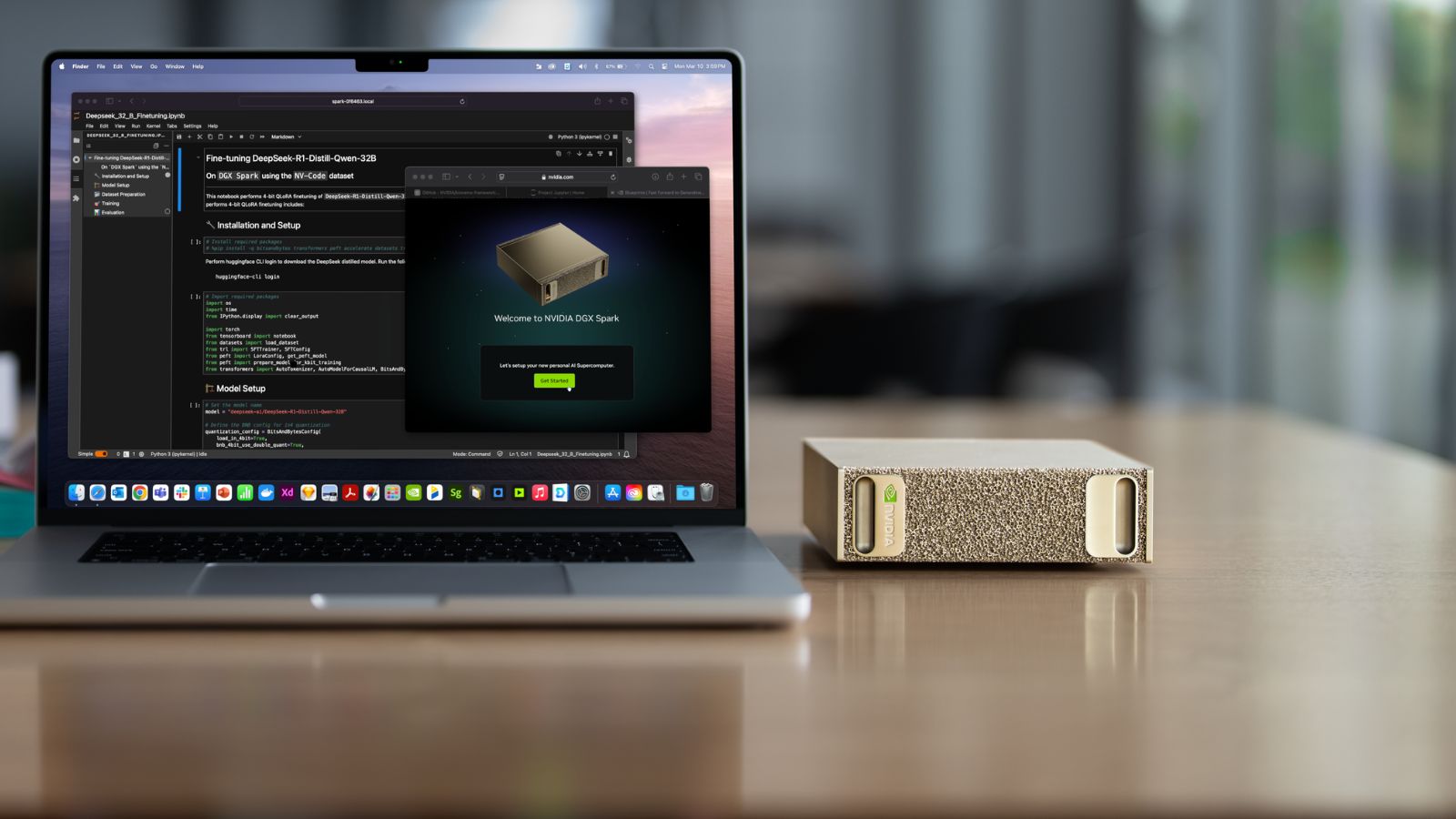
But the most exciting feature is the pair of QSFP ports driven by Nvidia’s ConnectX-7 network interface card with the potential to yield 200 Gbps of bandwidth.
This is not just hype about high-speed connectivity. Two DGX Spark nodes can be connected to form a mini cluster that can support the execution of AI models with 405 billion parameters.
This is beneficial for researchers and software developers because it is now possible to start small and scale big without having to move your work to an entirely new infrastructure. The setup also comes with Wi-Fi 7 and Bluetooth 5.4 for the convenience of being wireless.
So what can you do with one DGX Spark? By Nvidia’s count, one server is capable of running 200 billion-parameter AI models locally and fine-tuning models in the 70 billion parameter size ballpark. That brings something like Meta’s Llama 2 70B or comparable large language models within the grasp of lone devs.
Why the DGX Spark Excels in Prototyping and Exploration
It supports popular AI frameworks such as TensorFlow, TRT-LLM, and PyTorch and plays well with existing workflows. It is optimized for the realm of prototyping, model exploration, and research in the domain of edge AI where the unified memory architecture and optimized CPU-GPU integration excel the most.
However, Nvidia is being realistic in the DGX Spark’s role. Even though it has incredible power given the size, larger desktop GPUs like the RTX 5090 or professional cards like the RTX Pro 6000 do offer higher raw compute throughput. The DGX Spark is powerful in applications where large memory capacity and low-latency memory access become more valuable than raw brute-force compute power.
Perhaps the most surprising aspect of the DGX Spark is its price. Starting at $3,999, it’s certainly not an impulse purchase, but it’s remarkably affordable compared to traditional AI workstations or cloud computing costs over time. For small research labs, startups, or individual AI researchers, this represents a new category of accessible AI computing.
The DGX Spark is a pivotal event in the history of hardware for AIs. By delivering supercomputer-grade AIs within the form factors of desktops, Nvidia is taking bets that the future of developing AIs won’t solely occur inside giant data centers it’ll occur in desktops throughout the globe.