French quantum computing company Pasqal is reportedly in talks to raise €200 million in a funding round that would value it at more than $1 billion pre-money. While terms are still being finalised, the size and valuation of the raise send a strong signal: investors believe quantum computing is inching closer to real-world impact.
Quantum computing has never lacked ambition. For years, the industry has promised breakthroughs in drug discovery, materials science, logistics optimisation, and even cryptography. The bottleneck, however, has been engineering. Building quantum machines that can keep qubits stable long enough to perform meaningful computations—and then scaling those machines without making them impossibly fragile—has proven enormously difficult.
Pasqal believes it has a solution.

Credits: Ascendants
Why Neutral Atoms Could Be the Game-Changer
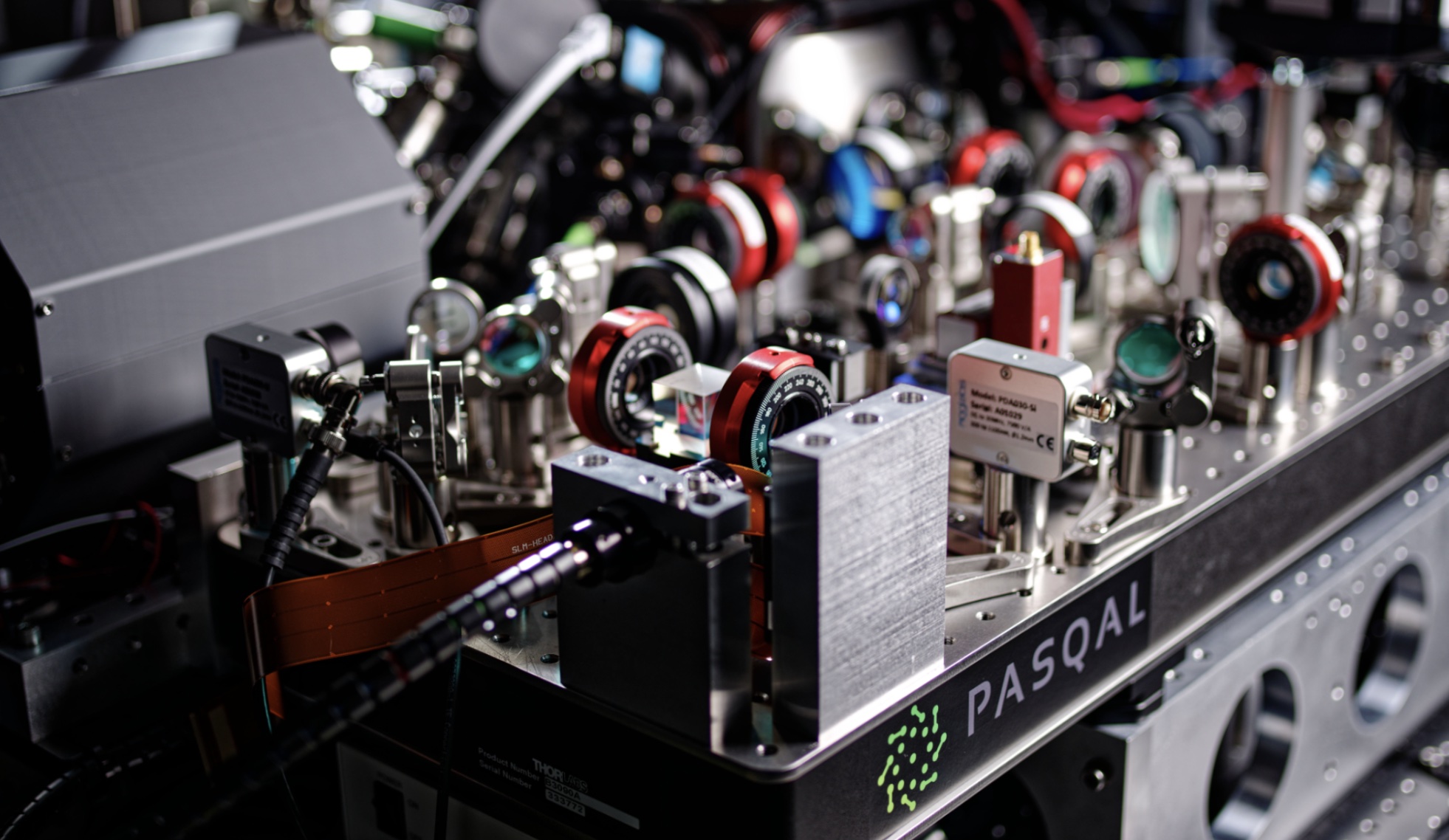
At the heart of Pasqal’s strategy is its use of neutral-atom qubits. Unlike superconducting qubits or trapped ions, neutral atoms are manipulated and trapped using lasers. According to the company, this approach offers high accuracy, long-lasting coherence, and flexible configurations.
That flexibility is critical.
In quantum computing, scale is everything. The more qubits a system can reliably control, the closer it gets to outperforming classical computers. But scaling introduces complexity—more qubits mean more potential for error and instability. Pasqal argues that neutral-atom technology allows qubits to be arranged more freely, making error correction and scaling more practical.
The company is positioning its platform as capable of scaling beyond 1,000 qubits using atoms—a threshold that many in the industry see as crucial for meaningful quantum advantage.
If Pasqal can deliver on that promise, it could mark a significant shift in how quantum hardware is built.
More Than Just Hardware
Pasqal isn’t pitching itself as just another hardware manufacturer. The company is building what it calls “fully integrated processors and software” that blend quantum and classical computing.
This hybrid approach matters because quantum computers are unlikely to operate in isolation. Instead, they will work alongside classical systems, offloading specific, highly complex tasks. By developing both hardware and software, Pasqal aims to control more of the stack—an approach that could help it move faster from experimental milestones to commercial applications.
In an industry where many companies focus narrowly on hardware breakthroughs, Pasqal’s full-stack strategy could become a differentiator.
The Competitive Arena
The quantum race is crowded and high-profile. Pasqal is competing against well-known names such as IonQ, Rigetti, IBM, and Oxford Quantum Circuits.
Each of these players is pursuing different technological approaches—from trapped ions to superconducting circuits. Where Pasqal seeks to draw a clear line is on scale. The company’s claim of scaling neutral-atom systems beyond 1,000 qubits is central to its competitive pitch.
The broader battle is not just about qubit count, though. It’s about which architecture can scale reliably, correct errors efficiently, and integrate into real-world computing environments.
The next few years will likely determine which technology paths prove viable beyond the lab.
Founders with a Scientific Edge
Pasqal was co-founded by Georges-Olivier Reymond and Antoine Browaeys with a clear mission: turn neutral-atom research into quantum machines that can eventually outperform classical computers.
Their vision is rooted in years of academic and scientific work. The company was built around the idea that neutral-atom technology, long explored in research labs, could be industrialised into scalable systems.
Now, with a potential €200 million infusion, Pasqal aims to accelerate that vision.
Where the Money Will Go
If the funding round closes on the reported terms, Pasqal plans to channel the capital into three key areas:
-
Scaling up its processors to push qubit counts and system stability.
-
Expanding and strengthening its software capabilities.
-
Running real-world pilot projects in industries such as pharmaceuticals and logistics.
These pilots are particularly telling. Rather than focusing solely on laboratory benchmarks, Pasqal is looking to test its systems in messy, real-world environments. That shift—from controlled demos to practical deployment experiments—could define the next chapter of quantum computing.
Credits: Sifted
A Signal from Investors
Even with the caveat that the deal is not yet final, the funding conversation itself is significant. A €200 million round at unicorn valuation suggests investors see quantum computing moving from theoretical promise toward early-stage commercial utility.
The real test now will not just be scaling qubits—but proving usefulness.
In the coming years, the companies that win may not be those with the flashiest lab results, but those that demonstrate measurable impact in drug discovery pipelines, logistics optimisation models, or industrial simulations.
Pasqal is betting that neutral atoms—and a full-stack strategy—will get it there first.