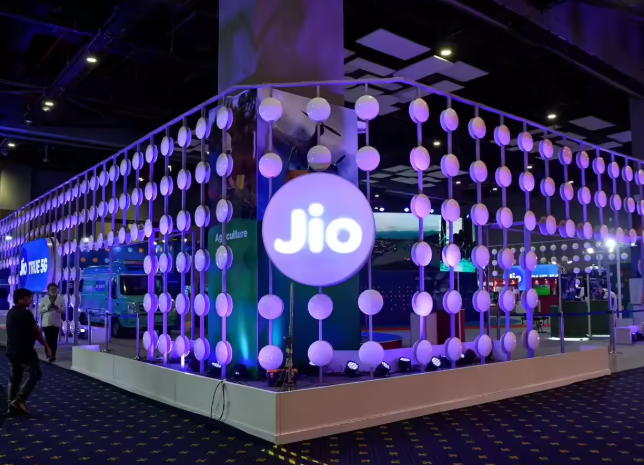
The biggest capital market event in Indian corporate history is undergoing a massive structural overhaul. During a high-profile shareholder meeting, Reliance Industries Limited (RIL) Chairman Mukesh Ambani announced a major shift in the framework of the highly anticipated Jio Platforms IPO. Instead of utilizing a massive Offer for Sale (OFS) that would allow early global venture capital firms to cash out, the upcoming public float will now consist entirely of a fresh issue of up to 27 crore equity shares.
Consequently, this strategic shift means that 100 percent of the massive capital pool raised from the public markets will flow directly into Jio Platforms’ balance sheet rather than into the bank accounts of exiting institutional backers. The announcement, which follows intense discussions between the Ambani family and marquee global investors like Meta, Google, KKR, and Saudi Arabia’s Public Investment Fund (PIF), has shifted the anticipated listing timeline back to July 2026. By choosing a pure equity infusion over an aggressive sell-off, RIL is laying down a long-term foundation for its digital ecosystem while deliberately protecting everyday retail investors from an overvalued debut.
The Strategic Pivot: Fresh Capital vs. Investor Exit Disagreements
The decision to transition the Jio Platforms IPO into a fully fresh capital issue stems from a fundamental pricing disagreement behind closed doors. Under the original framework drawn up in March, each of the company’s 14 early-stage private equity investors was scheduled to shed 8 to 8.5 percent of their respective holdings. However, global private equity firms pushed for a premium valuation band to maximize returns on the historic investments they made during the 2020 tech funding boom. Mukesh Ambani firmly pushed back against an overly aggressive valuation target, noting that overpricing the issue posed a severe threat of a weak listing day performance that would hurt domestic retail accounts. A massive public offer at a highly inflated entry point leaves zero margin for post-listing gains for everyday buyers. By pivoting to a fresh issue structure of 27 crore shares, RIL lets open public market trading determine the true organic price of the asset after listing. Institutional investors who still wish to adjust their portfolios can sell their shares directly via secondary exchanges once lock-in periods expire.
Where the Money Goes: Funding the Deeptech Era
Because the revamped Jio Platforms IPO structure forces all investor proceeds straight back into the business, the company is capturing an immense war chest to finance its next generation of digital infrastructure. According to the updated Draft Red Herring Prospectus (DRHP) details, the allocation of the incoming capital will be highly targeted.
Capital Allocation Profile for the Fresh Issue Proceeds
| Corporate Operational Layer | Anticipated Capital Expenditure | Primary Institutional Objective |
| Debt Repayment Framework | ~₹25,000 Crore | Complete deleveraging of spectrum liabilities |
| Deeptech Intelligence Era | ~₹8,000 Crore | Mass rollout of affordable local AI models |
| Sovereign Satellite Network | ~₹5,000 Crore | Mass deployment of LEO space broadband nodes |
| Core 5G Advanced & Fiber | Balance Accruals | Densification of rural mobile tower arrays |
The funding allocated to artificial intelligence and space infrastructure is particularly crucial. Led by Akash Ambani, the digital unit is stepping into what the company defines as the “deeptech intelligence era.” The tech giant plans to deploy massive, affordable artificial intelligence arrays engineered to disrupt standard AI economics across India. Simultaneously, the group is advancing a sovereign satellite constellation designed to bring low-latency internet connectivity to the remotest regions of the country, competing head-to-head with Western networks.
Banking Cadence and the Financial Balance Sheet
To manage an issue of this unprecedented scale, Jio Platforms has appointed a massive roster of 19 book running lead managers the second-highest number of advisory institutions ever registered for an Indian public listing. The elite banking syndicate includes Kotak Mahindra Capital, Morgan Stanley, Goldman Sachs, JM Financial, HSBC, Bank of America, and Citigroup From a purely financial perspective, the tech powerhouse enters the public domain with incredible fundamental numbers. In its latest Q4 FY26 financial disclosures, the firm registered an operational revenue from operations of ₹38,259 crore, backed by a resilient EBITDA of ₹20,060 crore.
By maintaining a steady operating margin above the 52 percent mark despite massive ongoing 5G network rollouts, the company has successfully proven its capability to generate self-sustaining cash flows. By using the fresh issue proceeds to wipe out its remaining spectrum debts, the tech conglomerate will instantly boost its bottom-line net profit margins. This optimization positions the Jio Platforms IPO to act as a permanent value-creation engine for long-term retail and institutional shareholders alike.