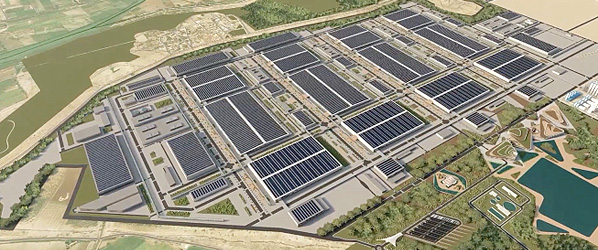
India is leading the world’s green energy revolution thanks to Reliance Industries Limited (RIL). The company’s executive director, Anant Ambani, revealed at the company’s August 29 Annual General Meeting (AGM) that RIL is constructing a solar park in Gujarat’s Kutch district that will be three times the size of Singapore. The goal of this massive effort is to make India a center for green hydrogen, its derivatives, and sustainable aviation fuel (SAF), not only clean power.
Credits: Reliance Industries Limited
A Solar Park of Unprecedented Scale
One of the largest single-site solar projects in the world, the proposed solar park will cover an incredible 5,50,000 acres of parched territory in Kutch. RIL will have one of the quickest installation rates in the world during its busiest building period, installing 150 megawatt-hours (MWh) of battery containers and 55 megawatts (MW) of solar modules daily.
According to industry experts, the project will have a minimum installed capacity of 10 gigawatts (GW), which is sufficient to meet around 10% of India’s electricity requirements over the course of the next ten years. The scale alone indicates a revolutionary influence on India’s renewable energy landscape, even though RIL has not revealed the precise capacity.
Round-the-Clock Renewable Energy
The intermittent nature of solar power is one of its main drawbacks. In order to solve this, RIL is installing Battery Energy Storage Systems (BESS) at the location to guarantee renewable energy is available 24/7. The company’s downstream projects—green hydrogen, green ammonia, green methanol, and SAF—need continuous renewable power for their production processes, thus this action is essential.
Building a Green Hydrogen Ecosystem
The Kutch solar park will be directly linked to RIL’s ambitious green hydrogen plans. The company aims to produce 3 million tonnes per annum (MTPA) of green hydrogen equivalent capacity by 2032, first meeting its own captive demand and then expanding into global markets.
To support this vision, RIL is also building facilities for green ammonia, green methanol, and SAF in Kutch. These products will play a vital role in decarbonizing industries such as chemicals, shipping, aviation, and refining. The company’s marine and land infrastructure in Jamnagar and Kandla will provide seamless connectivity for domestic use and export markets.
“This will make India a global hub for cost-competitive green hydrogen and its derivatives,” Ambani said, emphasizing RIL’s ambition to scale up quickly.
Backed by National Incentives
Reliance’s clean energy drive is supported by India’s policy framework. The company has secured incentives under the National Green Hydrogen Mission for both hydrogen production and electrolyser manufacturing. Additionally, it has bagged allocations worth over ₹50 billion under the government’s Production-Linked Incentive (PLI) scheme for solar module manufacturing.
These incentives will help RIL establish integrated poly-to-module facilities, reducing dependence on imports and strengthening India’s renewable supply chain.
Timelines and Phased Development
While RIL has not provided a definitive commissioning timeline, the solar park is expected to take shape in phases starting from FY27. Considering the sheer size and complexity, the project will likely see staggered rollouts, each adding incremental capacity to India’s renewable energy base.
Why This Matters
If successful, Reliance’s Kutch project could be a game-changer not just for the company but for India’s entire energy sector. It would:
- Significantly cut India’s dependence on fossil fuels.
- Position India as a leading exporter of green hydrogen and its derivatives.
- Help industries decarbonize, especially hard-to-abate sectors like steel, cement, shipping, and aviation.
- Create thousands of jobs and spur investment in clean tech infrastructure.
Credits: Moneycontrol
Conclusion
The solar park built by Reliance Industries in Kutch is the foundation of India’s green industrial revolution and goes beyond simply being a renewable project. RIL is placing a significant wager on the future of sustainable energy with the goal of harnessing the desert sun and using it as a global growth engine through the export of hydrogen and SAF.
Within the next ten years, India may become a global leader in green energy if the corporation fulfills its promises, with Kutch serving as the focal point of this change.