
In the startup world, growth often steals the spotlight. Investors celebrate soaring revenue charts, founders boast about customer acquisition milestones, and headlines frequently focus on companies expanding at breakneck speed. But growth alone does not guarantee a successful business. A company can grow rapidly while burning enormous amounts of cash, creating a business model that may eventually become unsustainable.
This is where the Rule of 40 comes into play.
Over the past decade, the Rule of 40 has become one of the most widely used benchmarks for evaluating Software-as-a-Service (SaaS) companies. It offers a simple yet powerful framework for assessing whether a company is striking the right balance between growth and profitability.
For investors, the metric serves as a quick health check. For founders, it acts as a strategic guide for determining when to prioritize expansion and when to focus on efficiency. Despite its simplicity, the Rule of 40 has become an important indicator in the SaaS industry, influencing valuations, investment decisions, and corporate strategy.
.svg)
Credits: Cube Software
What Is the Rule of 40?
The Rule of 40 is a performance benchmark that states:
A SaaS company’s revenue growth rate and profit margin should add up to at least 40%.
In formula form:
Rule of 40 = Revenue Growth Rate + Profit Margin
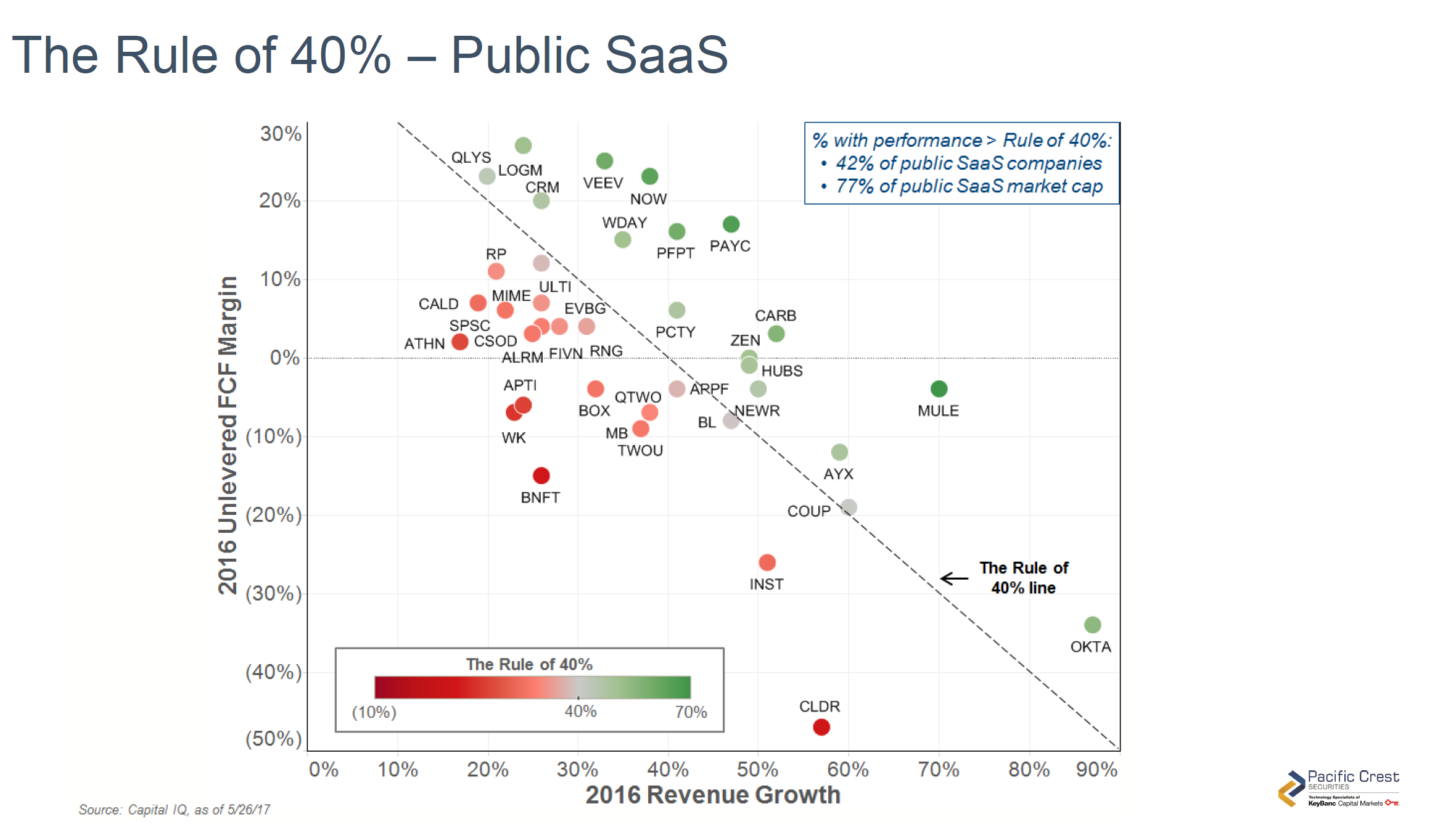
If the combined value exceeds 40%, the company is generally considered healthy and operating efficiently. If it falls below 40%, investors may view the business as underperforming relative to industry expectations.
The concept was popularized by venture capitalist Brad Feld, who argued that growth and profitability should not be evaluated independently. Instead, they should be viewed as complementary forces that together determine the quality of a SaaS business.
The rule acknowledges a reality that many startup founders understand well: companies often need to sacrifice profitability to achieve rapid growth. However, there must be limits to that trade-off.
Credits: Kellblog
Why SaaS Companies Need a Different Benchmark
Traditional businesses are often judged primarily on profits. Investors expect established companies to generate positive earnings and maintain healthy margins.
SaaS businesses operate differently.
Subscription-based software companies typically invest heavily in sales, marketing, product development, and customer acquisition. These investments can suppress profits for years while the company builds a recurring revenue base.
As a result, many fast-growing SaaS firms appear unprofitable under traditional accounting metrics despite having strong underlying business fundamentals.
The Rule of 40 was developed to address this challenge. Instead of focusing exclusively on profitability, it recognizes that growth has value. A company expanding rapidly may deserve a premium valuation even if it is not yet generating substantial profits.
At the same time, the metric discourages reckless spending by ensuring that growth is balanced by an acceptable level of financial discipline.
Understanding the Revenue Growth Component
The first half of the Rule of 40 calculation is revenue growth.
In SaaS companies, revenue growth is typically measured using recurring revenue metrics such as Monthly Recurring Revenue (MRR) or Annual Recurring Revenue (ARR).
Recurring revenue is particularly important because it reflects predictable income generated through subscriptions. Unlike one-time sales, recurring revenue provides visibility into future performance and is often considered the lifeblood of a SaaS business.
Monthly Recurring Revenue represents the total subscription revenue generated each month from active customers.
Annual Recurring Revenue is simply the annualized version of MRR.
Investors usually focus on the growth rate of these recurring revenue metrics rather than total revenue because they provide a clearer picture of a company’s long-term trajectory.
A business growing its ARR by 30%, 40%, or even 50% annually demonstrates strong customer demand and market traction, making it attractive to investors even if profitability remains limited.

Credits: Software Equity Group
Understanding the Profitability Component
The second half of the equation is profitability.
Most companies use EBITDA margin when calculating the Rule of 40.
EBITDA stands for Earnings Before Interest, Taxes, Depreciation, and Amortization. The metric is often preferred because it focuses on operational performance while excluding certain accounting and financing factors.
For SaaS businesses, EBITDA provides a more realistic picture of profitability than net income or operating profit.
Many growth-stage companies incur significant expenses related to expansion, stock compensation, or infrastructure investments. These costs can distort traditional profitability metrics.
Using EBITDA margin allows investors to compare companies more consistently while focusing on the underlying economics of the business.
A positive EBITDA margin suggests that a company is operating efficiently and converting revenue into profits. A negative margin indicates that the company is still investing heavily in growth.
How the Rule of 40 Works in Practice
The beauty of the Rule of 40 lies in its flexibility.
A company does not need both high growth and high profitability to pass the test. It simply needs a healthy combination of the two.
Consider a SaaS company growing revenue at 35% annually while maintaining a 10% EBITDA margin.
Adding the two figures produces a Rule of 40 score of 45%.
The company comfortably exceeds the benchmark and would generally be viewed favorably by investors.
Now imagine another company growing at only 10% annually but generating a 35% EBITDA margin.
Its score is also 45%.
Although the two businesses look very different, both satisfy the Rule of 40 because they achieve an effective balance between growth and profitability.
This flexibility is one of the reasons why the metric has gained widespread popularity among venture capitalists, private equity firms, and public market investors.
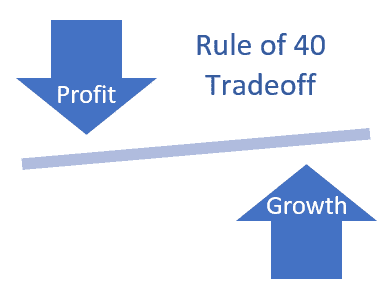
The Growth-Profitability Trade-Off
Perhaps the most important insight behind the Rule of 40 is that growth and profitability are interconnected.
Young SaaS companies often prioritize growth over profits. They invest aggressively in acquiring customers, building products, hiring talent, and expanding into new markets.
This approach frequently results in negative margins.
However, if growth is sufficiently strong, investors may tolerate those losses because they expect future profits to emerge once the company reaches scale.
For example, a company growing recurring revenue by 60% annually may still satisfy the Rule of 40 even if it operates with a negative 20% EBITDA margin.
In this scenario, investors may view the losses as acceptable because the company’s rapid expansion creates long-term value.
On the other hand, a company experiencing slow growth must compensate through stronger profitability.
If revenue growth falls to 5%, the company may need a 35% profit margin to remain attractive under the Rule of 40 framework.
The metric therefore creates a natural balance that discourages both excessive spending and excessive conservatism.
Credits: The SaaS CFO
Why Investors Pay Attention to the Rule of 40
Investors are constantly searching for ways to identify businesses capable of generating long-term returns.
The Rule of 40 provides a quick and effective method for evaluating SaaS companies because it captures two critical drivers of enterprise value: growth and profitability.
A company with a high Rule of 40 score is often viewed as having stronger fundamentals, better operational efficiency, and a more sustainable business model.
Research has shown that SaaS companies exceeding the Rule of 40 benchmark frequently command higher valuation multiples than their peers.
This does not mean the metric guarantees success. Rather, it serves as a useful screening tool that helps investors distinguish between healthy growth and growth achieved through excessive spending.
In an industry where revenue expansion often dominates discussions, the Rule of 40 introduces a valuable element of financial discipline.
When the Rule of 40 Is Most Useful
Although widely respected, the Rule of 40 is not equally applicable to every company.
The metric tends to be most effective for mature or late-stage SaaS businesses.
At this stage, companies have established products, predictable customer acquisition processes, and meaningful recurring revenue streams.
Because their business models are relatively stable, balancing growth and profitability becomes increasingly important.
Early-stage startups present a different challenge.
Seed-stage and early-growth companies often experience dramatic fluctuations in revenue growth and profitability. Their products may still be evolving, customer acquisition strategies may remain experimental, and financial metrics can change significantly from quarter to quarter.
As a result, Rule of 40 scores for early-stage startups can be volatile and difficult to interpret.
For these businesses, investors often place greater emphasis on market opportunity, product-market fit, and customer adoption rather than strict adherence to the Rule of 40.
Knowing When to Shift Focus
One of the most valuable aspects of the Rule of 40 is its ability to guide strategic decision-making.
Every SaaS company eventually faces a critical question:
Should the company continue prioritizing growth, or is it time to focus on profitability?
In the early years, pursuing growth aggressively often makes sense. Capturing market share, building brand recognition, and expanding the customer base can create significant long-term advantages.
However, growth naturally slows as companies mature.
At that point, investors begin expecting stronger margins and improved operational efficiency.
The Rule of 40 helps management teams determine when that transition should occur.
Rather than pursuing growth at any cost, companies can use the framework to maintain an appropriate balance between expansion and profitability throughout their lifecycle.

Credits: Valueworks.ai
Limitations of the Rule of 40
Despite its popularity, the Rule of 40 is not perfect.
The metric simplifies complex businesses into a single number, which means it cannot capture every nuance of performance.
Factors such as customer retention, churn rates, gross margins, product innovation, market competition, and customer acquisition costs remain critically important.
Two companies with identical Rule of 40 scores may have very different risk profiles and growth prospects.
Furthermore, economic conditions can influence how investors interpret the benchmark. During periods of abundant capital, markets may reward growth more heavily. During economic downturns, profitability often becomes a greater priority.
Therefore, the Rule of 40 should be viewed as one tool among many rather than a definitive measure of success.
The Bottom Line
The Rule of 40 has earned its reputation as one of the most important metrics in the SaaS industry because it captures a fundamental truth about building a successful software business: growth and profitability must eventually coexist.
By combining revenue growth and profit margins into a single benchmark, the metric provides a practical way to assess the health of a company and evaluate whether it is creating sustainable value.
For founders, it offers a framework for making strategic decisions about spending and expansion. For investors, it serves as a valuable indicator of operational quality and long-term potential.
While no single metric can tell the entire story, the Rule of 40 remains one of the clearest and most effective ways to measure whether a SaaS company is balancing ambition with discipline. In an industry where rapid growth often grabs the headlines, the Rule of 40 reminds everyone that sustainable success requires more than growth alone—it requires growth that is backed by sound economics.