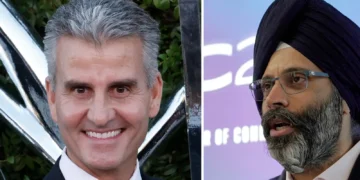
In a major executive pivot signaling a new phase of maturity and complexity, Spotify has announced a significant shift in its top management structure. Founder and long-time CEO Daniel Ek will transition into the role of Executive Chairman, while two senior leaders, Gustav Söderström and Alex Norström, have been appointed as Co-Chief Executive Officers.
This change, confirmed by Reuters, marks the end of the founder-CEO era for day-to-day operations and formalizes a distributed leadership model designed to manage the immense scale and dual complexity of Spotify: maintaining technological innovation while simultaneously driving aggressive content and market expansion. The move is a recognition that running a global platform with hundreds of millions of users, a massive content library spanning music, podcasts, and audiobooks, and operations in over 180 markets requires compartmentalized, specialized leadership at the very top.
The decision to appoint Co-CEOs reflects the distinct challenges and opportunities that define modern Spotify. Söderström and Norström are both long-serving company veterans, but they bring complementary skill sets that are critical for the platform’s continued evolution.
Gustav Söderström, previously the Chief R&D Officer, is expected to focus heavily on product, technology, and engineering. His mandate will be to ensure Spotify maintains its edge in personalization, machine learning, and AI-driven features. This is vital as the company seeks to integrate advanced intelligence into its discovery algorithms and its emerging audio formats.
Alex Norström, who previously oversaw the company’s Free and Premium business and global markets, is positioned to handle monetization, content, and market strategy. His focus will be on profitability, managing relationships with major rights holders, and driving subscriber growth in emerging global territories. By dividing the operational oversight one focusing on what Spotify is (the product) and the other on how it grows (the market and money) the company aims to increase agility and accountability across both domains.
Daniel Ek’s New Mandate: Vision, Disruption, and AI
Daniel Ek’s transition to Executive Chairman is strategically critical. By stepping away from the daily operational grind, Ek can dedicate his entire focus to long-term vision, capital allocation, and industry disruption. As the largest shareholder and founder, he retains ultimate control over the company’s trajectory but can now act as Spotify’s primary futurist.
His immediate mandate is likely to center on the next generation of audio technology, particularly how Generative AI will reshape music creation, licensing, and consumption. Ek will be tasked with ensuring Spotify remains ahead of technological shifts that could destabilize its business model, while also fending off major threats from tech giants like Apple and YouTube, which are constantly encroaching on the audio space. Ek’s role is no longer about managing quarterly earnings but about charting the five- to ten-year strategic course needed to cement Spotify as the world’s definitive audio ecosystem.
Challenges Facing the New Co-CEO Leadership
While the new structure provides clear operational direction, the Söderström and Norström leadership team faces immediate and significant challenges.
The most persistent issue for Spotify remains profitability. Despite massive revenue and subscriber growth, the company has historically struggled with thin profit margins due to the high costs associated with licensing music and the immense investment required to build its exclusive podcast library and integrate audiobooks. The new Co-CEOs must demonstrate they can squeeze more efficiency and margin from the core business, primarily through smarter ad monetization and aggressive cost management.
Secondly, they must fully realize the return on investment from the company’s multi-billion-dollar bet on non-music audio. Integrating and successfully monetizing podcasts and audiobooks is essential to break free from the reliance on music licensing fees. They need to prove that Spotify can be the primary destination for all forms of spoken word content, a goal that requires both sophisticated curation and innovative ad-tech solutions. The success of this dual CEO model will ultimately be judged by its ability to deliver consistent, substantial profit, turning Spotify’s market dominance into financial reliability.