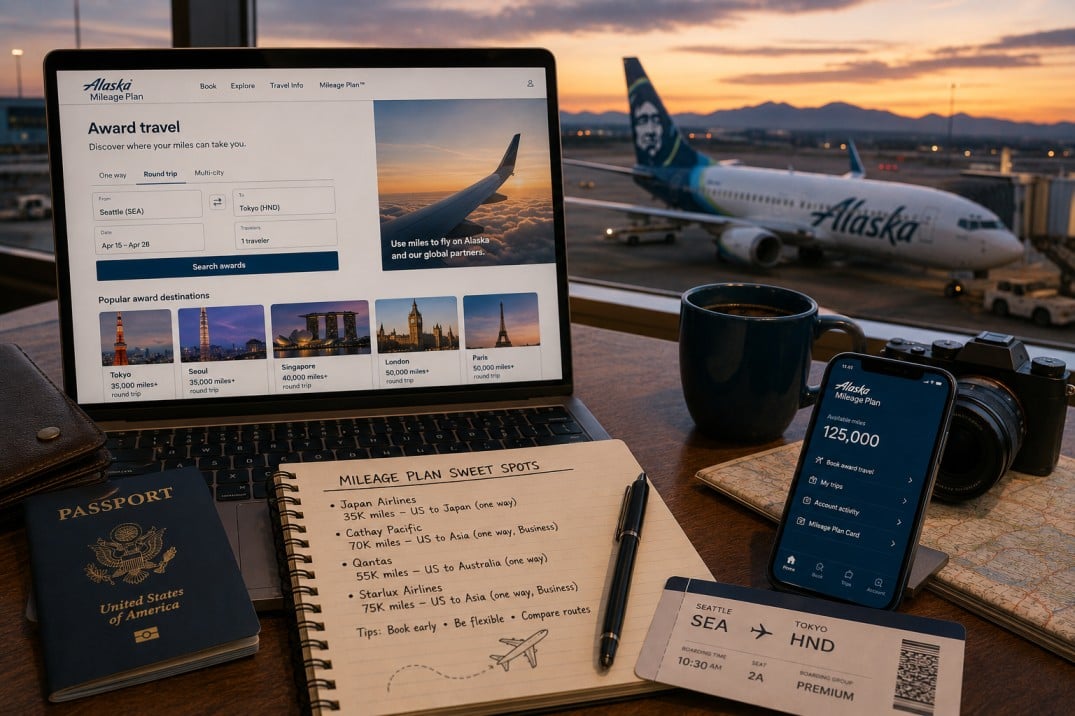
Every travel rewards programme has its loyal followers. Some swear by airline alliances. Others refuse to book anything unless hotel points are involved. Then there is the group that quietly smiles whenever somebody asks, “How did you only pay that many miles for business class?”
Quite often, the answer is Alaska Mileage Plan.
For years, Alaska Airlines built a reputation for offering airline awards that frequently made seasoned travellers look like financial magicians. While other loyalty programmes steadily moved towards fully dynamic pricing, Alaska continued offering redemption opportunities that often rewarded people willing to spend a little time comparing routes and partner airlines.
That reputation has naturally changed as award charts have been updated and pricing has become more variable. Yet even after several programme changes, Mileage Plan still contains redemption opportunities that stand out against many competing airline schemes.
Travel enthusiasts call these opportunities “sweet spots.” They are not secret discounts or hidden promotions. Instead, they are simply situations where the number of miles required feels unusually reasonable compared with the cash price of the same ticket.
Understanding where those opportunities exist helps explain why Alaska miles continue attracting attention from experienced travellers, even in an increasingly crowded loyalty market.
Why Alaska Mileage Plan Still Stands Out
Most airline loyalty programmes become easier to understand once you accept one simple fact. The airline would quite like you to spend more miles whenever possible.
Mileage Plan occasionally breaks that expectation.
Rather than relying entirely on one pricing formula, Alaska uses a mixture of distance based and region based award pricing, particularly across its own flights and partner airlines. The result is that some journeys cost far fewer miles than travellers might expect.
The programme became even more interesting after Alaska expanded its airline partnerships through the oneworld alliance and maintained relationships with several carriers outside the alliance. Members now have access to airlines including American Airlines, Japan Airlines, Cathay Pacific, Qatar Airways, Aer Lingus, Icelandair, STARLUX Airlines and several others.
Instead of viewing Alaska as simply an airline serving the west coast of the United States, many travellers now treat Mileage Plan as a gateway into dozens of international airlines.
That larger partner network has increased redemption possibilities without requiring travellers to collect separate loyalty balances for every airline they fly.
Mileage Plan also includes another characteristic that has become increasingly uncommon.
International one way award tickets can include a free stopover on many eligible itineraries. In practical terms, this allows travellers to spend several days in one city before continuing to their final destination while paying the same mileage price for the overall journey.
Many competing airline programmes either removed this option years ago or restrict it heavily. Alaska continues offering it on eligible awards, making itinerary planning considerably more flexible.
Another attraction comes from relatively modest taxes and carrier charges on many partner awards. Cash payments still apply, but they often remain lower than comparable bookings made through certain European airline loyalty programmes.
The Domestic Awards That Quietly Offer Strong Value
International premium cabins receive most of the attention on travel websites, but many Mileage Plan members find value much closer to home.
Short flights under roughly seven hundred miles begin at only 4,500 miles in economy on eligible routes. That covers many domestic journeys where cash fares occasionally rise sharply during holidays or major events.
Flights between seven hundred and one thousand four hundred miles begin at 7,500 miles, another pricing level that often compares well with last minute ticket purchases.
These awards work particularly well for travellers who need positioning flights before international departures or short journeys that would otherwise carry expensive cash fares because of limited competition.
American Airlines flights booked through Alaska also create opportunities on selected domestic routes where award availability matches between the two programmes.
None of these redemptions will produce glamorous social media photographs from a lie flat business class seat. They may, however, save a useful number of miles or a considerable amount of money across several trips during the year.
Hawaii remains another area where Mileage Plan regularly receives attention.
Alaska Airlines and Hawaiian Airlines both operate substantial networks serving the islands. Economy awards frequently begin around ten thousand to fifteen thousand miles on selected dates, although pricing rises during busier travel periods.
Families often appreciate these awards because several seats sometimes appear on the same flight when bookings are made early enough.
Business class availability naturally proves more limited, though it occasionally offers worthwhile value compared with cash fares during holiday seasons.
One point often overlooked involves Alaska’s own flights.
The airline does not impose blackout dates on its own award seats in the traditional sense. Pricing changes according to availability, yet members generally retain opportunities to book using miles throughout the schedule.
Where International Awards Become Interesting
Ask frequent travellers about Alaska Mileage Plan and the conversation usually turns international within minutes.
Japan Airlines remains one of the programme’s strongest attractions.
Business class awards between North America and Japan frequently begin around sixty thousand miles from the west coast, with longer routes requiring higher mileage amounts.
Japan Airlines has earned a strong reputation for cabin service, seating and onboard dining, making these awards popular whenever availability appears.
First class awards occasionally become available as well, though finding seats requires considerably more patience.
Cathay Pacific also remains an airline many travellers watch closely.
Flights between North America and Hong Kong in business or first class have historically represented strong uses of Alaska miles when award space appears. Cash prices for these cabins often climb into several thousand pounds, making mileage bookings look particularly attractive by comparison.
Travellers heading towards Europe also find worthwhile opportunities.
Flights between parts of the east coast of North America and shorter European routes may begin around forty five thousand miles in business class on selected partners such as Aer Lingus or Iberia.
Longer routes require more miles, yet they often remain competitive against several rival loyalty programmes.
South America deserves attention too.
Mileage requirements depend on distance, but longer business class flights can sometimes produce value that compares favourably with paying cash, particularly during holiday periods when ticket prices rise.
The programme also works well for journeys within Asia using partner airlines, allowing travellers already visiting the region to book shorter flights without spending excessive numbers of miles.
Australia, New Zealand and the South Pacific also appear within Mileage Plan’s partner network through airlines including Qantas and Fiji Airways, though award availability changes considerably depending on season and route.
One reason experienced travellers continue comparing Alaska with competing loyalty programmes is simple.
Mileage Plan often produces different answers.
A route that costs eighty thousand miles elsewhere might require considerably fewer through Alaska. On another journey, the opposite may happen. That is why experienced members rarely assume one programme always wins.
Instead, they compare.
Booking Strategy Matters Almost As Much As The Miles
Collecting miles represents only half the process.
Finding worthwhile awards usually begins with checking availability before making any transfer or redemption decision. Alaska’s website allows members to search many partner awards online, making comparisons relatively straightforward.
Mixed cabin itineraries deserve careful attention.
If part of a journey takes place in business class and another section operates in economy, pricing may reflect the highest cabin used. Reading the itinerary carefully before confirming the booking avoids unwelcome surprises.
Travellers also benefit from understanding where Alaska miles come from.
Unlike several competing airline schemes, Chase Ultimate Rewards points do not transfer directly into Mileage Plan. Instead, Alaska miles are commonly earned through Bank of America credit cards, flying Alaska Airlines or partner carriers, or transferring from selected programmes such as Bilt Rewards.
That distinction matters because travellers planning future redemptions need to understand which reward currencies actually feed into the programme.
Transfer decisions also deserve patience.
Award seats appear and disappear throughout the day as airlines release inventory or passengers cancel bookings. Booking immediately is not always necessary, but waiting too long can also mean losing an attractive redemption.
Mileage Plan continues changing alongside the wider airline industry. Award charts evolve, partnerships expand, pricing changes and new routes appear.
Yet the programme still attracts experienced travellers because it rewards flexibility rather than simple spending.
For travellers willing to compare partner airlines, search different travel dates and understand how the programme prices awards, Alaska Mileage Plan continues offering opportunities that stand apart from many larger airline loyalty schemes.
The famous “sweet spots” are no longer quite as sweet as they once were. Even so, they remain interesting enough to keep experienced travellers returning to the search page, hoping the next itinerary turns out to be one of those bookings that makes every collected mile feel worthwhile.