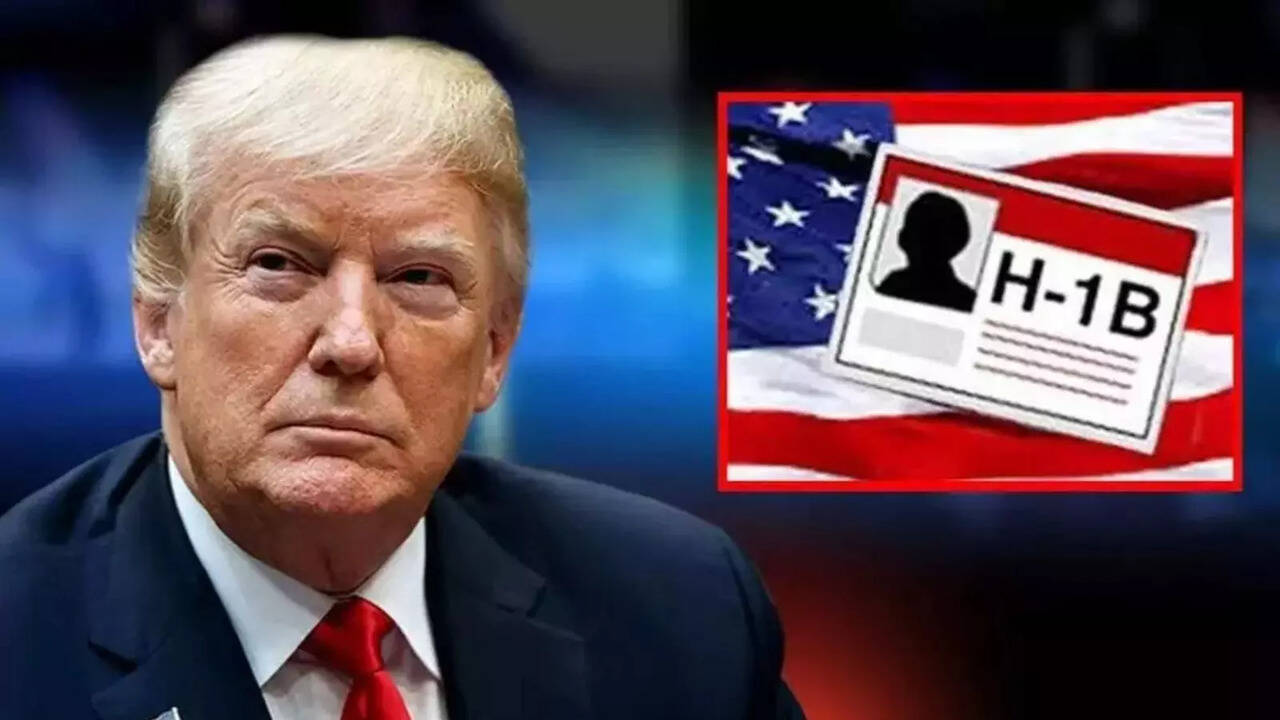
President Trump’s latest move on immigration has sent shockwaves through Silicon Valley and beyond. On September 19, 2025, he signed an executive order that will require employers to pay a staggering $100,000 annual fee for each new H-1B worker visa, effective September 21. The announcement has triggered panic among tech workers, emergency travel advisories from major corporations, and immediate market reactions.
The executive order, called “Restriction on Entry of Certain Nonimmigrant Workers,” is pretty straightforward in its demands. Any company wanting to hire foreign workers on new H-1B visas must cough up $100,000 per year, per worker. No payment means no entry for the visa holder; it’s that simple.
High H-1B Visa Fee Sparks Outcry and Panic Among Tech Giants
Trump’s administration says the move targets what they see as abuse of the H-1B system, particularly by outsourcing companies that have historically used these visas to bring in workers at below-market wages.
The hefty fee is designed to ensure only highly skilled, well-paid professionals make the cut. Plus, the government expects to rake in over $100 billion for the Treasury, money that’s supposedly earmarked for reducing national debt and cutting taxes.
The tech industry’s response was immediate and intense. In a matter of hours of the news, giants such as Microsoft, JPMorgan Chase, Amazon, and Meta sent frantic advisories to their H-1B and H-4 visa workers. The warning was straightforward: if you’re outside America, return before midnight on September 21, and you will be barred from entry. If you’re in the country, do not leave.
H-1B Visa Fee Hike Causes Chaos for Indian IT Professionals
In-house company circulars emphasized the seriousness of the situation, and cautioned the workers that departing from the US might lead to exclusion from re-entry. The consequence? Pandemonium across the board as Indian IT professionals and their families rushed to secure last-minute flights back to America, at prices ranging from the stratosphere and up.
The statistics speak for themselves. Indians control roughly 71% of all H-1B visas, and so will be the overwhelming majority affected by this shift. Large-scale Indian IT services firms such as Infosys, TCS, and Wipro have founded their US business on H-1B workers, utilizing them to work on American clients’ projects.
The market’s reaction was immediate and merciless. US-Listed shares of large Indian IT firms went down 2-5% right after the fee was announced, showing investors’ fears regarding future business models.
The White House provided some clarification within 24 hours, but it was insufficient to quell the outcry. Officials explained that only new H-1B petitions filed after September 21 would be subject to the new $100,000 fee. Existing, accepted petition-employees, visa-holders, and visa-hopefuls looking to renew active visas will be exempted. Even those chosen under the most recent H-1B lottery, whose visas become active October 1, will escape the new fee.
But even after these reassurances, there is anxiety amongst tech workers and their firms, and anxiety is concentrated around travel and future visa planning.
Indian H-1B Visa Changes and the “Reverse Brain Drain” DilemmaTCS
Indian business leaders report that this was something they had been expecting. Many Indian IT firms had, in recent years, reduced dependence on H-1B visas, taking work offshore or nearshore instead. Some report their H-1B filings off by more than 50% so far this year from earlier years.
But there are concerns among experts of “reverse brain drain” – top tech professionals relocating back from the US to India or elsewhere. Whilst the former may enrich offshore operations, the latter may erode American innovation and competitive edge in the long term.
US Commerce Secretary went on the defensive, explaining the policy targets workers who receive below-average wages and aim at “filtering out the bottom quartile.” Critics, though, complain the large fee will decrease diversity, accessibility of talent worldwide and will only end up channelling the investment and skilled workers elsewhere.
This executive order is the most sweeping change of the H-1B program in decades. If its supporters think it will protect American jobs and put an end to wage stagnation, its critics worry it will do the opposite and make America less competitive for the rest of the world’s brightest and best talent.
Thousands of tech workers and families remain in suspense, unsure what this portends for their American futures.