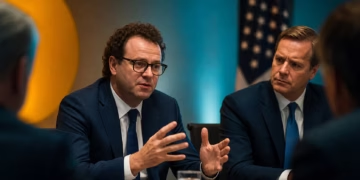
US President Donald Trump is scheduled to meet South Korean President Lee Jae Myung on August 25, 2025, at the White House in Washington, D.C., marking their first face-to-face summit since Lee took office in June 2025. This high-profile meeting comes amid ongoing efforts to strengthen the bilateral alliance in response to an evolving security and economic environment. The summit will focus on transforming the US-South Korea alliance into a future-oriented, comprehensive strategic partnership that addresses both economic cooperation and regional security challenges, especially related to North Korea.
President Lee will arrive in the US on August 24 and depart on August 26. His visit, classified as an official working trip, will include a working lunch with Trump. Accompanying Lee will be the South Korean first lady, Kim Hea Kyung, and possibly business leaders, although the latter are yet to be finalized.
Focus on Modernizing Military Alliances and Defense Spending:
One of the core issues expected to dominate discussions is the increase in South Korea’s defense spending and the modernization of the military alliance with the United States. The Trump administration has reportedly advocated for South Korea to raise its defense budget from the current approximately 2.3% of GDP to around 3.8%, moving closer to what Washington terms the “global standard” of 5% for its allies. Additionally, talks are anticipated to address the over $1 billion annual contribution South Korea makes towards hosting some 28,500 US troops stationed in the country under the US Forces Korea command.
Aiming to increase the extent of US military presence in Korea to better deter threats—not only from North Korea but also to balance an increasingly assertive China in the Asia-Pacific region the US is looking for more operational and strategic flexibility for its forces there, going beyond simple financial contributions. These actions fit the larger objective of “modernizing” the alliance to take into account the changing geopolitical landscape.
Trade, Investment, and Technology Collaboration:
The summit follows a recent trade deal wherein South Korea agreed to cut threatened US tariffs on Korean imports from 25% to 15%. In exchange, Seoul committed to investing around $350 billion in US projects over time, including in critical industries like shipbuilding, semiconductors, and batteries. Additionally, South Korea will be purchasing roughly $100 billion worth of US energy products. The leaders will further flesh out plans to strengthen economic ties, particularly in cutting-edge sectors such as advanced technologies and critical minerals.
These economic discussions aim to bolster mutual prosperity and secure supply chains critical for both nations. They also reflect a growing sense of urgency to build resilient alliances capable of responding to global supply chain disruptions and competition. The deepening economic relationship serves as a foundation for the expanded strategic partnership that both governments envision.
Peace, Denuclearization, and Coordinated Defense:
The region’s security is still seriously threatened by North Korea’s nuclear weapons program. Trump and Lee are expected to coordinate plans to promote peace on the Korean Peninsula during the summit, with a focus on denuclearization initiatives. In order to keep defense capabilities strong in the face of Pyongyang’s ongoing missile launches and military provocations, the two leaders will talk about ways to preserve and strengthen the Korea-US combined security stance.
The meeting also comes amid North Korea’s deepening military cooperation with Russia and persistent diplomatic challenges. While South Korea balances its security cooperation with the US, it also seeks stable relations with China, underscoring the complexity of regional diplomacy. The summit is perceived as a critical platform to reinforce alliances and review policies aimed at mitigating the threat North Korea poses to peace and stability in Northeast Asia