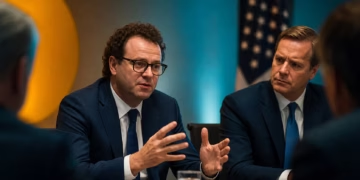
The Tata Group, one of India’s most respected and oldest business conglomerates, is once again facing internal turbulence. This time, the discord is not at Tata Sons but within the very institution that controls it, Tata Trusts. A growing rift among trustees has created what observers are calling a governance crisis at the heart of India’s largest corporate house. The issue revolves around control, leadership, and transparency in decision-making after the passing of Ratan Tata in October 2024. What began as a disagreement over board appointments has now turned into a power struggle threatening the stability of the $350 billion group that contributes nearly four percent of India’s GDP.
Tata Trusts, which holds about 66 percent of Tata Sons, plays a central role in shaping the direction of the entire Tata empire. Its trustees appoint directors to the Tata Sons board, which in turn governs flagship companies such as Tata Steel, Tata Motors, Tata Power, and Tata Consultancy Services. After Ratan Tata’s death, his half-brother Noel Tata assumed the role of chairman of Tata Trusts, a move that initially brought hope for continuity. However, less than a year later, that hope has faded as internal disagreements have surfaced, with some trustees challenging Noel Tata’s authority.
At the centre of this rift are two groups within the board. One faction is led by Noel Tata, supported by Venu Srinivasan, the vice-chairman of Tata Trusts, and Vijay Singh, a former Defence Secretary who served on the Tata Sons board. The other group, led by businessman Mehli Mistry, includes trustees Darius Khambata, Pramit Jhaveri, and Jehangir HC Jehangir. Together, these four dissenting trustees are said to be acting as a “super board,” attempting to influence decisions traditionally handled by the chairman and executive office of the Trusts.
The tensions came to light after the September 2025 decision to block the reappointment of Vijay Singh to the Tata Sons board. Under a new policy introduced after Ratan Tata’s passing, all Tata Sons nominee directors above the age of 75 were required to be reappointed annually. Although Noel Tata and his allies supported Singh’s continuation, the Mistry-led faction voted against it, effectively ending his tenure. Soon after, Singh resigned from the board, citing the untenable atmosphere within the Trusts.
This incident was not an isolated dispute. The dissenting trustees also attempted to nominate Mehli Mistry himself as a Tata Sons board member, a move strongly opposed by Noel Tata and Srinivasan. The rejection deepened divisions and led to public discussions about a governance vacuum within the group. According to insiders, the opposing faction has been reviewing board meeting minutes, questioning appointments, and seeking greater control over Tata Sons’ decision-making process.
The timing of this internal strife could not be worse. Tata Sons is already under regulatory scrutiny following the Reserve Bank of India’s directive requiring the company, classified as a core investment firm, to either list publicly or deregister by September 30, 2025. The deadline has passed without resolution, and the ongoing feud within Tata Trusts has further complicated the company’s ability to make critical decisions. A fractured leadership at the Trusts level raises questions about the conglomerate’s future governance and stability.
This new power battle also revives memories of the 2016–2018 corporate drama involving Cyrus Mistry, who was abruptly removed as chairman of Tata Sons. That episode ended only after a Supreme Court ruling in 2021 that upheld his dismissal. Mehli Mistry, a cousin of Cyrus Mistry, was a key supporter during that earlier dispute, and his current involvement in the Tata Trusts turmoil has drawn parallels between the two crises. The Shapoorji Pallonji (SP) family, with which Mehli Mistry has ties, still owns about 18.37 percent of Tata Sons. Their long-standing wish for Tata Sons to go public in order to liquidate their stake continues to be a sensitive issue.
Observers believe this latest rift stems not only from corporate disagreements but also from personal rivalries and long-standing differences over management philosophy. Noel Tata, who has led several Tata companies including Trent and Voltas, is seen as a steady hand aiming to preserve the group’s traditional approach of consensus-based decision-making. In contrast, the opposing trustees are demanding more transparency, stricter oversight, and what they call modern governance reforms. They have reportedly accused the leadership of excluding them from key decisions, particularly those related to appointments and financial reporting.
The government, concerned about the implications for the wider economy, has stepped in to defuse the situation. According to reports, senior union ministers Amit Shah and Nirmala Sitharaman summoned both Tata Sons Chairman N. Chandrasekaran and Tata Trusts Chairman Noel Tata to New Delhi for discussions. The ministers stressed the need to protect the stability of the Tata Group, which directly or indirectly employs hundreds of thousands of people and has a combined market capitalisation exceeding ₹25 lakh crore.
VIDEO | Delhi: Noel Tata arrives at Union Home Minister Amit Shah’s residence.
(Full video available on PTI Videos –https://t.co/n147TvrpG7) pic.twitter.com/oAxPW9tWNs
— Press Trust of India (@PTI_News) October 7, 2025
The government’s involvement reflects the national importance of the Tata Group. Beyond its massive corporate footprint, the group has deep links with India’s industrial, technological, and philanthropic sectors. From the salt-to-software empire’s influence on stock markets to its ownership of Air India, the Tata Group represents a cornerstone of India’s economic structure. Any prolonged instability at the top raises risks of decision-making paralysis that could affect investors, employees, and even national projects tied to Tata companies.
8 years ago, in an interview to CNBC-TV18, the late Ratan Tata spoke about the role played by Tata Trusts in the functioning of the Tata Group. He was speaking to Suhel Seth on why the Trust structure was created in the first place. #Watch#RatanTata #LateRatanTata #Tata… pic.twitter.com/qwHVLZowOi
— CNBC-TV18 (@CNBCTV18News) October 8, 2025
The crisis also exposes deeper governance issues within philanthropic holding structures in India. Tata Trusts, originally designed to fund charitable causes, has long functioned as both a philanthropic body and the controlling shareholder of the Tata Group. Ratan Tata managed this delicate balance through his personal authority and vision. Without his presence, the system’s vulnerabilities have become apparent. The absence of a single unifying figure has allowed competing interests to emerge, making it difficult to maintain coherence across the organisation.
Insiders describe the mood within Tata Sons and the broader group as cautious. Several senior executives are said to be frustrated by the uncertainty and delays in strategic decisions, particularly at a time when global markets are volatile and competition is intense. There are concerns that prolonged infighting may slow down key initiatives in sectors like electric mobility, renewable energy, and global expansion.
The trustees are expected to meet again in early October 2025 to address the ongoing disputes. While no formal agenda has been disclosed, the meeting is likely to focus on leadership roles, governance reforms, and the process of director nominations. Many within the business community are hoping the meeting will bring some clarity and restore unity. However, sources indicate that the divisions are deep-rooted and may not be resolved quickly.