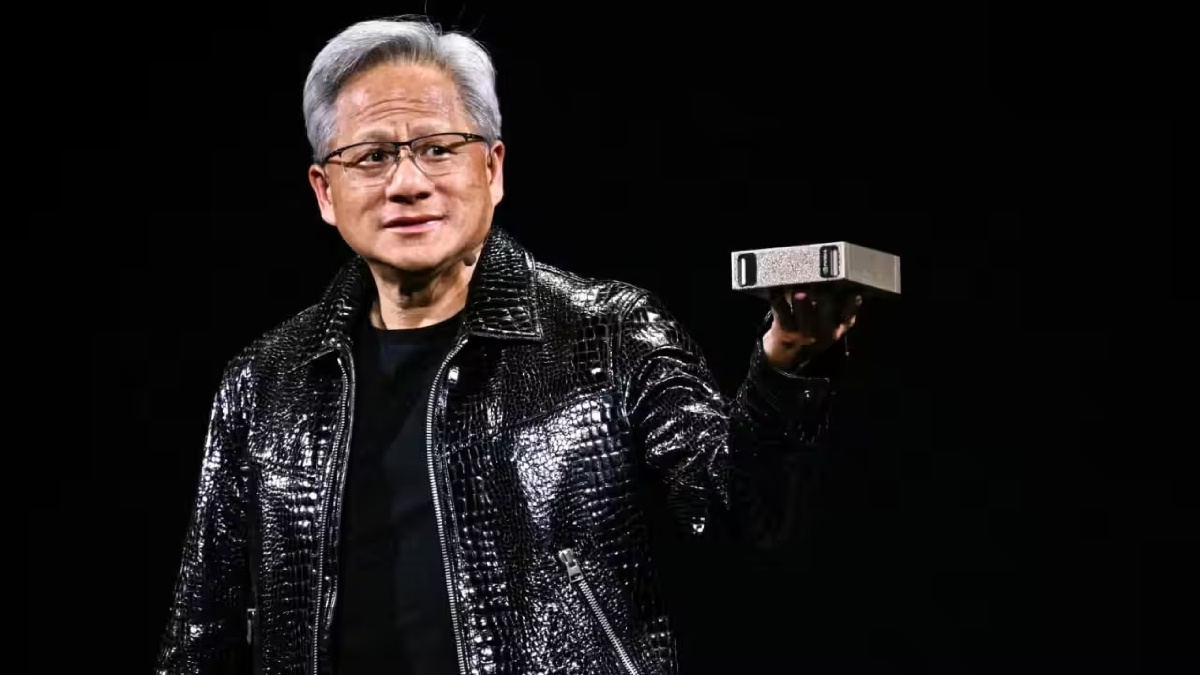
Nvidia’s leadership structure is facing renewed scrutiny as its board investigates allegations that CEO Jensen Huang was targeted by a foreign intelligence operation. The developments have also brought an important question into focus: Who could take over the world’s most valuable chipmaker if its co-founder eventually steps down?
Huang co-founded Nvidia in 1993 and has led the company for more than three decades. Under his leadership, Nvidia has transformed from a graphics processing unit (GPU) manufacturer into a global powerhouse in artificial intelligence (AI) chips and computing infrastructure.
However, the company has never publicly identified a designated successor. Several senior executives, including Indian-origin former sales chief Jay Puri, Chief Financial Officer Colette Kress and prominent technology leaders, have emerged in succession discussions, according to the Associated Press.
The uncertainty is further complicated by Nvidia’s management structure. Reuters reported on November 9 that more than 60 executives report directly to Huang, leaving the company without an obvious second-in-command.
The board announced an independent investigation on November 8 following reports concerning Huang’s relationship with Chinese businesswoman Alice Huang. Nvidia said there was no reason to believe company secrets or US national security had been compromised and expressed confidence in Huang’s leadership.
While no leadership transition has been announced, here are seven executives and senior figures whose names have surfaced in discussions about Nvidia’s future leadership.
Credits: OneIndia
1. Jay Puri: The Indian-origin former sales chief
Ajay K. Puri, popularly known as Jay Puri, is among the prominent names attracting attention in Nvidia’s succession discussions.
Puri joined Nvidia in 2005 after spending 22 years at Sun Microsystems. In 2009, he became executive vice-president of worldwide field operations, overseeing global sales, business development, strategic partnerships and customer relationships.
He played an important role in expanding Nvidia’s international business and strengthening its relationships with major customers.
However, Puri retired from his executive position on August 24, 2026, according to Nvidia’s regulatory filings. He was expected to remain associated with the company as a senior adviser during the transition.
Nick Parker, formerly a Microsoft executive, succeeded him as executive vice-president of worldwide field operations. Puri has not been officially identified as a CEO candidate.
2. Colette Kress: Nvidia’s finance chief
Colette Kress is another prominent name in discussions about Nvidia’s leadership succession.
She joined the company in September 2013 and has overseen its financial operations during its transformation into a dominant player in the AI industry.
Before Nvidia, Kress held senior finance positions at Cisco, Microsoft and Texas Instruments, giving her extensive experience across the technology sector.
Her long tenure, understanding of Nvidia’s financial strategy and relationships with investors make her a potential leadership option.
Executive search specialist Shawn Cole told CFO Dive that Kress could provide continuity as an interim CEO if a leadership transition became necessary.
3. Ian Buck: The executive behind CUDA
Ian Buck is Nvidia’s vice-president of hyperscale and high-performance computing and one of its prominent technology leaders.
He joined the company in 2004 and contributed to the development of CUDA, Nvidia’s software platform that enables developers to use GPUs for general-purpose computing.
CUDA has become a critical part of Nvidia’s competitive advantage, particularly as demand for AI computing infrastructure continues to grow.
Buck oversees products and relationships serving major cloud and AI customers, including Microsoft, Google and Amazon. His technical expertise and understanding of Nvidia’s computing ecosystem have brought him into succession discussions.
4. Bill Dally: Nvidia’s chief scientist
Bill Dally is another senior technology executive whose name has surfaced as a potential successor.
Dally joined Nvidia in 2009 after serving as chairman of Stanford University’s computer science department. He currently serves as the company’s chief scientist and senior vice-president of research.
He oversees research into computer architecture, artificial intelligence and advanced computing technologies.
His academic background and technical leadership make him an influential figure within Nvidia’s research ecosystem. However, there has been no official indication that he is being considered for the CEO position.
5. Chris Malachowsky: Nvidia’s other co-founder
Chris Malachowsky represents Nvidia’s founding leadership and has been associated with the company since its inception in 1993.
He co-founded Nvidia alongside Jensen Huang and Curtis Priem and previously led several engineering, operations and research functions.
Malachowsky currently serves as an Nvidia Fellow and member of the executive staff.
His decades-long association with the company and understanding of its technology and organisational culture have placed him among the names attracting attention in succession discussions. The Associated Press also identified him as a figure worth watching.
6. Nick Parker: The new worldwide sales chief
Nick Parker took over as executive vice-president of worldwide field operations in August 2026, succeeding Jay Puri.
Before joining Nvidia, Parker spent 26 years at Microsoft, where he held several senior leadership positions.
His appointment places him in charge of Nvidia’s global sales operations, business development and customer relationships.
Although his relatively recent arrival at Nvidia makes his succession prospects uncertain, his extensive experience in enterprise technology and global business operations makes him an important figure in the company’s leadership structure.
7. Debora Shoquist and Bryan Catanzaro: Key technology and operations leaders
Two other executives with significant responsibilities are Debora Shoquist and Bryan Catanzaro.
Shoquist joined Nvidia in 2007 and oversees manufacturing, supplier relationships, logistics and operations. Her responsibilities are particularly important given the complexity of Nvidia’s global semiconductor supply chain.
Catanzaro, meanwhile, serves as vice-president of applied deep learning research. He leads research involving AI systems, computer graphics and chip design and has contributed to Nvidia’s cuDNN software library.
Both executives occupy important positions within Nvidia, although neither has been publicly designated as Huang’s successor.

Credits: Moneycontrol
Nvidia’s succession question remains unanswered
Despite the growing attention surrounding potential successors, Nvidia has not announced a formal succession plan or identified an executive who could immediately replace Huang.
The company’s extraordinary growth has been closely associated with its co-founder, whose leadership has helped establish Nvidia at the centre of the global AI boom.
However, as the company expands across AI chips, software, cloud computing and data centre infrastructure, leadership continuity is becoming an increasingly important consideration.
For now, the executives mentioned in succession discussions remain possibilities rather than confirmed candidates. Any eventual transition would represent a defining moment for Nvidia and the broader AI industry.