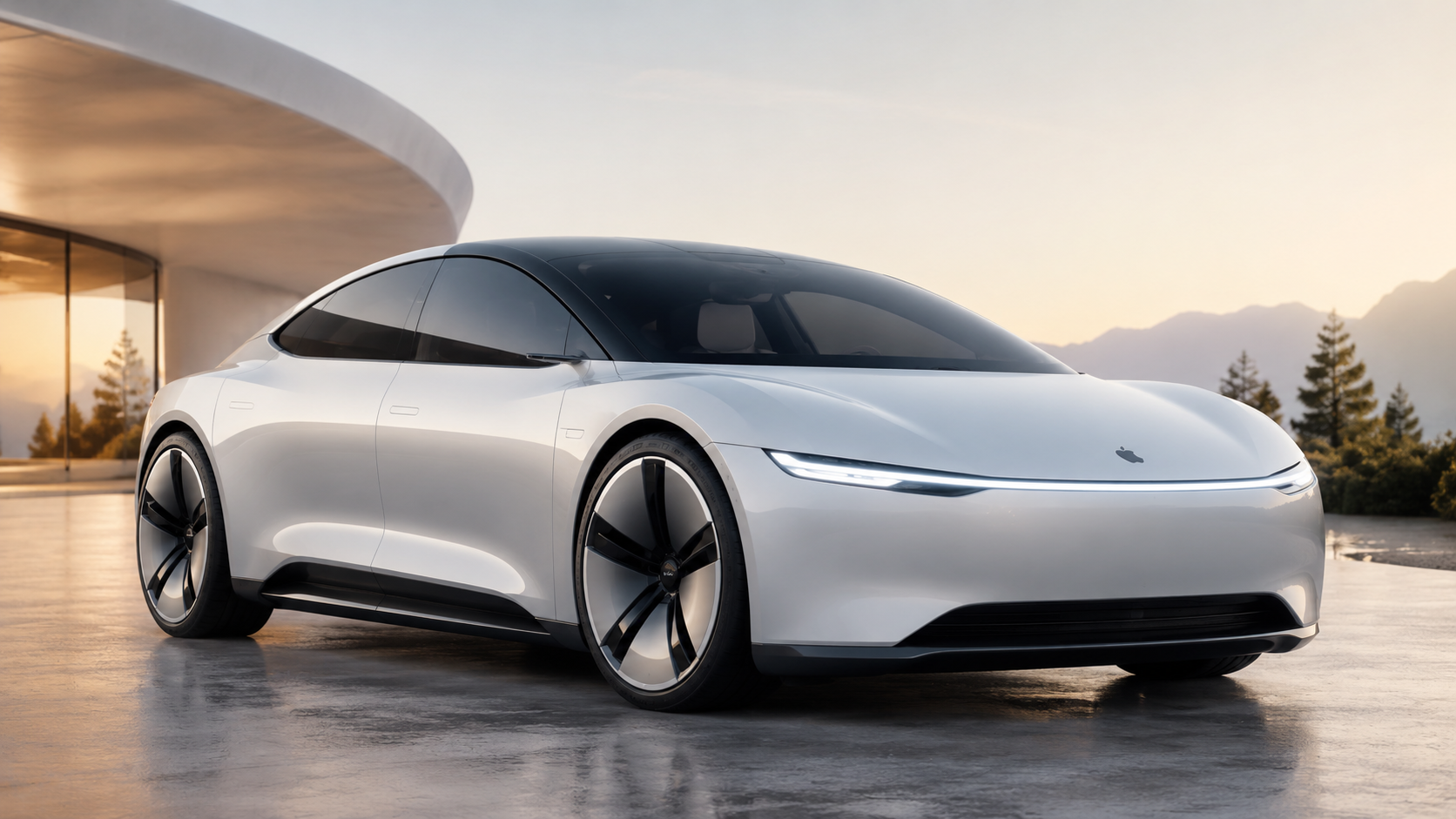
For almost ten years, the Apple Car remained one of the biggest mysteries in the technology industry. Every few months, fresh rumors hinted that Apple was preparing to enter the automotive world. Patent filings, reports of secret testing, and the hiring of engineers from companies such as Tesla, Porsche, Ford, Mercedes-Benz, and Rivian only fueled speculation. Many believed Apple would do to the automobile what it had done to the smartphone: redefine an entire industry through elegant design, seamless software, and an unmatched user experience.
But that moment never came.
After investing billions of dollars and dedicating years of research to what became known as Project Titan, Apple decided to pull the plug. In early 2024, the company officially cancelled its long-running vehicle program and reassigned many of its engineers to artificial intelligence initiatives. The decision marked the end of one of Silicon Valley’s most ambitious and secretive projects.
The obvious question followed: Why would Apple, one of the world’s most valuable companies, walk away after investing so much time, talent, and money?
The answer is more complex than a single failed idea. A combination of technological limitations, shifting market conditions, rising development costs, and Apple’s own uncompromising standards ultimately convinced the company that building a car no longer aligned with its long-term strategy.
Project Titan Began With a Vision Far Bigger Than an Electric Car
Apple reportedly launched Project Titan around 2014 with an ambition that extended well beyond producing another electric vehicle. The company wanted to rethink personal transportation from the ground up, much like it had reinvented mobile phones with the iPhone.
Instead of creating just another EV, Apple envisioned a vehicle that combined premium hardware, intelligent software, autonomous driving capabilities, and deep integration with the broader Apple ecosystem. The goal was to deliver an experience that felt unmistakably Apple, where the car would function as an extension of the user’s digital life.
To make that vision a reality, Apple quietly assembled one of the largest automotive engineering teams in the technology sector. At its peak, Project Titan reportedly employed nearly 2,000 specialists, including experts in battery technology, robotics, artificial intelligence, automotive engineering, industrial design, and machine learning. The company also recruited experienced executives from established automakers, signaling that its ambitions were genuine.
Yet despite years of work, the project never reached the stage of a production-ready vehicle.
Changing Goals Became One of the Project’s Biggest Challenges
One of the defining characteristics of Project Titan was its constantly evolving direction. Reports over the years suggested that Apple repeatedly redefined what it wanted the project to become.
Initially, the company explored developing a fully Apple-designed vehicle. Later, management shifted its attention toward creating an autonomous driving platform that could potentially be licensed to other manufacturers. After that, Apple reportedly returned to the idea of building its own car before scaling back its ambitions again to focus on a more conventional electric vehicle equipped with advanced driver assistance systems.
Every strategic pivot forced engineering teams to revisit years of work. Designs had to be modified, software rewritten, hardware re-engineered, and timelines extended. Unlike consumer electronics, where rapid iteration is relatively common, automotive development depends on long-term planning and consistency. Even small design changes can have significant implications for manufacturing, safety certification, and regulatory approval.
As a result, Project Titan struggled to maintain the momentum needed to transform an ambitious concept into a commercial product.
Autonomous Driving Technology Wasn’t Ready
Apple’s biggest technological hurdle was autonomous driving.
From the beginning, the company reportedly envisioned an Apple Car capable of delivering a level of self-driving performance that would clearly outperform competitors. Apple wasn’t interested in incremental improvements. It wanted to introduce a genuinely revolutionary driving experience.
However, the automotive industry gradually discovered that achieving reliable fully autonomous driving is one of the most difficult engineering challenges ever attempted.
Road environments are inherently unpredictable. Construction zones change overnight, weather conditions interfere with sensors, pedestrians behave unpredictably, and countless real-world scenarios remain difficult for artificial intelligence systems to interpret accurately. Building software that can safely respond to millions of possible driving situations requires enormous computational power, extensive real-world testing, and years of continuous refinement.
Even companies whose sole focus has been on autonomous driving have struggled to overcome these obstacles. For Apple, which was simultaneously attempting to build an entirely new vehicle, the challenge became even greater.
Ultimately, the technology simply did not mature as quickly as the company had hoped.
The EV Market Changed Dramatically
When Apple entered the automotive race, the outlook for electric vehicles appeared overwhelmingly positive. Governments were introducing stricter emissions regulations, battery prices were steadily declining, and investors were pouring billions into electric mobility startups.
By the early 2020s, however, market dynamics had begun to shift.
Although EV adoption continued growing globally, the pace slowed in several major markets. Intense price competition reduced profit margins, while Chinese manufacturers such as BYD, XPeng, and NIO dramatically expanded their presence with increasingly affordable products. At the same time, several established automakers delayed EV launches or reduced investment after facing weaker-than-expected consumer demand.
For Apple, these changing conditions made the automotive business far less attractive than it had once appeared.
Cars Don’t Generate iPhone-Level Profits
Another important consideration was profitability.
Apple has built one of the world’s most successful businesses by selling premium consumer electronics with exceptionally strong profit margins. The automotive industry operates very differently.
Manufacturing vehicles requires massive investments in factories, tooling, supply chains, safety testing, and long-term warranty support. Profit margins are generally much lower than those in consumer electronics, while recalls and production delays can quickly become extremely expensive.
Entering such a capital-intensive industry would have required Apple to accept financial realities that differed significantly from its existing business model.
For a company accustomed to industry-leading returns, the economics of building automobiles became increasingly difficult to justify.
Building Cars Is Far More Complex Than Building Electronics
Although Apple is widely recognized for its manufacturing expertise, producing automobiles presents challenges on an entirely different scale.
Modern vehicles contain thousands of components sourced from hundreds of suppliers around the world. Every part must meet strict quality standards, pass extensive safety testing, and comply with regulations in every country where the vehicle is sold.
Beyond manufacturing, Apple would also have needed to establish an entirely new service infrastructure, including maintenance facilities, spare parts logistics, repair networks, and customer support systems.
Creating that ecosystem from scratch would have required years of additional investment and operational expertise.
Leadership Changes Slowed Development
Throughout its lifespan, Project Titan experienced multiple leadership changes that complicated its progress.
Senior executives joined and departed the program, priorities shifted, and management frequently reassessed the project’s long-term objectives. Such instability is particularly damaging in the automotive industry, where development cycles often span five to seven years.
Each leadership transition brought new ideas and revised strategies, making it increasingly difficult for engineering teams to maintain consistent progress.
Apple’s High Standards Became a Double-Edged Sword
Apple has built its reputation by refusing to launch products that fail to meet its internal standards. That philosophy has helped the company create category-defining products across multiple industries.
However, those same standards may have contributed to Project Titan’s cancellation.
Reports suggest Apple executives wanted the Apple Car to offer a dramatically superior autonomous driving experience rather than simply matching competitors. Releasing a vehicle that offered only incremental improvements reportedly did not align with the company’s long-term vision.
Faced with technological limitations and growing development costs, Apple ultimately chose not to compromise.
Artificial Intelligence Became the New Priority
Perhaps the most decisive factor behind Apple’s decision was the rapid rise of artificial intelligence.
As generative AI transformed the technology industry, companies around the world began investing heavily in AI models, intelligent assistants, and advanced machine learning capabilities. Apple also recognized that AI would influence virtually every future product in its portfolio.
Project Titan employed thousands of highly skilled engineers whose expertise could be redirected toward AI development. By ending the automotive program, Apple was able to shift valuable talent toward technologies expected to deliver broader long-term benefits across its ecosystem.
Rather than continuing to fund a highly uncertain automotive venture, the company chose to invest in an area that aligned more closely with its future strategy.
Competition Had Become Stronger Than Ever
The competitive landscape also looked very different by the time Apple considered launching its vehicle.
Tesla had become the world’s most recognizable electric vehicle brand. Chinese manufacturers were rapidly expanding their global footprint, while traditional automakers had collectively invested hundreds of billions of dollars in electrification.
Entering such a crowded market would have required Apple to deliver a product that was not only innovative but significantly better than everything already available. Meeting that expectation became increasingly difficult as competitors continued improving their products year after year.
Project Titan Leaves Behind Valuable Lessons
Although the Apple Car never reached production, Project Titan remains an important case study in innovation.
It demonstrated that even companies with extraordinary financial resources cannot overcome every technological challenge through investment alone. It also highlighted the importance of strategic consistency, realistic timelines, and aligning ambitious ideas with market realities.
Perhaps the most significant lesson is that knowing when to walk away can sometimes be as valuable as knowing when to invest. Rather than launching a product that failed to meet its expectations, Apple chose to redirect its efforts toward technologies where it believes it can create greater long-term value.
The Road Ahead for Apple
While the dream of an Apple-branded car has come to an end, Apple’s involvement in the automotive industry is unlikely to disappear completely.
The company continues expanding Apple CarPlay, strengthening its mapping technologies, improving custom silicon, and investing heavily in artificial intelligence. These innovations could still shape the future of connected vehicles without requiring Apple to manufacture an automobile itself.
Many industry analysts believe this approach better reflects Apple’s strengths. Instead of competing directly with automakers, Apple may eventually become one of the companies powering the software experiences inside next-generation vehicles.
In the end, the Apple Car wasn’t cancelled because Apple lacked the talent, the money, or the ambition. It was cancelled because the company concluded that the technology, economics, and market conditions no longer justified the enormous investment required to bring its vision to life.
Project Titan may never have produced a vehicle, but its influence will almost certainly live on through the AI technologies, software innovations, and engineering expertise that Apple continues to develop. Sometimes, the biggest innovations are not the products that reach consumers, but the lessons learned from the ones that never do.