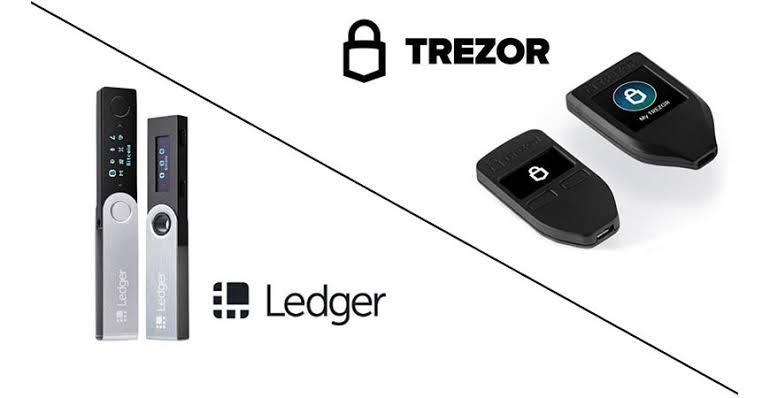
As digital currencies become more widely accepted by the public at large, protecting these assets is one of the most significant issues for cryptocurrency investors today. Although software wallets and cryptocurrency exchanges provide quick and easy options to use these digital currencies, they often do not provide enough security and can be the victim to both hackers and phishing scams. Because of this many cryptocurrency enthusiasts would rather use a hardware wallet that stores its private keys offline and provides a second layer of protection against cyber-attacks.
When it comes to hardware wallets, Ledger and Trezor are the top two brands in the marketplace and have built a reputation for safely storing cryptocurrencies for their customers. Both companies have earned their reputation, but they have many differences in terms of how they handle security, what features they offer, what their pricing structure is, how users will experience their hardware wallet, etc. Choosing between Ledger and Trezor can be incredibly hard and confusing for someone starting out in the cryptocurrency world, due to the number of factors that go into making a decision.
Understanding Hardware Wallets
A hardware wallet is a physical device used to store the private keys that give access to cryptocurrency. Unlike a software wallet that connects through either computer or smartphone, the hardware wallet keeps private keys offline so it minimizes any risk that a hacker can gain access to your funds.
Whenever you send cryptocurrency, the transaction will get signed within the hardware wallet, so the private keys do not leave the device, which adds significantly to the safety of your digital assets. This is best known as “cold storage,” and it has established itself as the kingpin in securing cryptocurrency long term.
Although both Ledger and Trezor provide cold storage solutions, they vary slightly in their approach to security and functionality.
Ledger: An Overview
Founded in 2014, Ledger has quickly grown into one of the leading manufacturers of hardware wallets. The two best-selling Ledger products are the Ledger Nano S Plus and the Ledger Nano X. Each of these wallets offers great security, an excellent range of different cryptocurrencies supported, and a stylish appearance.
The key differentiating factor between Ledger and other hardware wallets is that they use Secure Element (SE) chips to protect your personal data from physical attacks as well as from high-tech hacking attacks. These chips are dedicated pieces of hardware similar to what can be found in credit cards, passports, and banks, which provides users with added assurance that their funds will be safe.
Using Ledger Live gives cryptocurrency users all the tools they need for managing their assets, such as staking, buying/selling cryptocurrencies, and tracking their asset values, all in one easy-to-use application. This complete set of tools has allowed Ledger to distinguish themselves as a highly reputable brand amongst cryptocurrency investors globally.
Trezor: An Overview
Trezor is a hardware wallet that was made available to the market in 2014 by Czech Republic based company SatoshiLabs. Trezor is considered one of the earliest cryptocurrency wallets on the planet. The Trezor Model One and Trezor Model T are two examples of hardware wallets manufactured by SatoshiLabs. Trezor’s main commitment is toward transparency, both in terms of hardware as well as software used for storage, through an open-source development process.
Trezor (like Ledger) does not have a Secure Element chip embedded within their wallets. They rely on an open-source approach for developing hardware and software, providing complete access to both parties that want to verify their brands and products have been created by a reputable source.
Trezor is targeted towards individuals who appreciate transparency and have a need for verification. These products have an intuitive design, which makes it easier to connect Trezor devices to many wallets made by other developers. The Trezor interface is designed so that anyone who isn’t a cryptocurrency expert will be able to use the service without difficulty: whether you’re new to cryptocurrency or simply looking for an easy way to get into cryptocurrency, your experience with Trezor’s usability and setup is going to be smooth and easy.
Security Comparison: Ledger vs Trezor
When selecting a hardware wallet, security is typically a major consideration, and both Ledger and Trezor provide great security; however, the two companies take different approaches to providing that security.
Ledger’s main focus is on hardware-based security via its Secure Element chip. The Secure Element is designed to withstand attacks and protect sensitive data in the event that the device gets into the hands of an unauthorised user. Ledger claims that adding the Secure Element chip in addition to other hardware gives Ledger a stronger level of protection against sophisticated criminals than if it did not have the Secure Element chip.
In contrast, Trezor places great importance on transparency through open-source technology. By making its code source available to the public, Trezor allows independent agencies to review and analyse its security protocols to ensure they are sufficient. Many cryptocurrency users like the fact that Trezor is open-source as it allows them to help identify weaknesses in the system and make improvements addressing them.
From a practical standpoint, both wallets are viewed as extremely secure for the average user. Due to its Secure Element chip, Ledger will likely provide a little bit more physical security while Trezor will likely receive a lot of acknowledgment for providing a secure, transparent and auditable system.
Cryptocurrency Support
Cryptocurrency support is one specific area where Ledger has superior performance to Trezor. Ledger hardware wallets allow users to safely store thousands of different types of digital currencies and tokens on different networks within one device, including Bitcoin, Ethereum, Solana, Cardano, Polygon, and virtually every ERC-20 token available today. Therefore, no matter how many different kinds of digital assets an investor accumulates, Ledger will almost always completely cover those assets.
Although Trezor does provide support for many different types of digital currencies, it does not provide as much overall support for digital currencies by comparison to Ledger due primarily to its lower number of coins and tokens supported. While both Ledger and Trezor provide complete support for all major classes of digital currencies (e.g., Bitcoin/Ethereum/USDT), some of the newer or niche digital coins and tokens are much more difficult to find on Trezor than on Ledger.
In summary, for investors who have a very diverse portfolio consisting of many different digital assets across various blockchain platforms, Ledger generally provides much greater overall convenience and flexibility than Trezor.
User Experience and Ease of Use
Both Ledger’s and Trezor’s wallets can be very secure. Still, if you’ve never used a hardware wallet before, you may find the experience frustrating due to its lack of user-friendliness. Fortunately, both brands have spent a lot of time designing and building a great user experience for first-time users.
Ledger has built something that is slick and very polished, from its Ledger Live crypto management platform, to how easy it is for you to manage your assets, install apps supporting your favorite cryptocurrencies, stake your supported cryptos, and get an overview of your portfolio and how it performs through a clean and modern interface. You can even install the Ledger Live app on your mobile device, so that you can easily manage your crypto holdings from anywhere.
On the other hand, Trezor takes a more minimalistic approach with a simple and easy-to-understand interface, which is likely to be more appealing to users who prefer simplicity over bells and whistles. The Trezor wallets are also very quick to set up and work seamlessly with many third-party applications.
Overall, both Ledger and Trezor are beginner-friendly wallets. However, if you’re looking for a better overall experience by having access to more software features from Ledger, then you may want to consider Ledger’s wallet over Trezor’s.
Design and Build Quality
There are a few key distinctions in the design philosophies of Ledger and Trezor. For example, when it comes to portability, Ledger has a more rugged product. It has compact and portable USB drives shaped like traditional USB drives and protected by stainless steel construction when travelling. Ledger’s use of high-quality materials gives their products a modern, fashionable, and durable look.
Another distinguishing factor in these two brands is construction materials used to build each device. For instance, the Trezor devices contain mostly plastic with some of their higher-end models (such as the Trezor Model T) using touchscreen technology that enhances the user experience by providing better mobility. Upper-tier models also feature larger screen sizes than lower-tier models and typically have a higher-quality finish.
Ultimately, the user will ultimately choose between Ledger and Trezor based on their personal preferences. A user might prefer a wallet with good durability and portability or prefer a wallet with a large touchscreen and large screen for navigation.
Backup and Recovery Features
If a Ledger or Trezor device is lost, stolen or damaged, both devices utilize recovery seed phrases to allow users to recover their assets. A recovery seed is a follow-up series of words provided to the user to allow them access to their wallet. Therefore, it acts as an overall backup to all cryptocurrencies in the wallet.
Some Trezor models offer advanced backup options to include Shamir Backup. This allows the user to split their recovery seed into multiple pieces, decreasing the amount of risk to the user by storing only one copy of their backup.
Ledger has traditional recovery methods and emphasizes securely storing and managing seed phrases. The two solutions provide very effective means of backup, but Trezor provides some advanced features in their backup methodology that may provide additional redundancy for users looking for it.
Pricing Comparison
Price is necessarily a key factor for many buyers.Ledger’s least expensive hardware wallet, the Nano S Plus, provides security and a broad spectrum of supported cryptocurrencies while being affordable. The Ledger Nano X has a higher price point but includes additional features such as Bluetooth capability and increased memory.
Likewise, Trezor’s Model One is a value-priced option with an easy-to-use interface. Its equivalent, the Trezor Model T, has more features and costs more but has a colour touchscreen.
Ultimately, the best decision will depend on which features are most essential to the person who is investing.
Ledger vs Trezor: Which One Should You Choose?
Choosing between a Ledger and Trezor is all about what you value as an individual investor or follower of crypto-currency.
If you want to have a hardware wallet that can hold a lot of coins securely, is easy to use, and has advanced security features like a Secure Element (which is found in Ledger wallets), then the Ledger hardware wallet would be an appropriate choice for an active trader with many different types of investments. If you’re looking for an open-source, independently-audited hardware wallet with an interface that is easy to operate then the Trezor Hardware Wallet would likely meet the needs of those with a strong interest in cryptocurrencies or striving to protect their privacy.
It’s also crucial to note that Ledger and Trezor may not always be the superior option to each other in certain categories. Both companies have established themselves as the leader of providing secure and reliable hardware wallets; therefore, the final decision will largely rest on your personal measure of how much value your investment will have and what level of privacy/concern over transparency both choices offer.