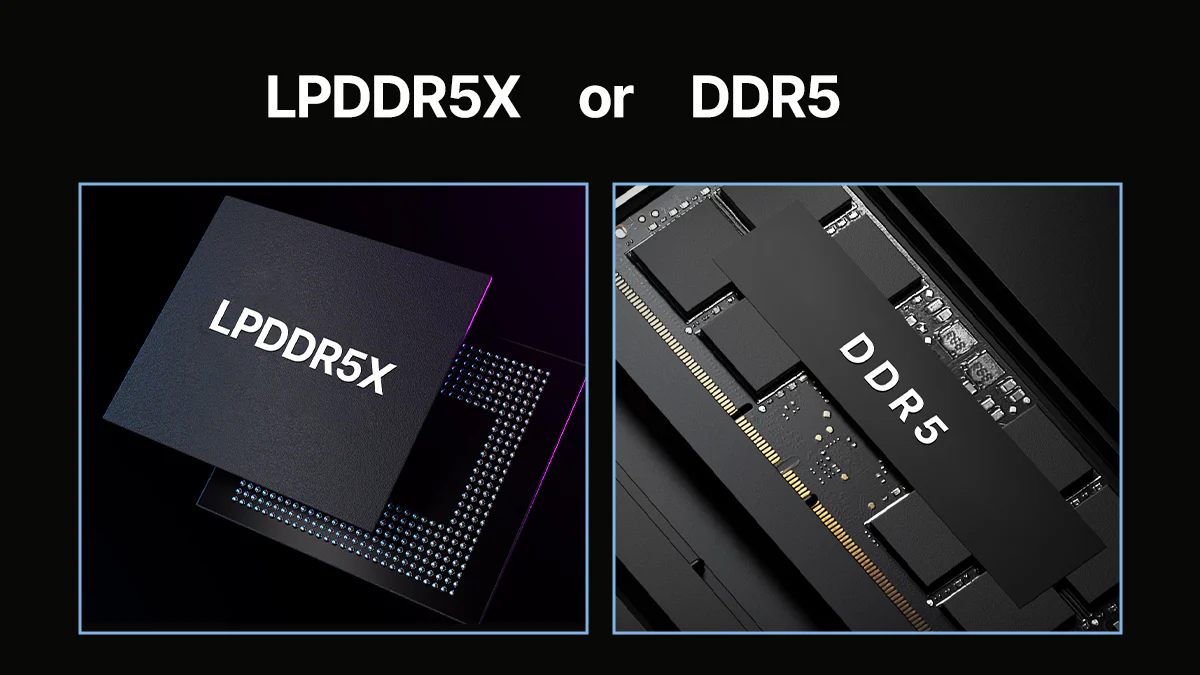
With increased processing power, the importance of memory keeps increasing. In today’s computers, RAM doesn’t only hold running applications. Its importance extends to gaming, artificial intelligence, multitasking, energy efficiency, and graphics operations, among other things. This is why a person should know about DDR5 vs LPDDR5X before buying a new computer, whether a desktop or laptop.
On the surface, DDR5 and LPDDR5X may look alike since they are both upgrades from DDR4 and LPDDR4X, respectively. However, while one is mainly concerned about performance and future upgrades, the other concentrates on power saving, higher speeds, and a compact system design.
The DDR5 vs LPDDR5X comparison guide provides insight into what they are, their strengths, and which one would be more suitable for your next computer.
DDR5 VS LPDDR5X: What Is DDR5?
The new DDR5 is a mainstream technology that can be used in desktop computers and high-performance laptops. It was developed to replace the older DDR4 and offers increased efficiency, improved bandwidth, and large memory capacities.
There are several notable features that JEDEC added in DDR5. For instance, one of the major upgrades is the presence of two independent 32-bit sub-channels in each memory module. It enables more efficient data accessing by the processor and enhances multitasking capabilities.

The next change implemented by JEDEC is the move of power management to the memory module. Together with the lowered voltage of 1.1V, it ensures an effective power supply and helps reduce losses in comparison with DDR4.
One of the key advantages of the DDR5 vs LPDDR5X comparison is the flexible structure of the DDR5 memory. It uses removable DIMM or SODIMM memory modules that allow you to add memory in the future. It makes it a perfect solution for desktop computers and professional use for many years to come.
What Is LPDDR5X?
(LPDDR5X means ‘Low Power Double Data Rate 5X’.) LPDDR5X is developed for applications where battery longevity, compactness, and heat dissipation take precedence.
While DDR5 usually consists of discrete memory chips, LPDDR5X is typically soldered onto the mainboard. Thus, it enables the location of the memory closer to the CPU, cuts signal lines, and shrinks the size of the mainboard. The outcome is more compact gadgets that work with less energy.
The maximum transfer speed was enhanced up to 8533 Mbps by JEDEC from the 6400 Mbps limit of LPDDR5. The additional bandwidth comes in handy for integrated graphics accelerators, artificial intelligence operations, and tasks that require transferring large amounts of data.
The only downside is obvious. As LPDDR5X is soldered onto the board, its upgrade is impossible, and users should choose an appropriate amount of RAM in advance.
Speed and Bandwidth
Buyers believe that the greater speed is always an indicator of superior performance. The truth is that whether the device will benefit from this greatly depends on the way in which the computer uses memory.
While comparing DDR5 vs LPDDR5X, in most cases, LPDDR5X boasts higher memory bandwidth capacity, making it more applicable to ultrabooks, gaming handhelds, and artificial intelligence computers with integrated graphics cards.
The DDR5 boasts high-speed as well, yet, when it comes to desktop computers, balanced performance is the priority. In the case of a PC with a dedicated graphics card, DDR5 is more than enough.
With a computer with integrated graphics, LPDDR5X is usually a better choice. With a computer with a discrete graphics card, the bandwidth is not that critical.
Latency and Responsiveness
Bandwidth is not everything. Latency of memory also influences the overall speed.
DD5R provides latency, which is lower compared to LPDDR5X. Lower latency implies faster delivery of data by the processor, which is essential in case you perform operations that require intensive memory usage.
Thus, DDR5R is better when it comes to desktop gaming, software development, video editing, virtualization, and multitasking.
LPDDR5X is mostly concerned with the data transfer rate. While providing high bandwidth, the latency of LPDDR5X is higher compared to that of DDR5R. Many mobile devices can use higher bandwidth more efficiently than latency.
When comparing **DDR5 VS LPDDR5X**, latency favors DDR5, while bandwidth often favors LPDDR5X.
DDR5 VS LPDDR5X: Power Efficiency
The issue of power consumption is one of the key factors differentiating between those specifications.
While DDR5 enhances its power efficiency compared to DDR4 through lowering its voltage and power management, this makes DDR5 more efficient for desktops and workstations since they need high performance while consuming not much power.
But LPDDR5X pushes the boundaries in terms of power efficiency as every aspect of its design revolves around low power consumption, which leads to increased battery life and lower temperatures.
This is why LPDDR5X is used in premium ultrabooks, tablets, AI laptops, and gaming handhelds.
In the comparison between DDR5 VS LPDDR5X, LPDDR5X wins hands down if battery life is important for you.
Upgradeability
Upgrade options matter for many buyers.
DDR5 systems usually include removable memory slots. If your needs change later, you can install additional RAM or replace existing modules with larger ones. This extends the life of the computer and allows users to match memory capacity with future software requirements.
LPDDR5X offers no such flexibility. Since the memory is permanently attached to the motherboard, the installed capacity remains fixed for the life of the device.
For anyone planning to keep a computer for several years, upgradeability becomes a major factor in the DDR5 VS LPDDR5X decision.
DDR5 VS LPDDR5X: Best Use Cases
The best memory depends on the type of computer you are buying.
Choose DDR5 if you need:
A desktop PC
- An upgradeable laptop
- A gaming system with a dedicated GPU
- A workstation for content creation
- Better responsiveness during heavy workloads
Choose LPDDR5X if you need:
- A thin-and-light laptop
- A gaming handheld
- A tablet
- An AI-focused ultraportable
- Longer battery life
- Better integrated graphics performance
The DDR5 VS LPDDR5X comparison is less about choosing the faster technology and more about choosing the right one for your device.
DDR5 VS LPDDR5X: Which One Should You Buy?
However, in most cases, DDR5 would be a better option for desktop users due to its high speed, low latency, and the ability to install more RAM in the future. All these benefits make it great for gaming, creative tasks, programming, and other productivity tasks.
In the case of portable devices, however, LPDDR5X would be a more sensible choice thanks to its lower energy usage, high bandwidth, and size. It enables the production of more compact gadgets that last longer on battery and have more powerful integrated graphics.
When comparing DDR5 VS LPDDR5X, we will have to look at our preferences first.
Final Thoughts on DDR5 VS LPDDR5X
The DDR5 VS LPDDR5X comparison isn’t meant to identify a single winner. The two different forms of memory have been created to cater to various types of machines and the requirements of users.
DDR5 offers flexibility, reduced latency, and easy upgrade options, which is why it is a better solution for desktop computers and high-performance laptops. LPDDR5X provides increased memory bandwidth, reduced power consumption, and sleek systems design, which makes it a better choice for ultrabooks, game consoles, and AI-equipped portable devices.
As you prepare to purchase your new computer or laptop, pay less attention to the speed of memory that is specified in the specification list. Consider whether you need future upgrades, longer battery life, improved integrated graphics or reduced latency. After matching your requirement to the device type, the choice of memory between DDR5 VS LPDDR5X becomes easier.