• Send Us A Tip
  • Calling all Tech Writers
  • Advertise
Friday, October 9, 2026
  • Login
TechStory
  • News
  • Crypto
  • Gadgets
  • Memes
  • Gaming
  • Cars
  • AI
  • Startups
  • Markets
  • How to
No Result
View All Result
  • News
  • Crypto
  • Gadgets
  • Memes
  • Gaming
  • Cars
  • AI
  • Startups
  • Markets
  • How to
No Result
View All Result
TechStory
No Result
View All Result
Home Tech

DDR5 VS LPDDR5X: Which Memory Standard Should You Choose in 2026?

by Sneha Singh
June 27, 2026
in Tech
Reading Time: 6 mins read
0
DDR5 VS LPDDR5X: Which Memory Standard Should You Choose in 2026?
TwitterWhatsappLinkedin

With increased processing power, the importance of memory keeps increasing. In today’s computers, RAM doesn’t only hold running applications. Its importance extends to gaming, artificial intelligence, multitasking, energy efficiency, and graphics operations, among other things. This is why a person should know about DDR5 vs LPDDR5X before buying a new computer, whether a desktop or laptop.

You might also like

How Businesses Use Mobile Proxy Servers for Localized Data Collection

Navi Eyes $40 Mn Funding as IPO Plans Take Shape

Ola Electric Eyes ₹1,000 Cr Rights Issue at 26% Discount

On the surface, DDR5 and LPDDR5X may look alike since they are both upgrades from DDR4 and LPDDR4X, respectively. However, while one is mainly concerned about performance and future upgrades, the other concentrates on power saving, higher speeds, and a compact system design.

The DDR5 vs LPDDR5X comparison guide provides insight into what they are, their strengths, and which one would be more suitable for your next computer.

DDR5 VS LPDDR5X: What Is DDR5?

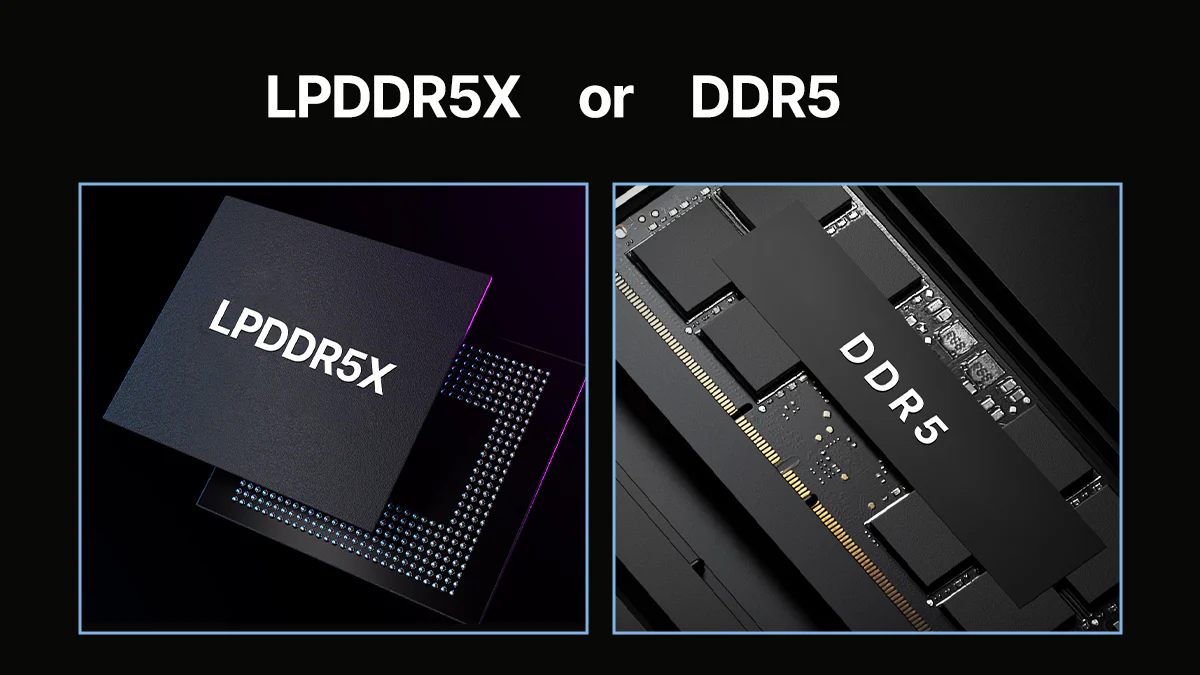
The new DDR5 is a mainstream technology that can be used in desktop computers and high-performance laptops. It was developed to replace the older DDR4 and offers increased efficiency, improved bandwidth, and large memory capacities.

There are several notable features that JEDEC added in DDR5. For instance, one of the major upgrades is the presence of two independent 32-bit sub-channels in each memory module. It enables more efficient data accessing by the processor and enhances multitasking capabilities.

DDR5 VS LPDDR5X: Which Memory Standard Should You Choose in 2026?
Credits: Nantian Technologies

The next change implemented by JEDEC is the move of power management to the memory module. Together with the lowered voltage of 1.1V, it ensures an effective power supply and helps reduce losses in comparison with DDR4.

One of the key advantages of the DDR5 vs LPDDR5X comparison is the flexible structure of the DDR5 memory. It uses removable DIMM or SODIMM memory modules that allow you to add memory in the future. It makes it a perfect solution for desktop computers and professional use for many years to come.

What Is LPDDR5X?

(LPDDR5X means ‘Low Power Double Data Rate 5X’.) LPDDR5X is developed for applications where battery longevity, compactness, and heat dissipation take precedence.

While DDR5 usually consists of discrete memory chips, LPDDR5X is typically soldered onto the mainboard. Thus, it enables the location of the memory closer to the CPU, cuts signal lines, and shrinks the size of the mainboard. The outcome is more compact gadgets that work with less energy.

The maximum transfer speed was enhanced up to 8533 Mbps by JEDEC from the 6400 Mbps limit of LPDDR5. The additional bandwidth comes in handy for integrated graphics accelerators, artificial intelligence operations, and tasks that require transferring large amounts of data.

The only downside is obvious. As LPDDR5X is soldered onto the board, its upgrade is impossible, and users should choose an appropriate amount of RAM in advance.

Speed and Bandwidth

Buyers believe that the greater speed is always an indicator of superior performance. The truth is that whether the device will benefit from this greatly depends on the way in which the computer uses memory.

While comparing DDR5 vs LPDDR5X, in most cases, LPDDR5X boasts higher memory bandwidth capacity, making it more applicable to ultrabooks, gaming handhelds, and artificial intelligence computers with integrated graphics cards.

The DDR5 boasts high-speed as well, yet, when it comes to desktop computers, balanced performance is the priority. In the case of a PC with a dedicated graphics card, DDR5 is more than enough.

With a computer with integrated graphics, LPDDR5X is usually a better choice. With a computer with a discrete graphics card, the bandwidth is not that critical.

Latency and Responsiveness

Bandwidth is not everything. Latency of memory also influences the overall speed.

DD5R provides latency, which is lower compared to LPDDR5X. Lower latency implies faster delivery of data by the processor, which is essential in case you perform operations that require intensive memory usage.

Thus, DDR5R is better when it comes to desktop gaming, software development, video editing, virtualization, and multitasking.

LPDDR5X is mostly concerned with the data transfer rate. While providing high bandwidth, the latency of LPDDR5X is higher compared to that of DDR5R. Many mobile devices can use higher bandwidth more efficiently than latency.

When comparing **DDR5 VS LPDDR5X**, latency favors DDR5, while bandwidth often favors LPDDR5X.

DDR5 VS LPDDR5X: Power Efficiency

The issue of power consumption is one of the key factors differentiating between those specifications.

While DDR5 enhances its power efficiency compared to DDR4 through lowering its voltage and power management, this makes DDR5 more efficient for desktops and workstations since they need high performance while consuming not much power.

But LPDDR5X pushes the boundaries in terms of power efficiency as every aspect of its design revolves around low power consumption, which leads to increased battery life and lower temperatures.

This is why LPDDR5X is used in premium ultrabooks, tablets, AI laptops, and gaming handhelds.

In the comparison between DDR5 VS LPDDR5X, LPDDR5X wins hands down if battery life is important for you.

Upgradeability

Upgrade options matter for many buyers.

DDR5 systems usually include removable memory slots. If your needs change later, you can install additional RAM or replace existing modules with larger ones. This extends the life of the computer and allows users to match memory capacity with future software requirements.

LPDDR5X offers no such flexibility. Since the memory is permanently attached to the motherboard, the installed capacity remains fixed for the life of the device.

For anyone planning to keep a computer for several years, upgradeability becomes a major factor in the DDR5 VS LPDDR5X decision.

DDR5 VS LPDDR5X: Best Use Cases

The best memory depends on the type of computer you are buying.

Choose DDR5 if you need:

A desktop PC

  1. An upgradeable laptop
  2. A gaming system with a dedicated GPU
  3. A workstation for content creation
  4. Better responsiveness during heavy workloads

Choose LPDDR5X if you need:

  1. A thin-and-light laptop
  2. A gaming handheld
  3. A tablet
  4. An AI-focused ultraportable
  5. Longer battery life
  6. Better integrated graphics performance

The DDR5 VS LPDDR5X comparison is less about choosing the faster technology and more about choosing the right one for your device.

DDR5 VS LPDDR5X: Which One Should You Buy?

However, in most cases, DDR5 would be a better option for desktop users due to its high speed, low latency, and the ability to install more RAM in the future. All these benefits make it great for gaming, creative tasks, programming, and other productivity tasks.

In the case of portable devices, however, LPDDR5X would be a more sensible choice thanks to its lower energy usage, high bandwidth, and size. It enables the production of more compact gadgets that last longer on battery and have more powerful integrated graphics.

When comparing DDR5 VS LPDDR5X, we will have to look at our preferences first.

Final Thoughts on DDR5 VS LPDDR5X

The DDR5 VS LPDDR5X comparison isn’t meant to identify a single winner. The two different forms of memory have been created to cater to various types of machines and the requirements of users.

DDR5 offers flexibility, reduced latency, and easy upgrade options, which is why it is a better solution for desktop computers and high-performance laptops. LPDDR5X provides increased memory bandwidth, reduced power consumption, and sleek systems design, which makes it a better choice for ultrabooks, game consoles, and AI-equipped portable devices.

As you prepare to purchase your new computer or laptop, pay less attention to the speed of memory that is specified in the specification list. Consider whether you need future upgrades, longer battery life, improved integrated graphics or reduced latency. After matching your requirement to the device type, the choice of memory between DDR5 VS LPDDR5X becomes easier.

Tags: DDR5 VS LPDDR5XDesktop PCGamingPower EfficiencyTablet
Tweet55SendShare15
Previous Post

Novak Djokovic Joins General Atlantic As Global Strategic Advisor, Targeting Sports Tech And Wellness Investments

Next Post

Browser Sandboxing Explained: How Your Web Browser Protects You from Online Threats

Sneha Singh

Sneha is a skilled writer with a passion for uncovering the latest stories and breaking news. She has written for a variety of publications, covering topics ranging from politics and business to entertainment and sports.

Recommended For You

How Businesses Use Mobile Proxy Servers for Localized Data Collection

by Rohan Mathawan
October 9, 2026
0
Engineering teams building market intelligence pipelines frequently deal with rate limits and manipulated pricing data. Target platforms actively manage incoming traffic using security tools like Web Application Firewalls and TLS fingerprinting. Relying on commercial server nodes for data extraction often leads to interrupted sessions. To solve this, businesses are moving their infrastructure toward authentic cellular networks. Using mobile proxy servers allows them to collect accurate, localized web data reliably. TL;DR: Core benefits of mobile proxy servers for data extraction Carrier-grade trust: Mobile networks use CGNAT, masking your automated traffic alongside thousands of real smartphone users, resulting in maximum IP trust scores. Organic IP shifts: Security systems are adapted to mobile networks where IP addresses routinely change across local cell towers. A dynamic IP is completely natural, provided your geographic region and device footprint remain consistent. Dedicated vs. shared hardware: Dedicated modems allow manual IP rotation via API but require a 5 to 10-second pause while the physical hardware reboots. Shared proxies offer fixed-interval rotation without interrupting active users. Maintaining stable access: Premium infrastructures use the VLESS protocol to route proxy connections as standard HTTPS browsing. This helps maintain connections in environments with strict local ISP filtering. Why localized data extraction requires authentic connections Companies extract localized web data to see information exactly as it appears to a regular user in a specific region. Pricing and availability change based on the viewer's location. A consumer searching a travel aggregator from London sees different flight options than a user querying the exact same route from Tokyo. Teams historically built scraping infrastructure on data center IPs. Today, anti-fraud engines maintain strict databases of commercial cloud subnets. When a firewall detects consumer-level requests coming from a corporate server, it ruins the connection's trust score. Real users do not browse from cloud data centers. The target platform simply responds with CAPTCHAs or HTTP 429 errors. How mobile proxy servers maintain stable access To ensure stable data collection, automated traffic needs to match the normal network patterns of genuine human users. Mobile proxy servers accomplish this by routing requests through real 4G LTE or 5G modems equipped with authentic SIM cards. This works through Carrier-Grade NAT (CGNAT). Mobile carriers do not assign a unique public IP to every smartphone. Instead, they push the data streams of thousands of subscribers onto the internet through a single shared IP address. Banning a CGNAT mobile IP means disconnecting hundreds of real retail consumers in that area. To avoid this collateral damage, security engines treat mobile carrier ASNs with extreme leniency, granting them trust scores between 90% and 99%. Infrastructure Type Network Source CGNAT Shielding Average Trust Score Algorithmic WAF Reaction Data Center Commercial Cloud Providers No (1:1 routing) 20% - 40% Immediate block, CAPTCHA, or rate-limit for consumer endpoints. Static Residential Home Internet Providers Rare (Usually 1:1) 70% - 85% Reliable for steady sessions, but flagged during abrupt traffic spikes. Mobile (LTE/5G) Real Cellular Carrier Networks Yes (Thousands to 1) 90% - 99% High tolerance; blocking is mathematically prohibitive due to collateral damage. IP rotation: Why dynamic addresses are natural for mobile proxy servers Many operators believe that keeping a static, unchanging IP address is the only way to maintain a healthy session. They assume an IP rotation during a collection task immediately triggers security algorithms. In reality, the internet is heavily adapted to a mobile-first world. When genuine consumers browse on their smartphones, they commute across a city and experience brief signal drops. These physical events force their hardware to re-authenticate with the network. The mobile carrier then assigns the device a brand-new IP address from the regional pool. Target platforms inherently expect this behavior. Consequently, an IP address changing within the bounds of a specific city or county is not an automatic red flag. What actually triggers anti-fraud systems is inconsistency in the digital footprint. As long as the regional origin and the device identity remain synchronized, the session remains valid. Modern automation relies entirely on consistent device and location profiles rather than rigid IP addresses. Choosing the right mobile proxies: Dedicated vs. Shared hardware When integrating cellular infrastructure into a pipeline, engineering teams must decide between two distinct types of mobile proxies. This choice directly impacts hardware control and session persistence. Dedicated proxies Dedicated mobile proxies provide an operator with exclusive, single-tenant access to a specific physical modem and SIM card. This grants unrestricted bandwidth and absolute programmatic control over the connection. Operators can trigger an IP change precisely when their workflow demands it via an API call integrated directly into their Python or Node.js scripts. Developers need to handle the rotation delay. When the API command executes, the physical modem drops its connection to the local cell tower and renegotiates a new one. This reset takes 5 to 10 seconds. Scripts require deliberate pauses (e.g., time.sleep(10)) during this window. Sending payloads before the modem re-authenticates causes timeout errors. Shared proxies Shared mobile proxies allow multiple independent users to route their traffic through the same physical 5G/LTE modem simultaneously. Because the connection is multiplexed, the IP address on a shared port rotates at a strict, automated interval typically every 5 or 30 minutes. Manual rotation is disabled because resetting the network would drop the connection for everyone sharing the hardware. Shared ports provide cost-effective CGNAT trust for stateless tasks. Shared networks provide excellent, cost-effective CGNAT trust for stateless tasks where session persistence is irrelevant. Handling deep packet inspection with VLESS While mobile proxy servers manage external routing, businesses sometimes face interference from their own local Internet Service Provider (ISP). Some local ISPs use Deep Packet Inspection (DPI) to monitor outbound traffic. Standard proxy protocols have recognizable cryptographic handshakes that DPI systems often restrict. To resolve this, premium mobile infrastructure supports the VLESS protocol. Rather than generating a custom proxy certificate, VLESS borrows the cryptographic signature of a highly trusted, unrelated domain during the TLS handshake. Local DPI tools analyze this outbound data flow and see standard HTTPS web browsing. This allows data teams to work without local network interruptions. Digital identity and environment setup High-trust IP addresses lose their value if a script logs into an account using a flagged VoIP phone number. The same happens if a localized payment uses a card that mismatches the proxy's geographic location. Operators pair dedicated mobile IP connections with clean browser profiles. They use tokenized payment cards matching the proxy's billing region and real residential phone numbers for SMS verifications. Sourcing these components from different providers slows down infrastructure deployment. Platforms like CyberYozh App consolidate these tools. Teams deploy dedicated mobile IPs, issue virtual cards, and rent local ISP numbers from a single ecosystem. Checking the complete setup through a built-in fraud scorer ensures a highly trusted profile before data extraction begins. Real-world application A market intelligence firm monitored retail pricing across European e-commerce platforms using data center proxies. Within days, the target platform recognized the commercial subnets, applied rate limits, and served manipulated HTML. The firm restructured its pipeline. They replaced their data center nodes with CyberYozh dedicated mobile proxies physically located in the target countries. Because the requests originated from genuine 4G/5G mobile gateways shielded by CGNAT, the firewall perceived the traffic as authentic mobile shoppers. The Python script held a single mobile IP for a persistent session, extracting the localized pricing data. Once a geographic sweep was complete, the script fired an API rotation call, paused operations for 10 seconds while the physical modem reset its radio link to the local cell tower, and seamlessly resumed collection on the next batch of URLs. By aligning their geographic footprint and accounting for the physical realities of hardware rotation, the firm restored stable access to their target data. Final thoughts on mobile proxy infrastructure Basic data collection methods struggle against modern traffic analysis. Because international platforms look closely at connection behavior to protect their localized data, relying on commercial server networks often leads to unstable access. Authentic LTE and 5G cellular hardware solves this problem. Carrier-Grade NAT and API rotation align the traffic with natural network behavior. This approach secures high IP quality and enables reliable data extraction at scale. As businesses rely more on location-specific data, the technology behind reliable web access is becoming an important part of modern data collection. For more practical guides on emerging technology, online infrastructure, and digital tools, explore Kemotech.

Engineering teams building market intelligence pipelines frequently deal with rate limits and manipulated pricing data. Target platforms actively manage incoming traffic using security tools like Web Application Firewalls...

Read more

Navi Eyes $40 Mn Funding as IPO Plans Take Shape

by Ishaan Negi
October 8, 2026
0
Sachin Bansal Steps Down as CEO, Takes on Executive Chairman Role at Navi

Navi, the financial services company led by Flipkart co-founder Sachin Bansal, is looking to raise around $40 million from Elevation Holdings as it strengthens its finances ahead of...

Read more

Ola Electric Eyes ₹1,000 Cr Rights Issue at 26% Discount

by Ishaan Negi
October 8, 2026
0
Ola Electric Eyes ₹1,000 Cr Rights Issue at 26% Discount

Ola Electric is looking to raise ₹1,000 crore through a rights issue, offering new shares at ₹27 apiece as the electric vehicle maker seeks fresh funds to strengthen...

Read more
Next Post
Browser Sandboxing Explained: How Your Web Browser Protects You from Online Threats

Browser Sandboxing Explained: How Your Web Browser Protects You from Online Threats

Please login to join discussion

Techstory

Tech and Business News from around the world. Follow along for latest in the world of Tech, AI, Crypto, EVs, Business Personalities and more.
reach us at info@techstory.in

Advertise With Us

Reach out at - info@techstory.in

Aviator Game India 2026

BROWSE BY TAG

#Crypto #howto 2024 acquisition AI amazon Apple Artificial Intelligence bitcoin Business China cryptocurrency e-commerce electric vehicles Elon Musk Ethereum facebook funding Gaming Google India Instagram Investment iPhone IPO Market Markets Meta Microsoft News OpenAI samsung Social Media SpaceX startup startups tech Tech news technology Tesla TikTok trend trending twitter US

© 2025 Techstory.in

No Result
View All Result
  • News
  • Crypto
  • Gadgets
  • Memes
  • Gaming
  • Cars
  • AI
  • Startups
  • Markets
  • How to

© 2025 Techstory.in

Welcome Back!

Login to your account below

Forgotten Password?

Retrieve your password

Please enter your username or email address to reset your password.

Log In
Are you sure want to unlock this post?
Unlock left : 0
Are you sure want to cancel subscription?