
The artificial intelligence boom has created some of the fastest-growing companies in history. Investors have poured billions into startups promising to reinvent industries with AI, while businesses have rushed to adopt the technology to stay competitive. Amid this frenzy, few companies captured the imagination of investors quite like Builder.ai.
Founded with the ambitious goal of making app development as easy as ordering a pizza, Builder.ai positioned itself as the future of software creation. The company attracted prestigious investors, partnered with Microsoft, achieved a valuation exceeding $1 billion, and became one of the world’s most recognizable AI startups.
Then, almost overnight, everything unraveled.
In May 2025, Builder.ai filed for insolvency, leaving customers, employees, and investors stunned. What was once hailed as the future of software development became a cautionary tale about inflated AI claims, unrealistic growth expectations, and the dangers of prioritizing hype over sustainable business fundamentals.

Credits: The Times of India
The Vision That Captured Silicon Valley
Builder.ai began life in 2016 as Engineer.ai, founded in London by Sachin Dev Duggal and Saurabh Dhoot. The company’s mission was refreshingly simple: eliminate the complexity of software development by allowing anyone with an idea to build an application without writing code.
The concept resonated immediately.
Businesses often struggle with expensive software projects, long development cycles, and the challenge of finding skilled developers. Builder.ai claimed to solve these problems through artificial intelligence that could automatically assemble software components based on customer requirements.
Its virtual assistant, Natasha, guided users through the development process by asking questions about their app idea. Customers simply described what they wanted, selected features from a menu, and Builder.ai promised to handle everything else.
It sounded revolutionary.
The company marketed itself as the “Amazon of software development,” where building an app would become as straightforward as ordering products online.
Investors Couldn’t Get Enough
Builder.ai’s promise attracted some of the biggest names in venture capital.
The startup raised nearly $30 million in its Series A round in 2018, followed by $65 million in 2021 and another $100 million in 2022. Each funding round increased confidence that the company had discovered the future of software development.
The biggest breakthrough came in 2023.
Builder.ai secured a massive $250 million Series D funding round led by the Qatar Investment Authority. Microsoft also invested strategically while announcing a partnership to integrate Builder.ai’s platform with Azure services. The startup’s valuation climbed to between $1.3 billion and $1.5 billion, officially making it a unicorn.
For many observers, Microsoft’s involvement served as a stamp of legitimacy.
If one of the world’s largest technology companies believed in Builder.ai, surely the startup’s technology had to be genuine.
The Reality Behind the AI
Behind the polished marketing, however, cracks had already begun to appear.
In 2019, investigative reports questioned whether Builder.ai’s technology was as automated as the company claimed. Critics alleged that much of the software development was still performed manually by engineers rather than by sophisticated AI systems.
Instead of AI independently generating applications, human developers were reportedly doing much of the work behind the scenes. Allegations also surfaced that the company had displayed logos of clients it had never served and posted misleading online reviews.
The controversy highlighted a growing problem within the AI industry.
Many startups use artificial intelligence as a marketing buzzword, even when their products rely heavily on human labor. While human involvement is common in AI systems, the gap between Builder.ai’s marketing claims and operational reality raised uncomfortable questions.
Nevertheless, investors continued backing the company as enthusiasm for AI accelerated worldwide.
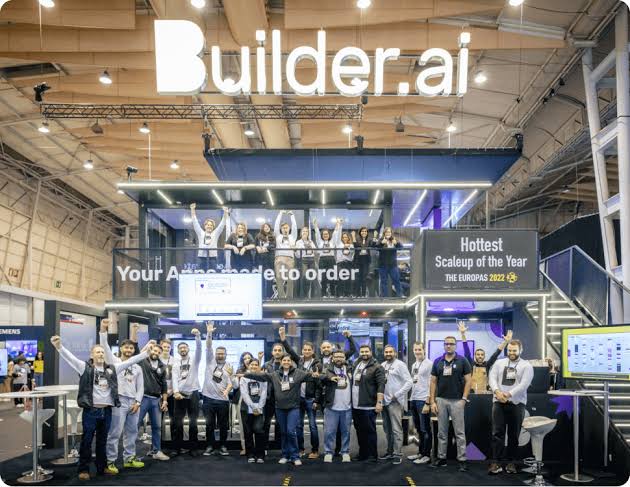
Credits: Sammy Rock Symphony
Growth at Any Cost
As Builder.ai expanded internationally, it opened offices across London, Los Angeles, and Delhi while employing hundreds of people. The company launched new offerings, including Builder Cloud and Studio Store, and reported impressive revenue growth.
But rapid expansion came with significant costs.
Scaling a global software business requires substantial spending on engineering, customer support, infrastructure, and sales. At the same time, Builder.ai faced increasing pressure to justify its billion-dollar valuation by delivering exceptional financial performance.
According to later reports, revenue projections became increasingly optimistic while operating expenses continued rising.
The company appeared to be chasing growth first and profitability later—a strategy that worked for many technology startups during years of abundant venture capital.
However, market conditions had changed.
Financial Cracks Become Impossible to Ignore
By late 2024, warning signs were becoming increasingly difficult to dismiss.
Builder.ai secured a $50 million credit facility after projecting revenue of around $220 million. Yet actual financial performance reportedly fell well below expectations. Cash reserves dwindled to roughly $7 million, and the company was forced to restate two years of financial results while facing growing scrutiny over its accounting practices.
Confidence among investors and lenders began to weaken.
The AI boom had made funding easier during the early years, but investors were now demanding proof of sustainable business models rather than ambitious promises.
Builder.ai struggled to provide convincing answers.
Leadership Changes Could Not Stop the Decline
In early 2025, founder Sachin Dev Duggal stepped down as CEO in an attempt to stabilize the company.
Manpreet Singh Ratia was appointed to lead a turnaround effort, while investors injected an additional $75 million in emergency funding. The board was restructured, and Builder.ai announced new enterprise partnerships aimed at rebuilding confidence.
Unfortunately, these measures came too late.
The company’s financial problems had become too severe, and lender confidence continued to deteriorate.
The Collapse That Shocked the Industry
In May 2025, Builder.ai officially entered insolvency proceedings.
Lenders declared the company in default, seized its remaining funds, and operations effectively came to an end. Leadership acknowledged that the business could no longer recover from past financial decisions and mounting operational challenges.
The collapse was remarkable because it happened despite Builder.ai’s impressive investor list, global partnerships, and billion-dollar valuation.
It demonstrated that even the most celebrated startups remain vulnerable when business fundamentals fail to match investor expectations.

Credits: nytimes
What Builder.ai’s Fall Means for the AI Industry
Builder.ai’s collapse extends far beyond a single startup.
It has become one of the defining cautionary tales of the AI era, reminding investors that impressive demonstrations and compelling narratives cannot replace genuine technological capability or sound financial management.
The company also intensified scrutiny of AI marketing claims.
Businesses are now asking tougher questions about how much automation actually exists inside AI products. Investors have become more cautious about startups making sweeping claims without demonstrating measurable technical advantages.
For customers, Builder.ai’s shutdown also created significant disruption. Companies that relied on its platform suddenly faced the challenge of maintaining or migrating their applications elsewhere.
The Low-Code Revolution Isn’t Over
Despite Builder.ai’s failure, the broader low-code and no-code industry remains healthy.
Organizations continue seeking faster ways to build software without hiring large engineering teams. Industry analysts expect the market to continue expanding rapidly, driven by digital transformation initiatives and increasing demand for custom business applications.
Established platforms such as OutSystems, Mendix, Microsoft Power Apps, Bubble, FlutterFlow, and Zoho Creator continue serving millions of users worldwide with transparent product capabilities and mature ecosystems.
The lesson isn’t that low-code platforms don’t work.
Instead, businesses are becoming more selective about choosing vendors with proven technology, sustainable finances, and realistic product claims.

Credits: Inc 42
Lessons Every Startup Should Learn
Builder.ai’s story offers valuable lessons for entrepreneurs across the technology industry.
First, marketing can attract customers and investors, but it cannot replace a product that consistently delivers on its promises.
Second, artificial intelligence should solve genuine problems rather than serve as a buzzword to inflate valuations.
Third, rapid fundraising is not a substitute for building a sustainable business. Even billions in investment cannot compensate for weak financial discipline or unrealistic revenue forecasts.
Finally, transparency matters. Trust, once lost, is incredibly difficult to regain.
Builder.ai promised to democratize software development and briefly became one of the brightest stars of the AI revolution. Instead, its dramatic collapse became a reminder that in technology, long-term success depends not on the biggest headlines or highest valuations, but on delivering real value, maintaining financial discipline, and earning customer trust every single day.