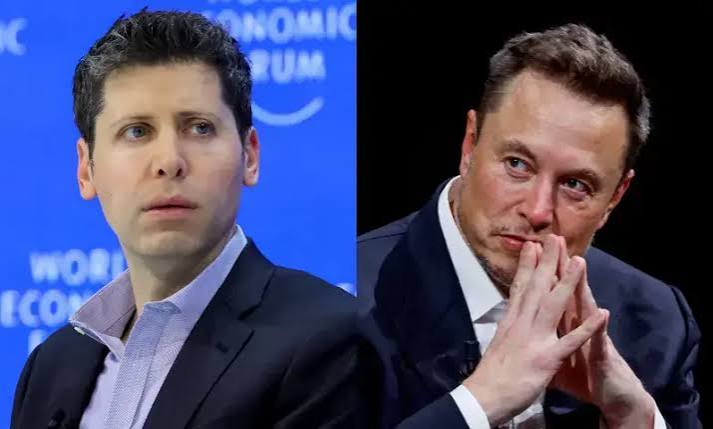
The long-running rivalry between Elon Musk and Sam Altman has found a new battleground: AI coding tools. OpenAI said on August 28 that it plans to stop providing its AI models to Cursor, the coding-tool company now owned by Musk’s SpaceX, adding another chapter to the increasingly bitter relationship between the two tech billionaires.
The decision comes after years of conflict between Musk and Altman, whose disagreements over the direction and ownership of OpenAI have spilled from the boardroom into courtrooms and now appear to be affecting business relationships between their companies.
Credits: The Indian Express
OpenAI Says SpaceX Cannot Be Trusted With Its Models
OpenAI said it was making the decision because it could no longer be confident that SpaceX would use its technology in accordance with the company’s terms of service.
The company pointed to what it described as a history of contract violations involving Musk’s companies as the reason for its concerns.
The move effectively puts Cursor in a difficult position. Coding tools increasingly depend on advanced AI models to provide features such as code generation, debugging, software planning and autonomous programming assistance. Losing access to OpenAI’s models could therefore force Cursor to rely more heavily on alternative AI providers or develop other ways of powering its services.
The dispute also demonstrates how relationships between AI companies and their customers can become complicated when those customers are controlled by major competitors.
Cursor’s SpaceX Ownership Changes the Equation
Cursor has become a prominent coding tool in the rapidly expanding AI-assisted software development market. Its acquisition by Musk’s SpaceX has now placed the company directly within the orbit of one of OpenAI’s most prominent rivals.
SpaceX has increasingly expanded beyond rockets and satellites into artificial intelligence and other technology areas. With Cursor now under its ownership, OpenAI appears to be treating the relationship differently from an ordinary customer arrangement.
The decision reflects a growing reality in the AI industry: access to advanced models can be a strategic asset. AI companies are not only competing to build better models but are also increasingly controlling how those models are distributed and who can use them.
Musk Responds: “I Couldn’t Care Less”
Musk quickly dismissed OpenAI’s decision.
In a post on X early Saturday, Musk responded to the announcement by writing, “I couldn’t care less.” He also accused Altman and OpenAI President Greg Brockman of being untrustworthy.
Musk repeated his longstanding claim that Altman and others betrayed OpenAI’s original mission by moving the organisation away from its nonprofit roots.
The comments underline just how personal the dispute between the two sides has become. What began as a disagreement over OpenAI’s direction has evolved into a broader battle involving lawsuits, public accusations and now commercial relationships.
The OpenAI-Musk Feud Has Already Reached Court
The latest confrontation follows a major legal battle between Musk and OpenAI.
Musk sued OpenAI and Altman, accusing them of abandoning the organisation’s original nonprofit mission and effectively turning what he described as a charity into a vehicle for private enrichment.
OpenAI, meanwhile, argued that Musk had sought control of the organisation and was unhappy after losing influence over its direction.
The dispute eventually went to trial, where both sides presented sharply different accounts of OpenAI’s transformation.
A federal jury ruled against Musk earlier this year, finding that he had filed the case too late. The verdict represented a significant legal setback for Musk, but it did little to end the public conflict between the two sides.
Credits: Mint
A New Front in the AI Power Struggle
OpenAI’s decision to cut off Cursor illustrates how the rivalry between Musk and Altman is extending beyond personal disagreements.
For OpenAI, the issue is about protecting its technology and enforcing its terms of service. For Musk, the decision appears to be another example of what he sees as OpenAI’s departure from its original principles.
The timing is also significant as AI companies increasingly compete across multiple layers of the technology stack. Model developers, coding platforms, cloud providers and AI applications are becoming deeply interconnected, meaning corporate ownership can influence which technologies remain accessible.
The Cursor dispute could therefore have consequences beyond the two companies involved. As AI becomes central to software development, access to leading models is becoming an increasingly valuable business relationship.
For now, however, the latest clash adds another chapter to the extraordinary Altman-Musk rivalry—one that has moved from OpenAI’s founding, to billion-dollar litigation, and now into the rapidly evolving market for AI-powered coding.