A methodology built around uncertainty
As artificial intelligence moves from experimental applications into business-critical systems, organisations face a challenge that extends beyond developing accurate machine-learning models. They must determine whether those models solve the intended problem, whether the underlying data remains reliable, and whether the resulting solutions can operate responsibly over time.
The Agile Iteration Process for Data Mining (AIP-DM), developed by Indian AI and product management professional Siddhesh Dongare, addresses this challenge through a structured but adaptive approach to AI and data science delivery.
The methodology received attention in connection with Dongare’s recognition through the Industrial Innovation Award at the 6th IEOM India International Conference on Industrial Engineering and Operations Management, held on November 5 to 7, 2026.
AIP-DM formed part of Dongare’s award nomination, alongside contributions involving AI-driven financial data intelligence and operational excellence. The recognition provides an occasion to examine the methodology’s approach, although an innovation award should not be interpreted as independent scientific validation of its effectiveness.
Why conventional delivery assumptions can become problematic
Traditional software development often begins with an expectation that requirements can be progressively converted into functioning software. Data science introduces an additional uncertainty: experimentation may reveal that the original business assumptions were incomplete or incorrect.
A fraud-detection model, for example, might achieve acceptable accuracy during testing while producing too many false positives for practical deployment. Alternatively, a transaction-categorisation model might meet its technical performance target but struggle when confronted with unfamiliar merchants or changing transaction descriptions.
In either case, additional model training may not be the appropriate response. The team may need to reconsider the available data, the problem definition or the business objective itself.
AIP-DM treats such reassessment as part of the normal delivery process rather than as an exceptional project disruption.
Its central proposition is that project direction should remain responsive to evidence generated during development.
How AIP-DM structures AI delivery
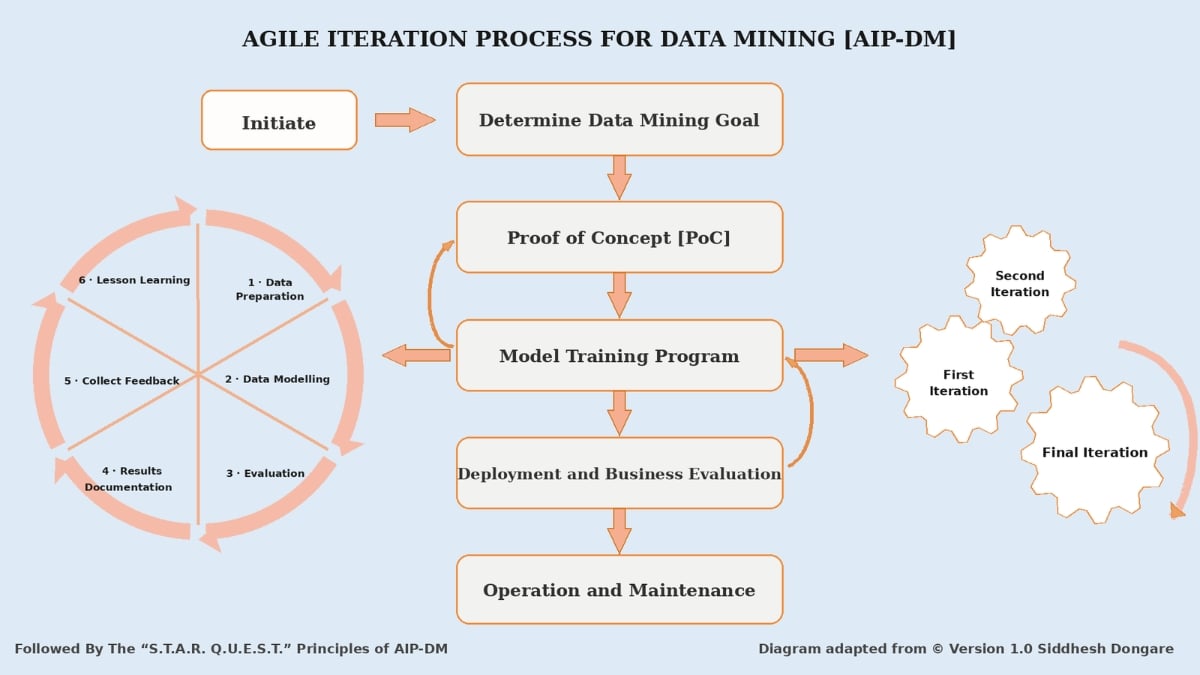
Figure 1. AIP-DM methodology overview (adapted from the AIP-DM framework, version 1.0).
AIP-DM describes six interconnected phases: Initiate, Determine Data Mining Goal, Proof of Concept, Model Training Program, Deployment and Business Evaluation, and Operation and Maintenance.
These phases establish a progression from business intent to production operation, but they are not intended to function as an irreversible sequence.
The framework permits teams to revisit earlier decisions when later findings expose problems with the original assumptions.
For instance, if deployment evaluation identifies an unacceptable operational error rate, the team may return to model development. If further investigation shows that the training data cannot adequately represent the business problem, the response may involve redefining the data-mining goal rather than continuing to optimise the existing model.
AIP-DM also identifies four supporting pillars: Mindset, People, Process and Outcomes.
Together, these broaden its focus beyond model development. They emphasise organisational collaboration, shared decision-making, delivery discipline and the continuing relevance of business results.
Its S.T.A.R. Q.U.E.S.T. principles incorporate stakeholder collaboration, transparency, adaptive planning, rigorous quality, user-centred value, ethical considerations, sustainable development and team empowerment.
The intended result is a delivery process in which technical experimentation remains connected to accountability and measurable value.
How does AIP-DM compare with CRISP-DM?
An assessment of AIP-DM requires comparison with established data science methodologies, particularly the Cross-Industry Standard Process for Data Mining (CRISP-DM).
CRISP-DM already provides a six-phase lifecycle covering business understanding, data understanding, data preparation, modelling, evaluation and deployment. Importantly, CRISP-DM is also iterative. Its established process explicitly allows movement between phases when necessary.
Consequently, iteration alone cannot be considered a unique innovation introduced by AIP-DM.
The distinction lies instead in the way AIP-DM attempts to combine lifecycle activities with an explicit organisational model encompassing people, working principles, governance and long-term outcomes.
Where CRISP-DM provides a well-established analytical project structure, AIP-DM presents a broader set of behavioural and operational expectations for the teams using that structure.
Other approaches, including Microsoft’s Team Data Science Process and modern machine-learning operations practices, also address collaboration, production deployment and continuous improvement.
AIP-DM therefore enters an existing methodological landscape rather than replacing an absence of structured approaches.
Its potential contribution would need to be demonstrated through how effectively these elements work together in actual delivery environments.
From model performance to operational accountability
One of the more relevant aspects of AIP-DM is its emphasis on evaluating the success of an AI initiative beyond the performance of its underlying model.
In financial transaction intelligence, for instance, a classification model may perform well against a labelled evaluation dataset while creating downstream problems for consumers or businesses.
Incorrect merchant identification, inconsistent categorisation and poor handling of unfamiliar transactions can undermine the usefulness of the resulting product.
A process focused exclusively on predictive accuracy risks overlooking these operational consequences.
AIP-DM’s emphasis on business evaluation and ongoing maintenance offers a mechanism for incorporating such considerations into delivery decisions.
This is particularly relevant to AI systems that operate in changing environments, where data distributions, user requirements and compliance expectations may evolve after deployment.
However, defining these responsibilities in a methodology does not guarantee their implementation. Organisations still require measurable acceptance criteria, decision ownership, monitoring capabilities and effective escalation procedures.
A publicly documented technical foundation
AIP-DM is also associated with the published United States patent application US20230385825A1, titled Agile iteration for data mining using artificial intelligence.
The published application identifies Dongare as inventor and Mastercard International Incorporated as assignee.
It describes a computer-implemented approach incorporating data-mining objectives, proof-of-concept model selection, iterative deep-learning training and validation against defined metrics.
The patent publication provides a technical record associated with the development of the approach. However, a published patent application is not equivalent to proof that the broader methodology delivers superior project outcomes.
Such performance claims require separate evaluation.
Recognition and the question of measurable impact
IEOM Society International’s Industrial Innovation Award category recognises contributions associated with industrial innovation and operational improvement.
AIP-DM’s inclusion in Dongare’s award submission connects the methodology to broader discussions about repeatability, quality, governance and the industrialisation of artificial intelligence.
The more consequential question is whether AIP-DM demonstrably improves AI delivery compared with established alternatives.
Several areas warrant further investigation.
Independent evaluations could examine whether organisations applying AIP-DM experience less late-stage rework, shorter periods between experimentation and deployment, stronger alignment between technical and business requirements, or more effective management of production-model issues.
Comparative studies against CRISP-DM, Team Data Science Process or existing MLOps practices would be particularly valuable.
Another consideration is implementation complexity. A methodology that introduces more formal reviews, stakeholder responsibilities and documentation can strengthen governance, but may also create unnecessary overhead if those controls are not proportional to project risk.
AIP-DM’s effectiveness would therefore depend partly on whether its adaptive structure improves decision quality without unnecessarily slowing experimentation.
What comes next for AIP-DM?
The growing adoption of generative AI and autonomous agents introduces further complexity into project delivery. Systems increasingly involve multiple models, external tools, human approval mechanisms and continuously changing information.
These developments make traceability, accountability and reassessment important operational concerns.
AIP-DM’s existing emphasis on feedback, governance and changing assumptions provides a conceptual foundation for addressing some of these concerns. Nevertheless, extensions into multi-agent systems would require their own validation, particularly around decision authority, safety controls and coordination between autonomous components.
The framework’s longer-term significance will depend less on its terminology or the recognition associated with its creator and more on whether independent practitioners can reproduce its benefits.
AIP-DM raises a relevant question for AI engineering and management: should successful delivery be measured primarily by whether a team completes its planned development activities, or by whether it can revise those plans responsibly when evidence demands a different direction?
Its answer favours adaptive execution tied to business outcomes.
Whether that approach becomes an influential contribution to AI project management will ultimately depend on independent research, wider adoption and documented operational results.