Apple has long positioned privacy as one of the defining principles of its products. But with its latest Apple Watch features, the company is entering territory that could make even privacy-conscious users uncomfortable: technology that can listen to and understand conversations around you.
At its September 2026 hardware event, Apple introduced new Apple Watch capabilities powered by on-device artificial intelligence, including Audio Intelligence, Live Rewind and Siri Recap. The features are designed to help users remember conversations, identify important sounds and capture useful information without requiring them to constantly reach for their phones.
But the technology also raises a difficult question: How much listening is too much?

Credits: Tech Crunch
Apple Watch can now understand sounds around you
Apple’s Audio Intelligence feature could have clear benefits, particularly for people who are deaf or hard of hearing. Using on-device AI, the Apple Watch can identify sounds such as sirens, alarms, doorbells and a baby crying, then alert the wearer.
The feature can operate even when the user’s iPhone is not nearby. In situations involving a fire alarm or carbon-monoxide detector, this capability could potentially provide critical assistance.
Unlike some of the more controversial applications of AI-powered listening, Audio Intelligence has an obvious accessibility use case. The bigger privacy concerns emerge with Apple’s other new features, which move beyond identifying environmental sounds and begin processing conversations.
Live Rewind turns conversations into searchable notes
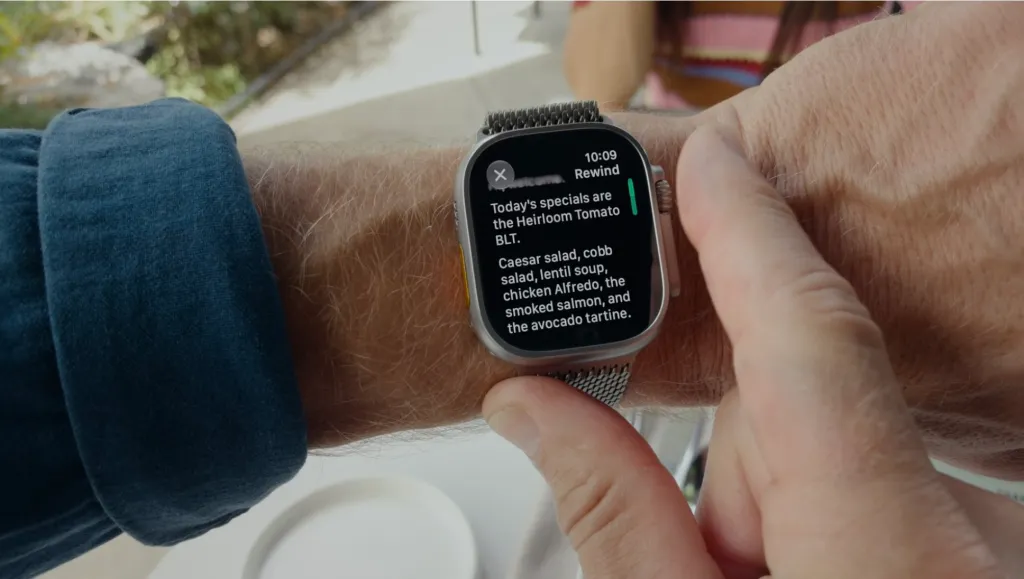
Apple’s Live Rewind feature allows users to go back approximately 15 seconds and transcribe what was just said by double-pressing the Apple Watch’s Digital Crown.
The resulting transcription can then be saved to Apple’s standalone Siri app, allowing users to revisit information later. Apple envisions scenarios such as remembering a book recommendation, a colleague’s idea or something the user failed to hear during a conversation.
The convenience is clear. But so is the uncomfortable side of the technology.
A person wearing an Apple Watch could potentially capture something another person said without that person realising that the conversation was being transcribed. While the watch provides an audible chime and displays a microphone animation when the feature is activated, the physical action required is considerably more subtle than raising a smartphone and pointing its camera.
That difference could have significant implications for social norms and consent.
Siri Recap takes ambient listening further
Apple’s Siri Recap feature goes a step further by using ambient listening to create high-level notes from conversations. Rather than generating a word-for-word transcript, the feature produces a title, summary and key points that users can review later through the Siri app.
Apple says this could be useful for remembering meeting takeaways or important details from events such as parent-teacher conferences.
However, ambient listening inevitably raises questions about who has consented to being recorded and processed. Recording laws differ across jurisdictions, and the legal status of AI-generated text from conversations could become increasingly complicated as these devices become more common.
The question is particularly relevant because Apple says it does not save the underlying audio. That could make any future disputes over the authenticity or context of a transcript more complicated.
Apple is drawing a line around privacy
Apple has attempted to distinguish its approach from always-on AI wearables.
Siri Recap is not automatically enabled at all times. Users can decide when to activate it, such as during work hours, and can switch the feature on or off through the Control Center.
Apple also says it does not create or store audio recordings. According to the company, raw audio cannot be accessed even by Apple, while speakers are not identified or attributed. Generated transcripts and recaps are protected using end-to-end encryption.
These safeguards could make Apple’s approach more acceptable to consumers who are concerned about surveillance.
Yet privacy is not only about where data is stored. It is also about how comfortable people feel knowing that a device on someone’s wrist can potentially capture and process what they say.

Credits: Tech Crunch
Will consumers accept an always-listening future?
The cultural impact of these features could ultimately be more significant than the technology itself.
People already modify their behaviour when they know they are being photographed or recorded. A smartphone camera is relatively obvious: someone has to point a device at a person or event. Audio capture through a smartwatch can be considerably less conspicuous.
If AI-powered wearables become widespread, people may increasingly assume that conversations could be captured, summarised or transcribed.
Apple may therefore be attempting something bigger than simply adding AI features to the Apple Watch. It could be trying to make ambient intelligence feel normal.
The company has provided several privacy protections to make that transition easier. Whether those safeguards are enough to convince consumers that the convenience outweighs the discomfort remains to be seen.
For Apple, the challenge will be maintaining its reputation as a privacy-focused technology company while convincing users that a device capable of listening to the world around them is ultimately there to help, rather than watch them.