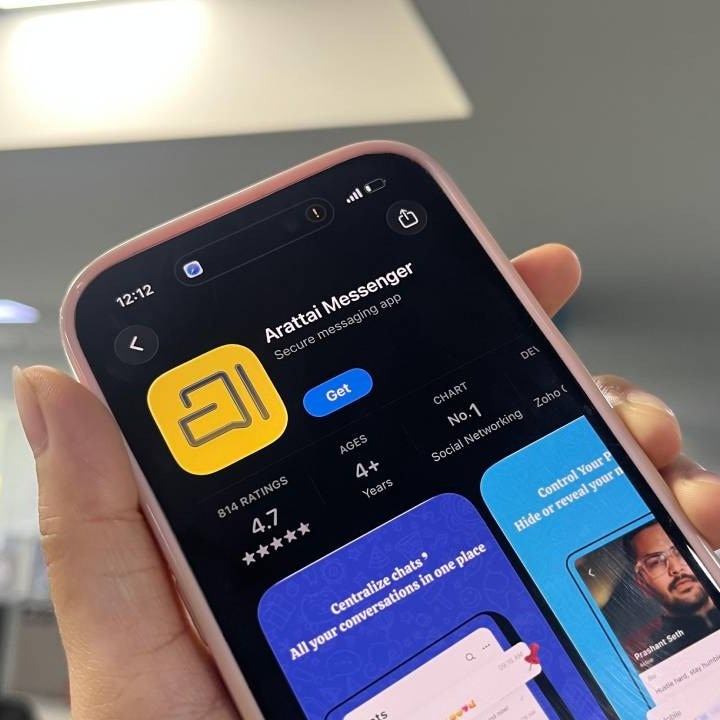
India’s tech landscape witnessed a surprising twist this week when Arattai, Zoho’s homegrown messaging app, suddenly shot into the spotlight. What triggered the surge? A series of strong endorsements from Union IT Minister Ashwini Vaishnaw and Education Minister Dharmendra Pradhan, who appealed to citizens to adopt Indian alternatives to popular foreign apps.
Earlier this month, Vaishnaw took to social media urging people to “join PM Narendra Modi’s call for Swadeshi by adopting indigenous products & services.” Pradhan echoed the message, encouraging citizens to switch to India-made platforms for their daily communication. Their appeal, wrapped in the larger narrative of Atmanirbhar Bharat, appears to have resonated strongly with the public.
Credits: India Today
From Quiet Existence to Overnight Fame
Launched in 2021, Arattai had remained relatively under the radar, overshadowed by global giants like WhatsApp and Telegram. Despite being feature-rich, it never quite managed to break into the mainstream conversation.
That changed almost overnight. Within 72 hours of the ministers’ endorsements, the app witnessed a staggering 100x spike in traffic, with daily sign-ups skyrocketing from 3,000 users to 350,000. A platform once quietly building its base is now being discussed as the Swadeshi answer to WhatsApp.
What Makes Arattai Special?
At its core, Arattai offers everything one expects from a modern messaging app—text chats, voice notes, multimedia sharing, group conversations, and audio/video calls. It even includes the popular “stories” feature familiar to users of Instagram and WhatsApp.
But what sets it apart is its Indian identity. The name itself—“Arattai”, meaning chat in Tamil—gives the app a uniquely local flavor. And unlike some Indian apps that only cater to mobile platforms, Arattai has gone the extra mile, making itself available across Android, iOS, iPadOS, Windows, Linux, and macOS. This wide compatibility ensures inclusivity for users across age groups and devices.
Zoho’s Challenge: Managing Sudden Popularity
For Zoho, this explosive growth is both exciting and challenging. Founder Sridhar Vembu confirmed the scale of the surge, noting on social media:
“We have faced a 100x increase in Arattai traffic in 3 days. New sign-ups went from 3,000 per day to 350,000 per day. We are adding infrastructure urgently to handle another possible surge.”
Vembu also revealed that Zoho had been preparing a major relaunch in November, with upgraded features, greater capacity, and a stronger marketing push. The unexpected traffic spike has now accelerated those plans. “We have a lot more planned for Arattai. Please give us some time. Thank you for your patience and support! Jai Hind,” he added.
The Larger Picture: India’s Appetite for Swadeshi Tech
The meteoric rise of Arattai is more than just a story about an app—it reflects a growing desire among Indians to support domestic digital solutions. With data privacy concerns, geopolitical tensions, and the government’s repeated emphasis on self-reliance, many users are beginning to rethink their heavy reliance on foreign apps.
Arattai’s rise also signals a cultural shift. Indians are increasingly willing to give homegrown platforms a chance, provided they offer a seamless user experience and competitive features. The November relaunch could mark a turning point, positioning Arattai as a serious contender in India’s messaging ecosystem.

Credits: MSN
What Lies Ahead
For now, Arattai finds itself in the national spotlight—a place few expected it to be just weeks ago. The app’s sudden popularity shows that Indians are ready to experiment with alternatives, especially when tied to the broader Swadeshi narrative.
As Zoho prepares to scale up, the next few months will be critical. Can Arattai convert this surge of curiosity into long-term adoption? Can it differentiate itself from WhatsApp and Telegram, not just through its Indian identity but also through innovation and trust?
If it succeeds, Arattai won’t just be another messaging app—it could become a symbol of India’s digital self-reliance.