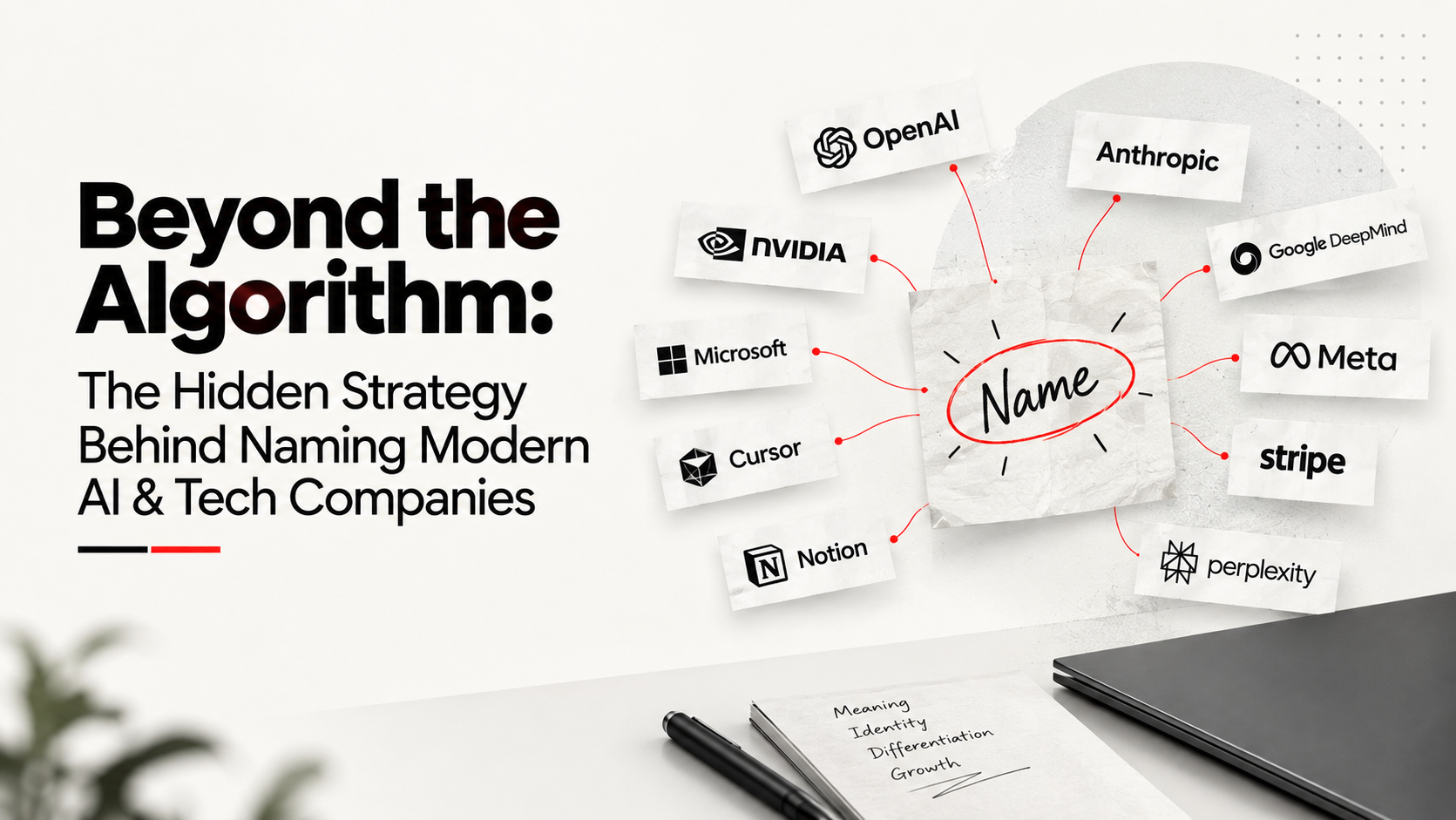
The one thing tech companies did for decades was talk in super technical terms. In today’s world, AI startups do not follow this trend and prefer to sound human-like, emotional, familiar to common items, real or entirely made-up names.
Look at the examples of platforms such as Lovable, Cursor, Suno, Grok, Claude, and Perplexity. All of these follow distinct linguistic patterns; however, the one important change in strategy they all have in common is not about naming the technological aspect of their products.
In the modern world where everyone tries to outdo competitors with their AI solutions, choosing an appropriate name for your brand becomes crucial.
The Decline of Predictable Tech & SaaS Naming
Software naming in traditional times usually uses descriptive functionality, such as DataFlow, SmartSolutions, CloudConnect, and AI Assistant. Although such names have an instant benefit, they also tend to make similar-sounding products that cannot stand out in a crowded market.
However, there is a new naming strategy. New tech companies use ordinary language in innovative technical situations – Cursor, Frame, Arc, and Linear. At the same time, Lovable makes an emotional qualifier into a key part of branding. In accordance with the analysis by Nymly of the naming trends in the era of AI, they allow their product to create its own meaning for the word in the course of time.
It is important to distinguish such nuances for AI startups. As long as competing platforms have similar machine learning capabilities, the main thing that differentiates products is their brand name.
1. Reinterpreting Everyday Words as Distinctive Brands
Why opt for complicated terminology when plain English makes for better brand recall?
- Cursor turns a common computing term into an identity for an AI coding editor.
- Perplexity taps into a word that embodies intellectual inquiry for an AI search engine brand.
- Linear uses a term that conveys direction and force for project management software.
These names opt not to spell out all the features from the get-go but rather use the name as a mnemonic device for the overall brand story.
But the challenge with real-world words is a trademark and digital asset headache. Common terms taken from the dictionary need trademark due diligence upfront.
2. Embracing Playful, Approachable, and Humanized Identities
An AI project doesn’t always have to be named like an academic laboratory. Names like Lovable, Suno, and Grok focus on being relatable, rather than technical, and become naturally shareable within social media, product reviews, and word-of-mouth marketing.
However, this trend towards humanization goes beyond just naming and is observed in the whole user experience. According to Business Insider, many tech corporations apply relatable features to brand their products and even use AI mascots like Meta’s Jolly. Modern AI branding is just as much about users’ emotions as about technology itself.
3. Leveraging Human Names and Character Personas
The practice of naming an AI technology in an individual way such as Claude, Devin, or Pi immediately fosters a feeling of familiarity.
This naming convention for AI assistants, autonomous agents, and conversational software turns the process of human-technology interaction into something much more natural. In the case when software generates codes, responds to research questions, or conducts workflow management activities on behalf of the user, it helps to promote better adoption rates among the users.
However, it should be noted that the use of human characteristics in branding should be approached strategically.
4. The Enduring Strategic Value of Coined & Invented Words
In spite of the prevalence of real words and relatable names in news headlines, coined words still present a strong tool for tech founders who wish to have exclusive brand ownership.
A coined name gives you all the freedom possible because there will be no previous dictionary definition that may influence your branding. Moreover, a coined name is extremely versatile, as it allows for pivoting and entering international markets.
However, inventing a name needs brand architecture. Random combinations of letters, odd spelling, or difficult pronunciation can impair memorability and natural search visibility.
We found a brand naming agency Tiepograph that specializes in technology naming using structural linguistics, phonetic balance, and brand durability. Tech naming methodology used by the company emphasizes the assessment of performance of different names in practical applications, trademark ability, and searchability in the long run.
5. Balancing Brevity with Phonetic Clarity
Names such as Grok, Suno, Cursor, and Claude work well since they are easy to say, easy to incorporate into user interface design, and easy to use in conversation.
Nevertheless, the quest for extremely short company names has led to market saturation, where nearly all two-syllable words and combinations of letters have already been claimed, and spelling them unnaturally does not help create a strong brand.
The main objective is not just keeping the number of characters low. One should understand if a chosen name can be identified at first glance and distinguished from other players in search results.
6. Designing a Brand Identity Built for Scaling
AI startups usually begin their journey with one feature, such as AI Copywriter, before scaling up into complicated workflow automation, enterprise-level software, or analytics solutions. Creating a name around the very first product feature will limit brand development in the future.
Founders should create brand architecture that will allow them to introduce different product lines later without a full-scale rebranding process.
This is what Tiepograph did with several of their clients:
- Empelin: A brand designed for an IT firm that later succeeded to enter the EV market.
- Xtragen: Brand identity created for a deep-tech enterprise which specializes in GNSS (Global Navigation Satellite System) and IoT technologies, combining technical sophistication and commercial success.
- Mavlit: Blend of ‘maverick’ and ‘ability’ to depict a company that has bold, and scalable advertising technology. It has a unique brand identity that illustrates the concept of linguistic design.
7. Why AI Naming Generators Are Only the First Step
AI-powered generative technologies can generate hundreds of brand name options in minutes, offering unparalleled efficiency in the brainstorming process.
Yet, the content generated is devoid of strategic filtering. Lists created by AI often consist of clichéd tropes, legally unobtainable words, or linguistically charged terms that carry negative connotations internationally.
The hard part comes with strategic filtering. Establishing a lasting tech brand involves thorough testing according to the following criteria:
- Phonetics & Pronounceability – How easily is the term pronounced and spelled?
- Linguistic & Cultural Context – Is the term translatable with positive associations internationally?
- Trademarks & Legality – Is obtaining IP possible in the company’s business regions?
- Digital & SEO Readiness – Can the brand dominate search engine results?
Executive Takeaways for Tech Founders
There is no easy formula for giving names to businesses related to AI or any other technology. Be it dictionary words, expressive names, human personalities, or made-up words, it all boils down to making sure that they align perfectly with the company’s mission.
The trend in contemporary brand building that matters the most is that of moving away from overly technical names. In today’s crowded environment, brand differentiation means making deliberate choices with regard to personality, sound, strategy, and scalability.
A good brand name is not necessarily the most short or technical name out there; it is the one that builds brand recognition now and provides room for growth later.