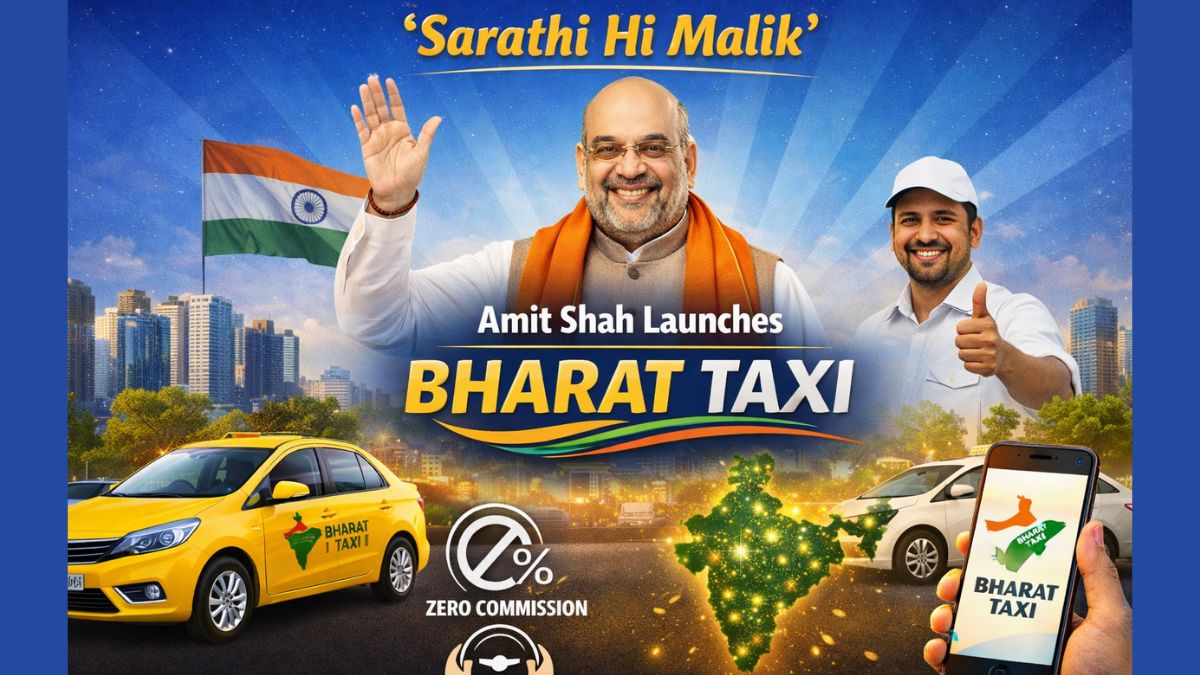
In a bold attempt to disrupt India’s ride-hailing ecosystem, Union Home Minister Amit Shah has launched Bharat Taxi, a cooperative-owned mobility platform designed to empower drivers and eliminate commission-based earnings models. The initiative aims to challenge dominant players such as Uber and Ola by introducing a system where drivers operate as owners, ensuring better income distribution and greater autonomy.
The launch signals a significant shift in how ride-hailing services could operate in India, with the government emphasizing a cooperative structure that prioritises driver welfare, fair pricing, and financial transparency.
&format=webp&quality=medium)
Credits: Zee Business
A Cooperative Model With Drivers at the Core
Bharat Taxi is built around the concept of cooperative ownership, positioning drivers — referred to as Sarathis (charioteers) — as stakeholders in the platform. Unlike traditional aggregator platforms that function as intermediaries, Bharat Taxi seeks to eliminate the middleman and place drivers at the centre of operations and value creation.
Speaking at the launch event, Amit Shah described the initiative as a transformative step in India’s mobility sector. He emphasised that the project reflects the philosophy of “Sahkar, not Sarkar”, meaning cooperative collaboration rather than direct government control. According to Shah, the initiative could replicate the success of India’s cooperative giants like Amul, which revolutionised the dairy sector by empowering farmers.
Shah highlighted that the cooperative model would allow Sarathis to function as taxi owners while benefiting directly from their earnings, potentially leading to improved financial stability and long-term economic empowerment.
Zero Commission and Direct Payments: A Game-Changing Proposition
One of Bharat Taxi’s most significant differentiators is its zero-commission structure. Currently, ride-hailing platforms typically charge drivers a commission ranging from 15% to 30% on every trip. Bharat Taxi, however, promises to eliminate commission deductions entirely.
Under the new model, customer payments will be transferred directly to drivers’ bank accounts, ensuring faster settlements and full transparency. Shah stated that this system would remove delays and hidden charges often associated with aggregator platforms.
While the platform itself will retain 20% of the overall revenue generated, this amount will be used to sustain operations and infrastructure development. Importantly, the cooperative structure ensures that profits ultimately benefit the Sarathi community rather than private shareholders.
Additionally, the platform will remove booking fees, heavy platform charges, and hidden costs, which could potentially make rides more affordable for passengers while simultaneously increasing driver earnings.
A Unified Mobility Ecosystem
Bharat Taxi is envisioned as a comprehensive mobility platform offering services across two-wheelers, three-wheelers, and four-wheelers. This multi-segment approach could enable the platform to cater to a broader user base, ranging from short urban commutes to longer intercity travel.
The government has planned a phased rollout, with the service expected to scale across regions over the next three years. The platform also allows drivers to operate simultaneously on other ride-hailing apps, as it does not impose exclusivity clauses. This flexibility could attract drivers who wish to diversify income streams without being locked into a single ecosystem.
Strong Focus on Women’s Safety and Empowerment
Another key highlight of Bharat Taxi is its emphasis on women’s participation and safety. Shah introduced initiatives such as “Sarathi Didi”, which aims to empower women drivers while ensuring safer travel experiences for female passengers.
The platform is also running the “Bike Didi” initiative, under which over 150 women drivers have already joined. These efforts reflect a broader attempt to increase female workforce participation in the mobility sector, traditionally dominated by male drivers.
Social Security and Welfare Measures for Drivers
Beyond earnings, Bharat Taxi places significant emphasis on social security and welfare. The platform offers health insurance, accident coverage, retirement savings options, and dedicated driver support systems.
At the launch event, share certificates were distributed to the top six performing Sarathis, reinforcing the cooperative principle of “Sarathi Hi Malik” (The driver is the owner). Each honoured Sarathi received personal accident insurance worth ₹5 lakh along with family health insurance coverage of the same amount.
To strengthen operational support, driver assistance centres have already been established at seven key locations in Delhi. These centres provide emergency support, verified ride data, and grievance resolution services.
)
Credits: Firstpost
A Potential Disruptor in India’s Ride-Hailing Industry
With its cooperative ownership model, zero-commission structure, and focus on driver welfare, Bharat Taxi has the potential to significantly alter India’s ride-hailing landscape. If executed effectively, the platform could attract thousands of drivers seeking higher earnings and financial independence.
However, the success of Bharat Taxi will depend on its ability to scale operations, maintain service quality, and compete with the technological sophistication and market dominance of established players. As the platform begins its phased rollout, industry stakeholders and consumers alike will closely watch whether this cooperative experiment can truly revolutionise India’s mobility sector.