For more than a century, pressing the brake pedal in a car has meant the same thing. Your foot pushes a pedal connected to a hydraulic system, brake fluid carries the pressure, and the brake pads squeeze the discs to slow the vehicle.
It is a simple idea that has proven reliable for generations.
But the automotive industry is changing faster than ever. Electric vehicles, advanced driver assistance systems (ADAS), autonomous driving technology, and software-defined vehicles are forcing engineers to rethink even the most fundamental components of a car.
One of the biggest changes happening behind the scenes is brake-by-wire.
Unlike traditional braking systems that rely almost entirely on hydraulic pressure, brake-by-wire introduces electronics, sensors, and software into the braking process. It replaces much of the mechanical connection between the driver’s foot and the brakes with digital controls while maintaining multiple safety backups.
Although the term sounds futuristic, millions of vehicles on the road already use some form of brake-by-wire technology today.
Here’s what it is, how it works, why manufacturers are embracing it, and whether drivers should trust it.
What Is Brake-by-Wire?
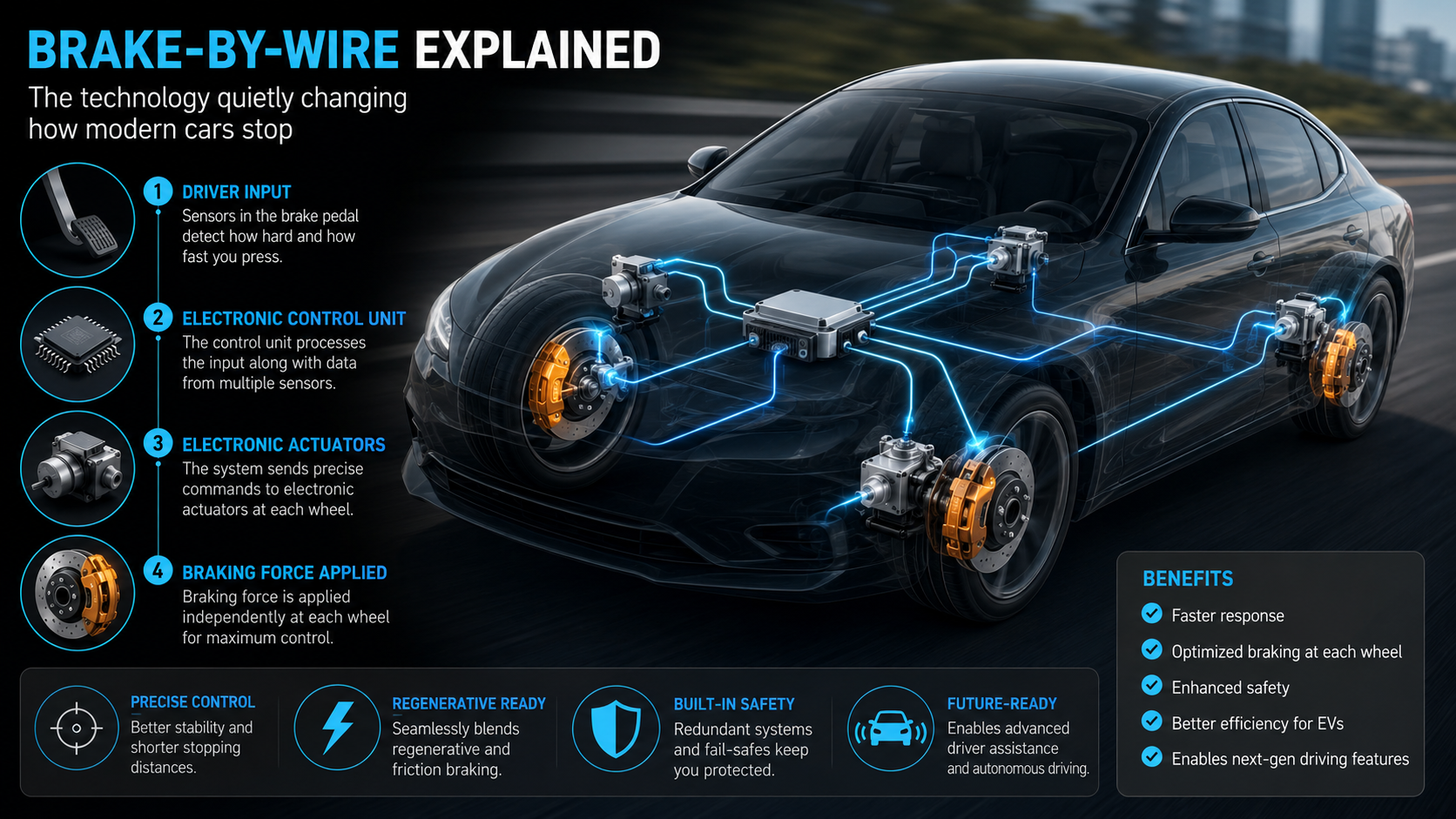
Brake-by-wire is an electronically controlled braking system where the driver’s pedal input is converted into electronic signals rather than directly creating hydraulic pressure.
Instead of your foot physically generating braking force throughout the entire system, sensors measure how hard and how quickly you press the brake pedal.
That information is instantly sent to a control unit, which calculates exactly how much braking force each wheel requires.
Electronic actuators then apply the required braking pressure with remarkable precision.
In simple terms:
Traditional braking:
Foot → Hydraulic Pressure → Brakes
Brake-by-wire:
Foot → Sensors → Computer → Electronic Actuators → Brakes
The physical feel of pressing the pedal remains almost identical, but what happens underneath is very different.
Why the Auto Industry Is Moving Away from Pure Hydraulic Brakes
The shift isn’t happening because hydraulic brakes have become unsafe.
Quite the opposite.
Traditional hydraulic braking systems are exceptionally dependable.
The challenge is that modern vehicles demand far greater precision than purely mechanical systems can easily provide.
Today’s cars constantly manage:
- Regenerative braking
- Adaptive cruise control
- Automatic emergency braking
- Lane-centering systems
- Stability control
- Autonomous parking
- Collision avoidance
All of these technologies need instant and precise braking control.
Electronic braking systems allow software to communicate directly with the brakes without waiting for hydraulic pressure changes.
That makes response times faster and vehicle behavior more predictable.
How Brake-by-Wire Actually Works
The technology sounds complicated, but its operating sequence is surprisingly straightforward.
Step 1: The Driver Presses the Brake Pedal
The pedal itself contains multiple sensors.
These detect:
- Pedal position
- Force applied
- Speed of pedal movement
Most systems use several independent sensors so they can cross-check one another.
Step 2: The Electronic Control Unit Takes Over
The brake control computer instantly receives the driver’s input.
It also gathers data from dozens of other sensors across the vehicle, including:
- Vehicle speed
- Wheel speed
- Steering angle
- Battery condition
- Road grip
- Vehicle weight
- Stability sensors
Within milliseconds, the system determines exactly how much braking each wheel requires.
Step 3: The Actuators Apply Braking Force
Instead of relying entirely on hydraulic pressure created by the driver’s foot, electrically controlled actuators generate the braking force.
Each wheel can receive a different amount of pressure.
This improves:
- Stability
- Cornering
- Emergency braking
- Wet-road performance
Step 4: Regenerative Braking Joins the Process
This is where electric vehicles gain their biggest advantage.
Instead of immediately using friction brakes, the system first attempts regenerative braking.
The electric motor acts as a generator, slowing the car while producing electricity.
If additional stopping power is needed, friction brakes seamlessly engage.
Drivers usually cannot feel the transition.
Brake-by-Wire vs Traditional Hydraulic Brakes
| Traditional Brakes | Brake-by-Wire |
|---|---|
| Hydraulic connection | Electronic control |
| Driver generates pressure | Computer manages pressure |
| Fixed brake balance | Wheel-by-wheel optimization |
| Limited software integration | Fully software integrated |
| Minimal regenerative capability | Optimized regenerative braking |
| Heavier components | Potentially lighter system |
Why Electric Vehicles Depend on Brake-by-Wire
Electric vehicles benefit more than conventional cars because energy recovery is one of their biggest advantages.
Every time a driver slows down, the vehicle can recover energy that would otherwise become heat.
The challenge is blending regenerative braking with friction braking.
Without electronic control, the transition could feel jerky or inconsistent.
Brake-by-wire solves this by continuously deciding how much stopping power should come from:
- Regenerative braking
- Hydraulic braking
The driver experiences one smooth braking action while the vehicle maximizes battery efficiency.
Better Emergency Braking
One of the most significant advantages is emergency response.
During panic braking, humans often don’t apply maximum pressure quickly enough.
Brake-by-wire systems recognize emergency situations almost instantly.
The software can:
- Increase braking pressure
- Distribute braking force
- Activate ABS earlier
- Coordinate stability control
The result is shorter stopping distances in many situations.
Improved Vehicle Stability
Every wheel has different grip depending on:
- Road surface
- Cornering angle
- Weight transfer
- Tire condition
Traditional systems apply nearly identical hydraulic pressure.
Brake-by-wire can adjust every wheel individually.
That allows much finer control during:
- Heavy rain
- Snow
- Gravel
- High-speed cornering
It Makes Advanced Driver Assistance Possible
Features that drivers increasingly rely on would be far less effective without electronically controlled braking.
Examples include:
- Automatic Emergency Braking: The vehicle can apply brakes before the driver reacts.
- Adaptive Cruise Control: The system continuously adjusts speed in traffic.
- Traffic Jam Assist: The car repeatedly brakes and accelerates without driver input.
- Autonomous Parking: Tiny braking adjustments help position the vehicle precisely.
- Future Self-Driving Systems: Autonomous vehicles require computers to control braking directly. Brake-by-wire forms a crucial part of that foundation.
What Happens If the Electronics Fail?
This is the question most drivers ask first.
If computers control the brakes, what happens if something goes wrong?
Manufacturers know braking is the most safety-critical system in any vehicle.
For that reason, brake-by-wire systems are built with extensive redundancy.
Most include:
- Dual processors
- Backup power supplies
- Multiple pedal sensors
- Independent communication networks
- Emergency hydraulic backup
- Continuous self-diagnostics
If one component fails, another immediately takes over.
Many systems also switch into a reduced-function safety mode while still allowing the vehicle to stop safely.
Does the Brake Pedal Feel Different?
Manufacturers spend enormous amounts of time tuning pedal feel.
Most drivers cannot tell whether a vehicle uses hydraulic braking or brake-by-wire.
Artificial feedback systems recreate the familiar resistance people expect.
Some luxury manufacturers even adjust pedal feel depending on the selected driving mode.
Comfort mode may feel softer.
Sport mode often feels firmer and more responsive.
Are Repairs More Expensive?
Potentially, yes.
Brake-by-wire systems contain:
- Sensors
- Electronic modules
- Software
- Wiring
- Actuators
These components are generally more expensive than traditional hydraulic parts.
However, they also eliminate or simplify certain mechanical components.
As production volumes increase, repair costs are expected to become more competitive.
Which Cars Already Use Brake-by-Wire?
Many people assume the technology belongs only to expensive electric cars.
In reality, various forms of brake-by-wire have already reached mainstream vehicles.
Several manufacturers now employ electronically controlled braking systems in models ranging from compact crossovers to premium luxury vehicles.
Many battery-electric vehicles use advanced brake-by-wire to seamlessly combine regenerative and friction braking. Several hybrids rely on similar systems for the same reason. Premium brands have also adopted electronically managed braking to improve ride quality, driver assistance performance, and overall braking precision.
As software-defined vehicles become more common, electronic braking is steadily moving from being a premium feature to an industry standard.
The Link Between Brake-by-Wire and Software-Defined Vehicles
Modern cars increasingly receive software updates after purchase.
These updates can improve:
- Efficiency
- Driver assistance
- Energy management
- Battery performance
Brake-by-wire integrates directly into this digital ecosystem.
Rather than relying solely on mechanical adjustments, engineers can refine braking behavior through software calibration.
Future updates could potentially improve pedal feel, braking response, regenerative braking performance, or compatibility with new driver assistance features without replacing physical hardware.
That flexibility is one reason automakers see electronic braking as an important step toward fully software-defined vehicles.
Challenges Still Remain
Despite its advantages, brake-by-wire is not without challenges.
One concern is public perception. Many drivers are naturally cautious about replacing familiar hydraulic systems with electronics, even though modern designs include multiple backup layers.
Another challenge is repair complexity. Independent workshops may require specialized diagnostic equipment and trained technicians to service these systems properly.
Cybersecurity is also an area of focus. Since brake-by-wire communicates with other electronic systems inside the vehicle, manufacturers employ encrypted communication, secure software architectures, and continuous monitoring to reduce the risk of unauthorized access.
Finally, there is the question of long-term durability. While electronic components have become increasingly reliable, manufacturers continue to test these systems under extreme temperatures, vibration, humidity, and years of real-world use to ensure consistent performance over a vehicle’s lifespan.
Why Brake-by-Wire Matters More Than Most Drivers Realize
Unlike flashy infotainment screens or dramatic exterior styling, brake-by-wire is the kind of innovation most drivers never notice. Yet it quietly influences almost every aspect of how a modern vehicle behaves.
From enabling smoother regenerative braking in electric vehicles to supporting advanced safety technologies that can prevent collisions, the system acts as a bridge between traditional automotive engineering and the software-driven future of mobility.
It also prepares vehicles for features that will become increasingly common over the next decade, including higher levels of driving automation and more sophisticated energy management systems.
The Road Ahead
Brake-by-wire represents one of the biggest shifts in braking technology since hydraulic systems became the industry standard many decades ago.
The move is not about replacing proven engineering for the sake of novelty. Instead, it reflects the growing need for vehicles that can respond faster, integrate seamlessly with advanced software, and support technologies such as regenerative braking and autonomous driving.
For drivers, the experience behind the wheel changes very little. Press the brake pedal, and the car slows smoothly and predictably, just as it always has. What changes is the intelligence working behind that familiar action.
As electric vehicles become more common and software takes on a larger role in automotive design, brake-by-wire is likely to become less of a premium feature and more of an expected standard. Like electronic fuel injection or anti-lock braking systems before it, the technology may soon fade into the background, quietly doing its job while making every journey a little safer, more efficient, and better connected.