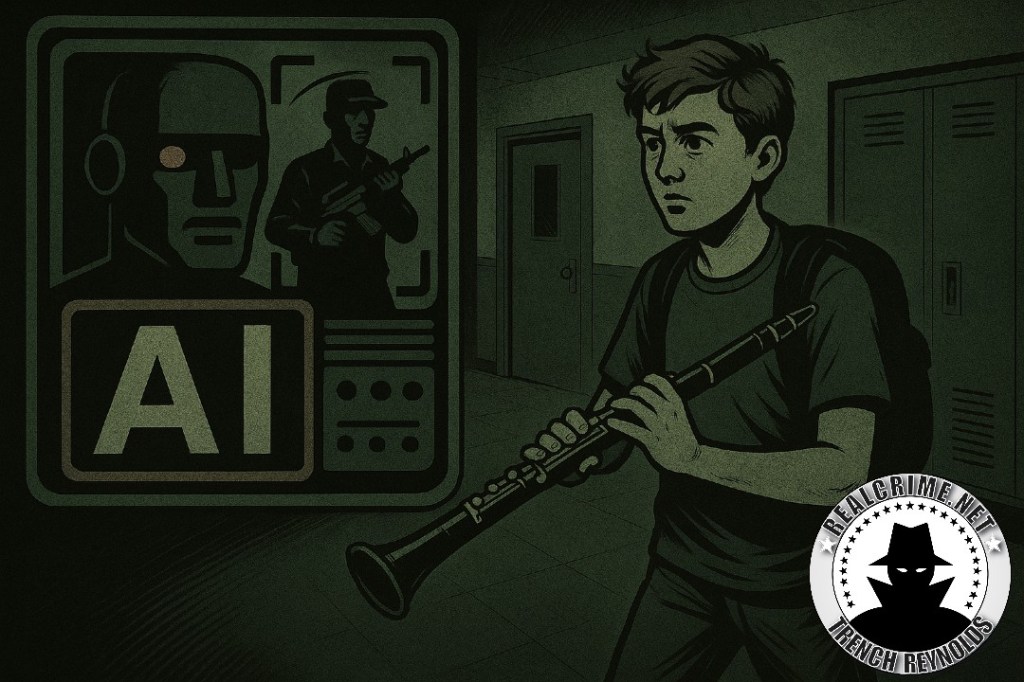
A Florida middle school went into full lockdown mode this week after an AI security system mistook a student’s clarinet for a firearm. The incident at Lawton Chiles Middle School in Oviedo has sparked fresh questions about whether these high-tech surveillance tools actually make schools safer or just create new problems.
Tuesday’s false alarm sent the school into a code red lockdown, with administrators and police racing to respond to what the AI flagged as a gun threat. The weapon? A clarinet case is being carried by a student heading to music class.
Principal Melissa Laudani sent a message home to parents explaining what happened, though her note included an odd request.
“While there was no threat to campus, I’d like to ask you to speak with your student about the dangers of pretending to have a weapon on a school campus,” she wrote. The wording left some parents confused about whether their kids should avoid carrying musical instruments altogether.
ZeroEyes AI Misidentification Sparks Scrutiny Over School Security Spending and Transparency
The school relies on ZeroEyes, a Pennsylvania-based company that has contracts across Florida and 43 states nationwide. Seminole County Public Schools pays $250,000 annually for the subscription service, which uses computer vision algorithms to scan live surveillance footage for potential firearms. The AI has been trained on images of more than 100 different gun types, according to the company.
Here’s how it’s supposed to work: When the system thinks it spots a weapon, it sends the footage to human analysts at ZeroEyes’ monitoring center.
Those analysts are meant to confirm whether it’s actually a threat before alerting law enforcement or school officials. Somehow, in this case, both the AI and the human reviewers apparently decided a clarinet looked dangerous enough to warrant a full emergency response.
What’s particularly concerning is how little information districts have shared about whether these systems actually work. Public records show Seminole County pays a quarter-million dollars for the service, but officials have refused to say if ZeroEyes has ever successfully identified a real threat.
The district’s safety and security division calls it an “effective deterrent” but won’t provide any statistics on confirmed threats, false positives, or legitimate interventions.
Parents are starting to ask hard questions. One frustrated mother told reporters she wants statistical evidence that the system delivers real results. If the AI has successfully identified genuine threats, why aren’t those successes being publicized? And if it hasn’t, why is the district spending so much money on it?
Artificial Intelligence Surveillance, False Alarms, and the ‘Security Theater’ Debate in Schools
Independent technology experts say there’s been surprisingly little objective evaluation of ZeroEyes’ performance. The available coverage has been mixed, with some public safety specialists suggesting these systems might provide more of a security theater than actual protection.
The situation gets murkier when you look at how ZeroEyes has expanded. The company has hired lobbyists in several states, and some lawmakers have passed procurement rules that essentially make ZeroEyes the only approved vendor for this type of technology.
Critics argue these laws stifle competition and prevent communities from having real conversations about whether AI surveillance actually works.
Privacy advocates have their own concerns. Chad Marlow, a senior policy counsel at the American Civil Liberties Union, warned last year that systems generating frequent false alarms could create “false senses of security” while subjecting kids to traumatic lockdowns and increased police presence for no reason.
The core technical problem is that machine learning models trained in controlled settings often struggle with the messy reality. School environments are chaotic places where backpacks, band instruments, sports equipment, and art projects can all potentially look like weapons to an algorithm scanning for threat patterns.
School districts adopted these AI systems amid enormous public pressure to do something about school shootings. The question now is whether “something” is actually better than nothing, or whether it’s creating new anxieties and disruptions without delivering measurable safety improvements.
False Alarms and High Costs: Rethinking AI’s Role in School Safety
For now, Seminole County maintains that the system is an essential precaution worth the investment, even after the clarinet incident exposed its limitations. Whether other districts will start demanding better performance data from vendors or rethinking their reliance on AI surveillance altogether remains to be seen.
One thing seems clear: when a student carrying a musical instrument can trigger a campus-wide emergency, it might be time to take a harder look at the technology we’re trusting to keep schools safe.