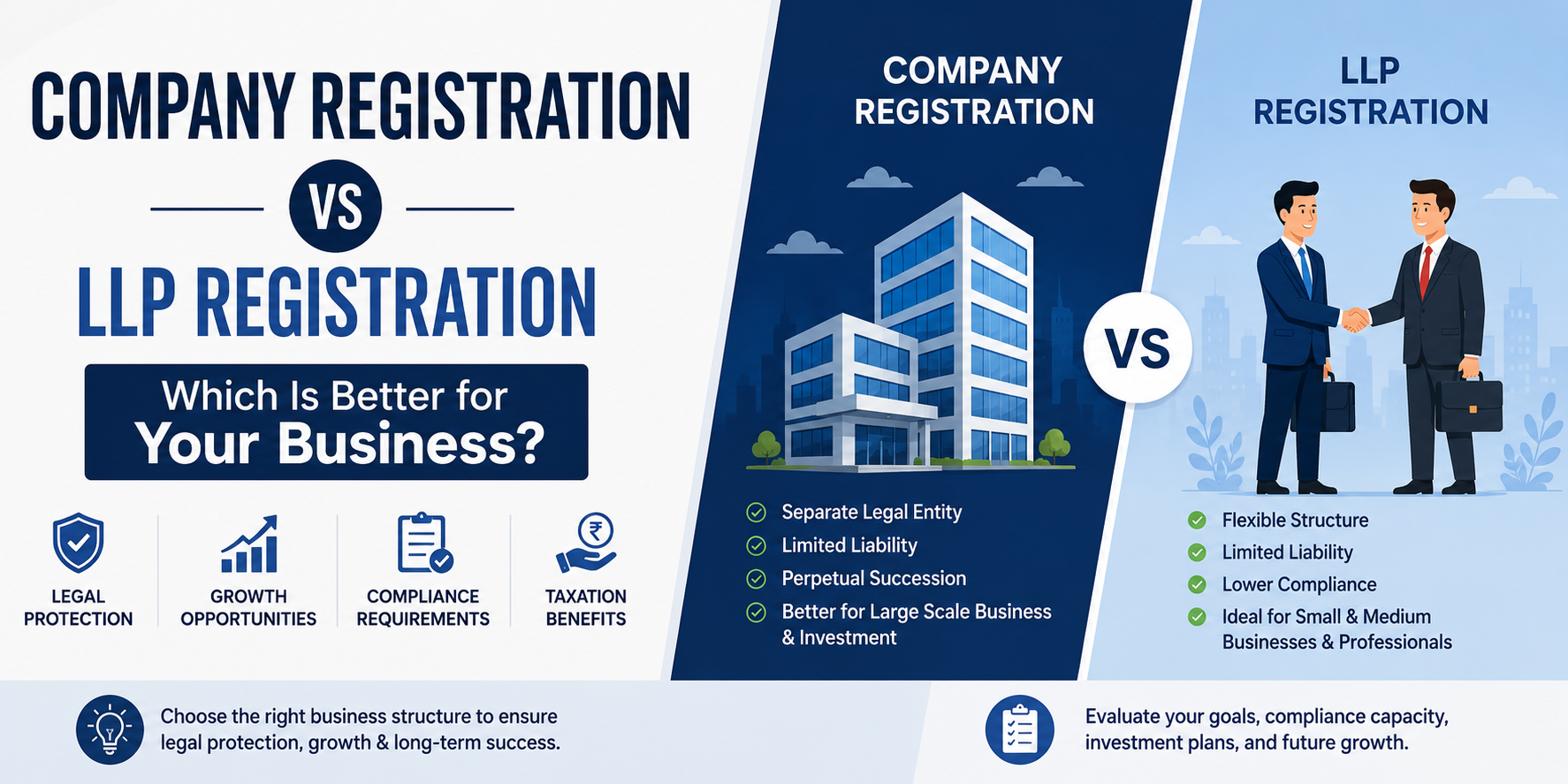
Every entrepreneur at some point of time faces this dilemma whether he should register his company as a Private Limited Company or as an LLP. The choice seems simple – pick up the form, file it at the Ministry of Corporate Affairs (MCA) and obtain the Certificate of Incorporation. But little do people realize that this is where their tax liability, fund-raising capacity, annual paperwork load and even the possibility of selling the company down the line all gets decided.
But here is the catch, the majority of founders are misguided about making the decision not because of lack of information but because of the abundance of information spread through various forums, out-of-date blog posts and misguided recommendations of well-wishers who “have done it once”. This leads companies to register themselves as LLP and then change to private limited company in another 18 months due to the request of an angel investor, doubling the legal fee in the process.
This blog cuts through that confusion. We compare company registration and LLP registration the way a Company Secretary or CA actually would,on liability, compliance cost, taxation, fundraising ability, and exit flexibility,so you register once and register right.
What Is Company Registration (Private Limited Company)?
What is a Private Limited Company? A Private Limited Company is a business entity incorporated under the Companies Act, 2013, registered with the Ministry of Corporate Affairs (MCA), that has a separate legal identity from its owners, limited liability for shareholders, and the ability to issue shares to raise capital.
A Private Limited Company (Pvt Ltd) is the most widely used structure for startups in India, especially those planning to raise venture capital, issue ESOPs, or eventually go public. It requires a minimum of two directors and two shareholders (who can be the same individuals), and there is no minimum capital requirement.
Key features of a Private Limited Company:
- Separate legal entity, distinct from its directors and shareholders
- Limited liability,shareholders are liable only up to their shareholding
- Perpetual succession,the company continues regardless of changes in ownership
- Can issue equity shares, preference shares, and ESOPs
- Mandatory statutory audit regardless of turnover
- Higher compliance burden,board meetings, annual returns, ROC filings
Did You Know? Investors almost never invest directly into an LLP or a proprietorship. If you plan to raise institutional funding at any stage, a Private Limited Company under the Companies Act, 2013 is effectively a prerequisite, since it cannot issue shares.
What Is LLP Registration?
A LLP Registration is a hybrid business structure governed by the Limited Liability Partnership Act, 2008, that combines the operational flexibility of a traditional partnership with the limited liability protection of a company, registered through the FiLLiP form on the MCA21 portal.
An LLP requires a minimum of two designated partners, has no minimum capital requirement, and is built around a governing document called the LLP Agreement, which defines profit sharing, partner rights, and management structure.
Key features of an LLP:
- Partners’ liability is limited to their agreed capital contribution
- No mandatory statutory audit unless turnover exceeds ₹40 lakh or capital contribution exceeds ₹25 lakh
- Lower annual compliance cost compared to a company
- Cannot issue equity shares or ESOPs,unsuitable for equity fundraising
- Governed by the LLP Agreement rather than a Memorandum and Articles of Association
- Fewer mandatory board-level formalities
Company Registration vs LLP Registration: Key Differences
| Feature | Private Limited Company | LLP |
| Governing Law | Companies Act, 2013 | LLP Act, 2008 |
| Legal Identity | Separate legal entity | Separate legal entity |
| Minimum Members | 2 shareholders, 2 directors | 2 designated partners |
| Liability | Limited to shareholding | Limited to capital contribution |
| Can Issue Shares/ESOPs | Yes | No |
| Fundraising (VC/PE) | Well suited | Not suited |
| Statutory Audit | Mandatory, regardless of turnover | Only if turnover > ₹40 lakh or contribution > ₹25 lakh |
| Annual Compliance Cost | ₹15,000 – ₹40,000+ | ₹5,000 – ₹15,000 |
| Registration Cost (all-inclusive) | ₹7,000 – ₹25,000 | ₹5,000 – ₹20,000 |
| Board Meetings | Mandatory, minimum frequency prescribed | Not mandatory |
| Ownership Transfer | Easier,via share transfer | Harder,requires partner consent/agreement change |
| Best Suited For | Startups planning to raise funding, scale, or issue equity | Professionals, service firms, small businesses with low compliance appetite |
Never confuse “cheaper” with “better.” An LLP is cheaper to run, but that cost advantage disappears the moment you need to raise institutional capital,because an LLP simply cannot issue shares to investors.
Documents Required for Company vs LLP Registration
Both structures need broadly similar founder-level documents, with a few structural differences.
Common documents required (both structures):
- PAN and Aadhaar of all directors/partners
- Address proof (bank statement, utility bill,not older than 2 months)
- Passport-size photographs
- Registered office proof (rent agreement/sale deed + utility bill + NOC from the owner)
- Digital Signature Certificate (DSC) for all directors/designated partners
Additional documents for a Private Limited Company:
- Memorandum of Association (MoA)
- Articles of Association (AoA)
- Declaration by first directors and subscribers (INC-9)
Additional documents for an LLP:
- LLP Agreement (stamped as per state stamp duty rules)
- Consent of designated partners
Registration Process: Step-by-Step
How to Register a Private Limited Company
Step 1: Obtain Digital Signature Certificates (DSC) for all proposed directors
Step 2: Apply for Director Identification Number (DIN)
Step 3: Reserve the company name via the SPICe+ Part A form on MCA21
Step 4: File SPICe+ Part B along with MoA, AoA, and required declarations
Step 5: Receive the Certificate of Incorporation along with PAN and TAN
Step 6: Open a current bank account and file INC-20A (commencement of business) before starting operations
How to Register an LLP
Step 1: Obtain DSC for all designated partners
Step 2: Reserve the LLP name using RUN-LLP
Step 3: File the FiLLiP form for incorporation (this bundles name reservation, incorporation, and PAN/TAN allotment)
Step 4: Draft and execute the LLP Agreement
Step 5: File Form 3 with the LLP Agreement within 30 days of incorporation
Step 6: Receive the Certificate of Incorporation
Time taken: Both structures typically take 5–10 working days with clean documentation, though delays in name approval or resubmission can extend this.
Cost Comparison: Company Registration vs LLP Registration Fees
| Cost Component | Private Limited Company | LLP |
| Government/MCA Fees | Nominal for small companies; scales with authorised capital | Slab-based: ₹500 (up to ₹1 lakh contribution) rising with contribution |
| Stamp Duty | ₹200 – ₹12,600, depending on state | ₹200 (Delhi) to ₹500–₹1,000+ (Maharashtra, Tamil Nadu) |
| DSC Charges | Per director | Per designated partner |
| Professional Fees | ₹5,000 – ₹15,000 | ₹3,000 – ₹15,000 |
| Total All-Inclusive Cost | ₹7,000 – ₹25,000 | ₹5,000 – ₹20,000 |
| Annual Compliance Cost | ₹15,000 – ₹40,000+ | ₹5,000 – ₹15,000 |
The first year of a Private Limited Company’s compliance,auditor appointment, INC-20A filing, DIR-3 KYC, statutory audit, and annual return,typically runs an additional ₹15,000–₹50,000. Many founders budget only for registration and are caught off guard by this recurring cost.
Compliance Requirements After Registration
Compliance Checklist,Private Limited Company:
- Appointment of statutory auditor (Form ADT-1) within 30 days
- Filing of commencement of business (INC-20A)
- Minimum number of board meetings per year
- Annual filing of financial statements (AOC-4) and annual return (MGT-7/MGT-7A)
- DIR-3 KYC for all directors
- Mandatory statutory audit,regardless of turnover
- cIncome Tax Return filing
Compliance Checklist,LLP:
- Filing of Form 11 (Annual Return) by 30th May every year
- Filing of Form 8 (Statement of Accounts & Solvency) by 30th October
- Income Tax Return (ITR-5) filing
- Statutory audit only if turnover exceeds ₹40 lakh or capital contribution exceeds ₹25 lakh
Penalties: Late filing of the LLP Agreement (Form 3) attracts a late fee of ₹100 per day. For companies, non-filing of the commencement declaration (INC-20A) can attract a penalty of ₹50,000 on the company and ₹1,000 per day on the officer in default.
Taxation: Company vs LLP
| Aspect | Private Limited Company | LLP |
| Tax Rate | 22% (plus surcharge/cess) under concessional regime for eligible companies | 30% flat, plus surcharge/cess |
| Dividend Distribution | Taxed in shareholders’ hands | Not applicable,profit share is tax-free in partners’ hands |
| Minimum Alternate Tax (MAT) | Applicable | Alternate Minimum Tax (AMT) applies instead |
| Presumptive Taxation | Not available | Not available for LLPs either |
Neither structure enjoys the pass-through taxation available to a proprietorship, but LLPs benefit from tax-free profit repatriation to partners since there is no dividend distribution tax equivalent.
Which One Should You Choose?
Choose a Private Limited Company if:
- You plan to raise funding from VCs, angel investors, or PE firms
- You want to offer ESOPs to attract talent
- You’re building a high-growth, scalable startup
- You eventually plan to go public or get acquired
Choose an LLP if:
- You’re a professional services firm,CAs, lawyers, consultants, architects
- You want lower compliance costs and simpler annual filings
- You don’t need external equity funding
- You want operational flexibility without heavy board-level formalities
Case Study: A three-partner digital marketing agency in Chennai initially registered as an LLP to keep compliance light. Two years later, when a strategic investor wanted equity in exchange for growth capital, the founders had to convert the LLP into a Private Limited Company,a process that took nearly two months and cost more in professional and stamp duty fees than a fresh company registration would have. Getting the structure right at the outset would have saved both time and money.
Common Mistakes to Avoid
- Registering an LLP purely to save cost, without considering future funding plans
- Ignoring the LLP Agreement stamp duty requirement, leading to late fees
- Assuming LLPs are audit-exempt in all cases,the ₹40 lakh/₹25 lakh thresholds still apply
- Missing the INC-20A commencement filing deadline for a newly incorporated company
- Choosing a structure based on a friend’s business model instead of your own funding and growth trajectory
- Not accounting for the higher annual compliance cost of a Pvt Ltd company while budgeting
Quote: The LLP structure was designed to give small businesses the shield of limited liability without the compliance weight of a full company,but that same simplicity becomes a limitation the moment you need external equity capital.
Latest News: Regulatory Updates You Should Know (2025–2026)
- The MCA has more than doubled the “small company” thresholds,paid-up capital up to ₹10 crore and turnover up to ₹100 crore now qualify,through the Companies (Specification of Definition Details) Amendment Rules, 2025 (G.S.R. 880(E), effective December 1, 2025), unlocking exemptions like no mandatory auditor rotation and reduced penalties under Section 446B.
- Draft Companies (Incorporation) Amendment Rules, 2026 propose consolidating multiple MCA forms into two new forms (E-CHNG and E-CON) and simplifying KYC and consent documentation,expected to further ease incorporation for both companies and LLPs once notified.
- A proposed Corporate Amendment Bill may revise both the Companies Act and the LLP Act together, with a stated focus on rationalising forms and decriminalising minor procedural defaults.
Because these rules are evolving, always verify current thresholds and forms on the MCA portal before filing, or consult a professional to avoid relying on outdated compliance requirements.
Why Choose Zolvit
- Expert lawyers and CAs with deep experience in Company and LLP registration
- Company Secretary support for ongoing ROC and MCA compliance
- Fast processing with minimal back-and-forth
- Affordable, transparent pricing,no hidden charges
- End-to-end compliance,from incorporation to annual filings
- Dedicated support throughout your business lifecycle
Ready to register your business the right way?
Get expert consultation, fast filing, and complete compliance support with Zolvit, talk to our experts today.
Key Takeaways
- A Private Limited Company suits startups planning to raise funding, issue ESOPs, or scale aggressively.
- An LLP suits professionals and small businesses that want limited liability with lower compliance costs.
- LLPs are cheaper to register and maintain, but cannot issue shares to investors.
- Statutory audit is mandatory for companies but conditional for LLPs (turnover > ₹40 lakh or contribution > ₹25 lakh).
- Recent MCA reforms have expanded “small company” thresholds, reducing compliance for many private companies.
- Converting from LLP to Company later is possible but costlier and slower than registering correctly the first time.
Conclusion
Choosing between Company Registration and LLP Registration isn’t about which structure is “better” in the abstract,it’s about which one matches where your business is headed. A Private Limited Company gives you the ability to raise equity, issue ESOPs, and scale with institutional backing, at the cost of heavier, mandatory compliance. An LLP gives you limited liability with a lighter compliance load, but closes the door on equity fundraising.
Getting this decision wrong is expensive to fix later,conversions involve legal fees, fresh stamp duty, and lost time. Whichever path fits your business, make sure your documentation, compliance calendar, and tax planning are handled by professionals who understand both structures inside out.