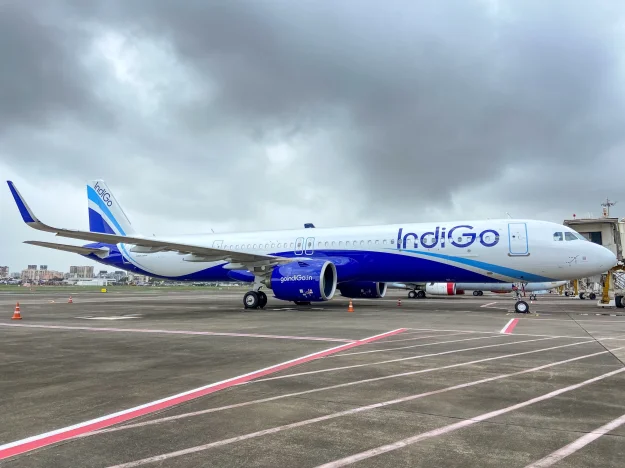
The past few weeks have brought severe pressure on India’s largest airline, IndiGo, as a series of flight disruptions, cancellations, and operational troubles unsettled both passengers and the aviation sector. What began as scattered delays soon developed into a nationwide crisis, drawing the attention of regulators, raising questions about the airline’s preparedness, and placing the company under financial strain.
In the middle of this turmoil, Crisil Ratings has placed InterGlobe Aviation, the parent of IndiGo, on “Rating Watch with Developing Implications”. This move comes after nearly a week of disturbances that forced the airline to cancel thousands of flights and refund large sums, leading to a rising concern about its near-term credit profile. The situation has become a major test for IndiGo, which holds a dominant share of the domestic aviation market and has long been seen as one of India’s most stable carriers.
The crisis unfolded over six days, during which IndiGo struggled to restore normal operations. By Wednesday, nearly 220 more flights had been cancelled, according to PTI, despite the company’s statement that operations were beginning to stabilise. In its regulatory filing on December 9, IndiGo said it had reinstated operations across its network and that all flights listed on its website were scheduled to operate under an adjusted plan.
The airline acknowledged that recovery had taken time but claimed that steady progress was underway. Crisil’s move to revise the outlook reflects the uncertainty surrounding this recovery period, as the rating agency waits for clearer information on the scale and duration of the disruption.
Crisil stated that the Rating Watch would be reviewed once there is better clarity on how long the problems will last and how they may affect IndiGo’s financial health. The agency said it would keep a close watch on developments and assess their influence on the carrier’s credit risk profile before taking further action. The concerns flagged by Crisil range from multi-layered operational issues to margin pressures and exposure to fuel and forex swings, all of which could weigh on the airline’s financial position if the disruptions continue.
One of the core issues identified by Crisil is the complex nature of the disruption itself. The problems did not arise from a single cause. Instead, the airline was hit by operational troubles, external factors, and regulatory intervention at the same time. The government launched an inquiry to determine the root cause, and the Directorate General of Civil Aviation (DGCA) ordered a 10% cut in IndiGo’s domestic winter schedule. This reduction, though temporary, places added strain on the airline’s ability to recover lost revenue during a season when demand for travel is usually high. With flight schedules already interrupted, the enforced reduction has created further uncertainty for passengers and pressure on the airline’s flight planning and crew deployment.
Crisil’s second area of concern relates to IndiGo’s margins. The airline has faced weak yields and cost pressures for some time, but the recent disruptions have amplified these challenges. The agency warned that if the airline’s operating profitability remains under stress for a long period, the rating could move downward. A drop in passenger load factors, rising operational expenses, or a further decline in yields may erode margins. This trend would signal underlying stress in the carrier’s financial performance at a time when the airline needs stability to manage the fallout from the ongoing crisis.
Fuel costs and foreign exchange swings add another layer of risk. Crisil pointed out that aviation turbine fuel remains one of the biggest components of an airline’s cost structure, accounting for nearly 35–40% of operating expenses. Volatility in crude oil markets feeds directly into ATF prices, which can lift expenses sharply in a short span. IndiGo has experienced margin pressure in earlier quarters due to elevated fuel prices, and further swings could squeeze its already thin buffers. Forex exposure presents a similar challenge. Around 30–35% of IndiGo’s operating costs, including lease payments and maintenance charges, are linked to the US dollar.
With the rupee weakening in recent months, the airline faces rising forex losses. In Q2 FY26, IndiGo’s net USD exposure stood at roughly $9 billion. Every rupee depreciation results in a foreign exchange loss of nearly Rs 900 crore, a figure acknowledged by the airline’s Chief Financial Officer, Gaurav Negi. This single factor alone can have a major influence on quarterly results, as seen in the previous quarter when the rupee’s fall added to the airline’s losses.
IndiGo has attempted to manage this exposure through natural hedges created by revenue from international routes, supplier-linked dollar inflows, and partial hedging with derivatives. The airline also holds forex-denominated deposits, which offer some protection against currency swings. During the last quarter, IndiGo recorded Rs 2 billion in hedge gains, though these gains are often offset by broader movements in currency markets.
Crisil has also pointed out that IndiGo’s liquidity position remains an important factor in the rating review. A key metric is the airline’s net debt to EBITDAR ratio, which could rise above 3 if lease liabilities climb sharply. This would raise concerns about IndiGo’s capacity to absorb further shocks. In Q2 FY26, the airline’s EBITDAR margin fell to 17.5%, down from 22.6% a year earlier, due to geopolitical challenges and forex losses. A drop of this scale places pressure on short-term cash flows and reduces room to handle unplanned expenses.
Despite all these concerns, the agency also acknowledged that IndiGo retains several strengths that support its rating. The airline controls nearly 64% of the domestic market as of the first half of fiscal 2026, giving it a strong competitive position. Large fleet orders and planned aircraft deliveries are expected to support its long-term growth. As of September 2025, IndiGo had a fleet of 417 aircraft, and its order book of more than 900 planes is one of the largest in the world. The airline has also maintained strong performance in areas such as passenger load factor, on-time operations, and cancellation rates over the years, which adds to its operational reputation.
IndiGo also has a solid liquidity buffer, with cash and equivalents of Rs 38,517 crore as of September 30. It also held an undrawn working capital limit of Rs 2,680 crore as of March 31. These reserves give IndiGo the ability to manage some of the pressures arising from the current crisis and help absorb short-term shocks.
However, the financial strain from the ongoing disruptions is already becoming clear. The airline has cancelled nearly 4,500 flights in the first week of December alone. Refunds for passengers up to December 9 have crossed Rs 900 crore. When estimated compensation is added under the Ministry of Civil Aviation’s passenger charter, IndiGo’s liability crosses Rs 1,800 crore. The actual figure may be lower as compensation varies by flight duration, but the blow to quarterly earnings will be heavy. The aviation ministry is also considering a penalty that may go as high as Rs 1,000 crore due to the scale of disruption.
Adding to the challenges, IndiGo had already posted a large net loss of around Rs 2,582 crore in Q2 FY26, fuelled by forex losses and high maintenance costs. The recent rupee fall from 88.85 on September 30 to 89.96 on December 10 has added further pressure. The DGCA’s mandate to cut 10% of domestic flights for the winter schedule may also reduce revenue for the rest of the season.
IndiGo has now lowered its Q3 guidance. It expects slower capacity growth, pressure on revenue per seat, and added costs from supporting affected passengers. CEO Vikram Singh Mehta said the company will bring in external technical experts to identify the root causes of the disruptions. He made it clear that the airline operated under the updated crew rostering rules and did not attempt to bypass them. He cited a mix of internal issues, winter schedule changes, weather conditions, and congestion as contributing factors.