Technology firms are investing massive amounts of money in artificial intelligence, but some economists are now questioning the impact of such investments on the US economy. Some of the biggest firms last year, including Meta, Amazon, Google, and OpenAI, invested billions of dollars in developing and expanding their AI systems. The total industry spend is expected to touch $700 billion this year, with most of the money being spent on building data centers that will be used to train and develop highly advanced AI models.
The amount of investment has generated a lot of buzz on Wall Street. Many people believed that this level of investment was leading to robust economic growth in the US. This trend also received political backing.
Former US President Donald Trump cited the level of AI investment as evidence of the strength of the US economy.
The AI Growth Paradox: Why Investment Doesn’t Always Equal GDP
In a post on Truth Social, he said that massive investment in AI had made the US economy one of the strongest in the world. He also expressed the fear that state regulations could hold back progress and urged a federal standard rather than state standards.
Some economists also supported the story of growth earlier in the year. Jason Furman, a professor at Harvard University, wrote on X that “investments in information processing equipment and software drove most of the U.S. GDP growth in the first half of the year.” Economists at the Federal Reserve Bank of St. Louis also came to a similar conclusion.
They estimated that AI investment made up a large part of economic growth in the third quarter of 2025.
However, some analysts now claim that this story may have exaggerated the effect.
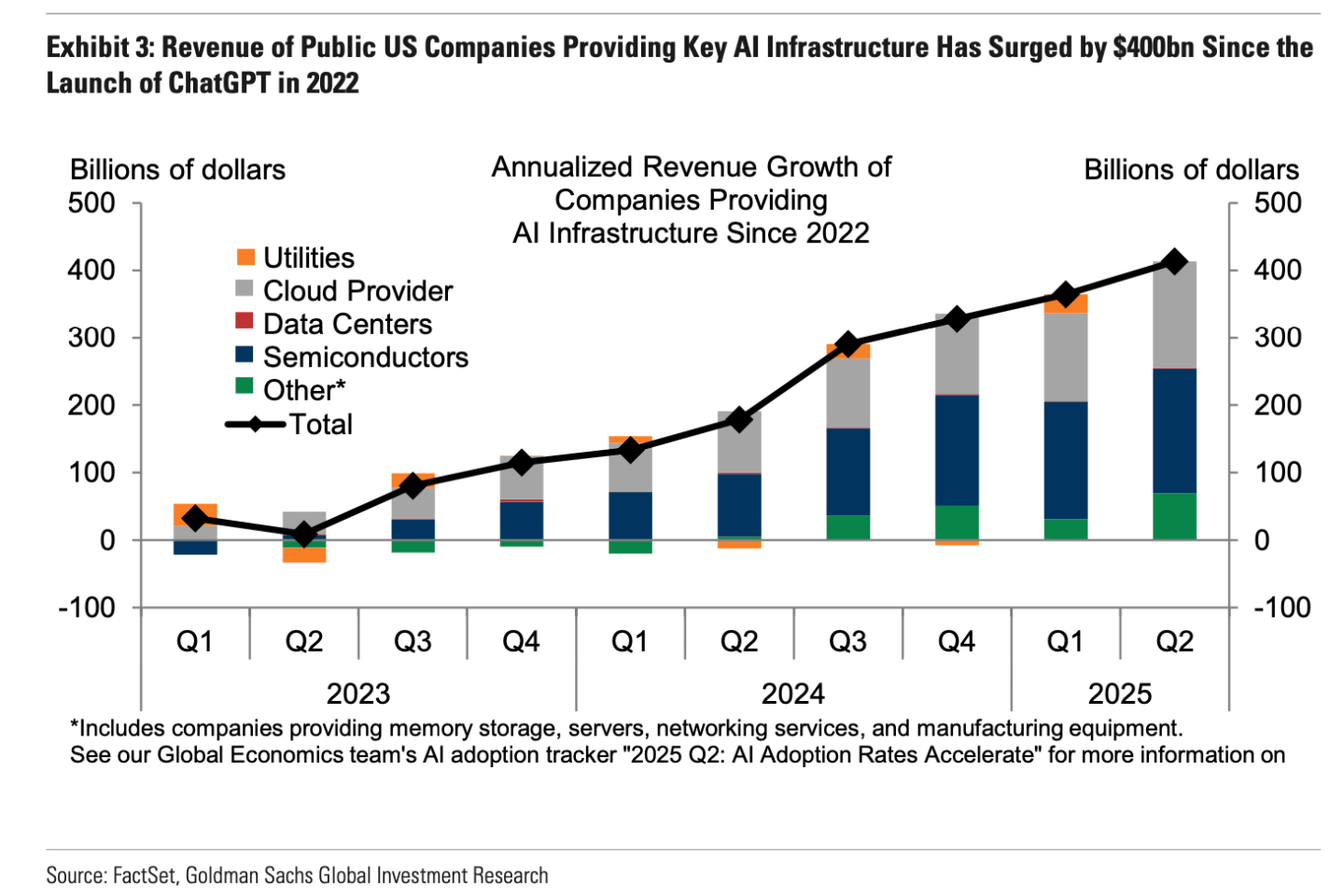
Researchers at Goldman Sachs started to investigate the data further. Economist Joseph Briggs said that the initial explanation seemed to make sense, so they did not investigate it much at first. But after they looked at the data more closely, the situation was different.
Goldman Sachs chief economist Jan Hatzius said that AI investment made a “basically zero” contribution to U.S. GDP growth in 2025. Hatzius made the statement in an interview hosted by the Atlantic Council.
One major reason has to do with how GDP is calculated. GDP is a measure of domestic production, not spending. A lot of the hardware that goes into AI systems is imported from abroad. American companies purchase highly advanced chips and equipment from companies in other countries, such as Taiwan and South Korea. These purchases are recorded as imports, which lowers the impact on the U.S. GDP.
AI’s Lagging Impact on Global GDP
In other words, American companies spend billions of dollars, but a lot of that money goes into other countries’ economies rather than the U.S. economy.
Another problem is that there is no good way to measure the impact of AI on productivity. Economists have not yet developed a way to measure the impact of AI on productivity. Companies may use AI software, but it takes time for new technology to make a difference in company profits and worker productivity.
The early results are not encouraging. A recent survey of almost 6,000 executives in the United States, Europe, and Australia found that 70 percent of companies already use AI software. However, 80 per cent of those companies reported no change in employment levels or worker productivity.
This discrepancy between investment and outcome does not indicate that AI has no long-term value. Many previous technologies, such as electricity and the internet, took years before they could change the face of economic production. Investment was high before the positive effects could be seen in global statistics.
However, this new data casts doubt on the idea that AI investment is the only reason for the recent economic growth. The current economic boom may be the result of future expectations rather than current improvements.
The message is clear for policymakers and investors: high numbers of investments do not necessarily translate into immediate economic effects. AI may change the face of industries in the future, but for now, its influence on GDP is less than many thought.