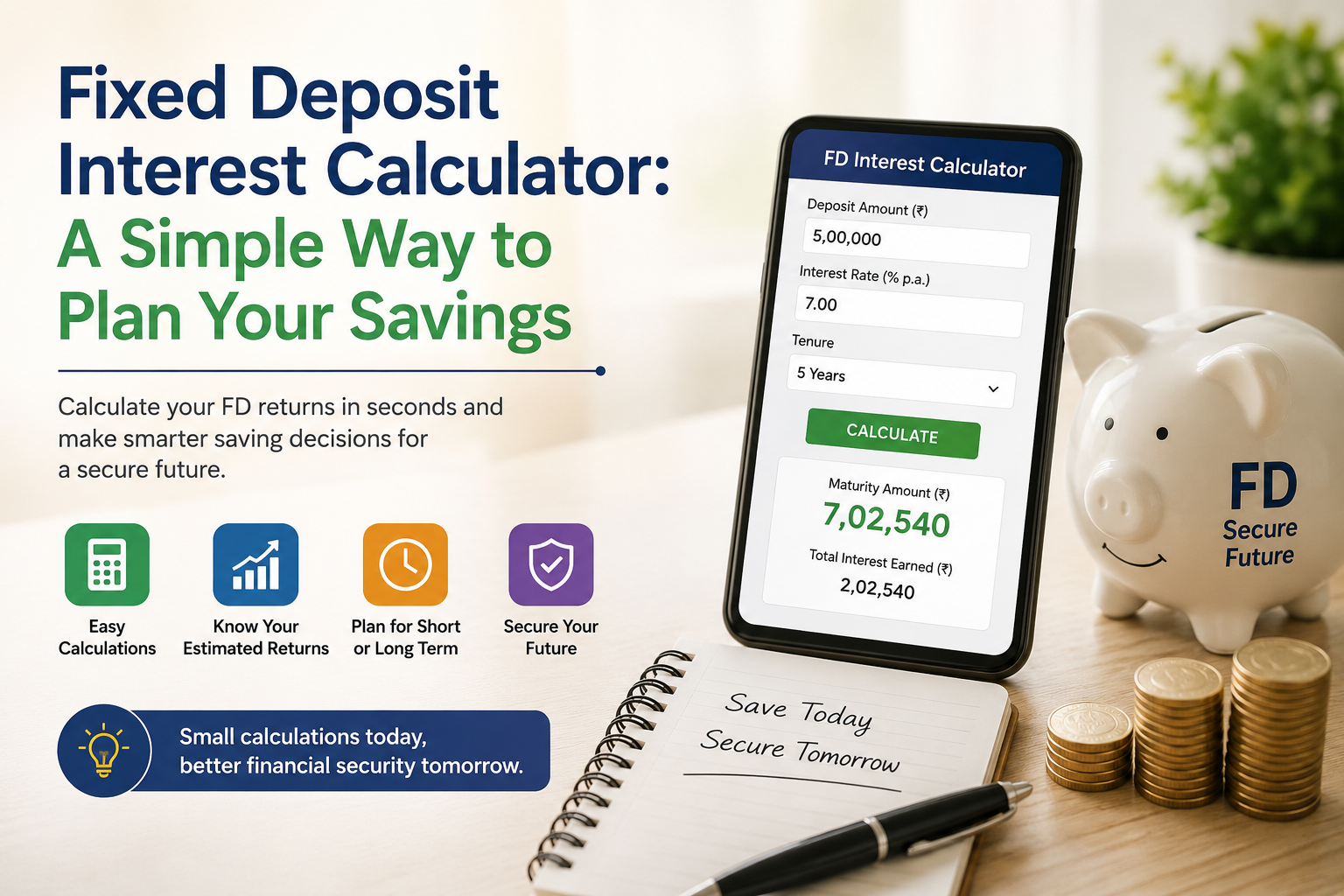
Saving money becomes easier when you have a clear picture of what your deposit may grow into over time. Fixed Deposits (FD) are commonly used by individuals who prefer predictable returns and want to keep a portion of their savings away from market fluctuations. However, comparing different deposit amounts, interest rates, and tenures manually can become complicated.
A fixed deposit interest calculator simplifies this process by estimating the maturity amount and interest earnings before you invest. Instead of working through formulas yourself, you can adjust a few basic details and quickly understand how different choices may affect your savings.
Let us explore how this tool works and how it can support better financial planning.
What is a Fixed Deposit Interest Calculator?
A fixed deposit interest calculator is an online financial tool that estimates how much your fixed deposit could be worth when it reaches maturity. It usually calculates the result using the amount you plan to deposit, the applicable interest rate, and the chosen investment period.
Depending on the calculator and deposit type, the calculation may also consider how frequently interest is compounded. Once the required details are entered, the tool generally displays the expected interest earned along with the total maturity value.
This makes it easier to compare different savings possibilities without performing repeated calculations manually.
How Does a Fixed Deposit Interest Calculator Work?
Using a fixed deposit interest calculator generally requires only a few inputs. Although the exact layout may vary between financial institutions, most calculators ask for the following information:
-
Investment Amount
Start by entering the principal amount you intend to place in the fixed deposit. This could be ₹25,000, ₹1 lakh, ₹5 lakh, or another amount based on your available savings.
The deposit amount directly influences your overall interest earnings. A larger principal generally produces higher absolute returns when the interest rate and tenure remain unchanged.
-
Interest Rate
Next, enter the applicable annual interest rate. Rates may differ depending on the financial institution, tenure, deposit category, and customer profile.
Rather than choosing a deposit based solely on the best FD rates, consider factors such as tenure suitability, premature withdrawal conditions, and how the deposit fits into your broader savings strategy.
-
Investment Tenure
Enter the length of time for which you plan to keep your money invested. Fixed deposit tenures can range from relatively short periods to several years.
Even a small difference in tenure can influence the maturity amount, particularly when interest is compounded periodically.
After these details are entered, the calculator provides an estimated maturity value and total interest amount.
Why Use a Fixed Deposit Interest Calculator Before Investing?
The main advantage of a fixed deposit interest calculator is that it turns abstract interest rates into practical numbers you can use while planning your finances.
Here are some ways it can help:
- Compare Different Deposit Amounts
You may have savings available but remain uncertain about how much to place in a fixed deposit. A calculator lets you test different amounts and see how the maturity value changes.
For example, you could compare the estimated returns from depositing ₹1 lakh against ₹1.5 lakh without performing separate calculations manually.
- Evaluate Different Tenures
Choosing the right tenure can be just as important as choosing the deposit amount. A shorter tenure may provide greater flexibility, while a longer tenure could suit goals that are several years away.
A fixed deposit interest calculator allows you to compare these alternatives before committing your funds.
- Estimate Maturity Value in Advance
Knowing approximately how much money you may receive at maturity can make goal-based saving easier. You can determine if the projected amount is likely to support a planned expense or if you need to increase your savings.
- Understand the Impact of Interest Rates
Interest rates may appear similar at first glance, but even modest differences can affect earnings over longer periods or larger deposits.
By changing the interest rate in the calculator, you can see how different rates influence your estimated returns.
- Reduce Calculation Errors
Manual compound-interest calculations can involve multiple steps, especially when compounding frequency needs to be considered. Using a calculator reduces the chances of basic mathematical errors and saves time.
Factors to Consider Beyond the Estimated Returns
A calculator provides useful projections, but the maturity amount should not be the only factor guiding your decision. Before opening a fixed deposit, consider the following aspects:
- Liquidity Needs: Check if you may require access to the money before maturity.
- Premature Withdrawal Terms: Understand possible penalties or reduced interest if the deposit is closed early.
- Interest Payout Option: Determine if interest will be paid periodically or accumulated until maturity.
- Tax Implications: Interest earned on fixed deposits may be taxable based on applicable tax regulations.
- Investment Tenure: Match the deposit period with the timeline of your financial goal.
Plan Your Savings With Greater Clarity
Fixed deposits can provide predictable growth, but effective saving begins with understanding the numbers before committing your money. A fixed deposit interest calculator helps you estimate returns, compare different tenures, and determine how changes in your deposit amount may influence the maturity value.
Use these projections as a starting point rather than looking at interest rates in isolation. Consider your financial goals, liquidity requirements, investment period, and applicable deposit conditions together. Lenders like ICICI HFC offer fixed deposit options and an FD calculator that can support structured savings goals across different tenures.
With careful planning, a fixed deposit interest calculator can help you make more informed decisions and align your savings with future financial needs.