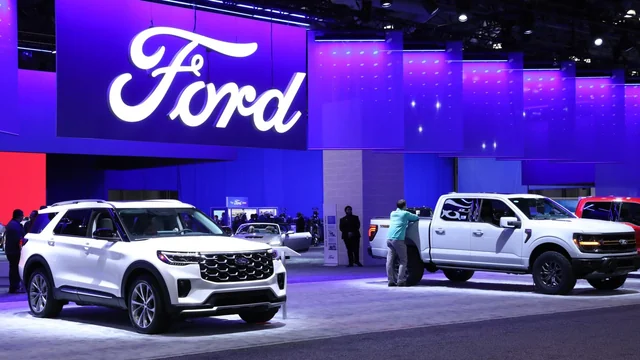
Ford just posted a $36 million net loss for the second quarter of 2025, despite pulling in record revenue of over $50 billion. Why the red ink? A mix of rising import tariffs, costly vehicle recalls, and the decision to pull the plug on a three-row electric SUV that was shaping up to be a money drain.
Let’s break it down.
Tariffs Bite Harder Than Expected
Back in May, Ford expected tariffs to cost $1.5 billion this year. Now, that number’s jumped to $2 billion.
That hit alone has forced the company to revise its profit expectations. Ford is now projecting full-year adjusted operating profit to land somewhere between $6.5 billion and $7.5 billion. That’s not just lower than what it expected earlier this year it’s also a big drop from last year’s $10.2 billion.
“We’re having productive talks with the administration,” said CFO Sherry House. “They’ve acknowledged Ford as the most American automaker. We’re hopeful they’ll help level the playing field.”
Still, with new import taxes kicking in this Friday some as high as 50% and fresh threats from former President Trump about raising tariffs on Canada and Mexico, things could get tougher before they improve.
Recalls and Cancelled EVs Add to the Pain
Ford’s Q2 wasn’t just about tariffs. The company is also dealing with fallout from a 700,000-vehicle recall tied to fire risks in Bronco Sport and Escape SUVs. Fixing that problem alone will cost Ford $570 million. That’s just one of several “special charges” that added up to $1.9 billion this quarter.
And then there’s the cancelled EV project. Ford decided to scrap a new three-row electric SUV that wasn’t likely to make money anytime soon. That cut adds another big write-down.
Sales Are Up, But Margins Are Down
Ford’s not struggling to sell cars in fact, U.S. sales were up 14% in Q2, thanks in part to generous incentives like zero down payment, zero interest for 48 months, and 90 days of no payments. That got people into showrooms but also squeezed profit margins, which dropped to 4.3% from 5.8% last year.
On the upside, the company’s adjusted earnings of 37 cents per share beat analyst estimates. So the quarter wasn’t all doom and gloom.
Electric Vehicle Division Still in the Red
Ford’s EV unit, Model e, lost $1.33 billion this quarter more than it did this time last year. But revenue from electric vehicles doubled to $2.4 billion, and Ford says they’re starting to see flat or improving profit margins on the Mustang Mach-E and F-150 Lightning.
Translation: the EV push is still expensive, but it’s showing signs of becoming more sustainable.
Liquidity Is Strong, But Ford’s Playing It Safe
Ford has $28.4 billion in cash and $46.6 billion in liquidity. That’s solid. Still, it’s preparing for uncertainty. Just this week, the company secured a new $3 billion credit line “in case things get rocky,” as House put it.
“We don’t see a recession,” she said, “but growth is definitely slower. We want to be ready.”
Ford is holding onto its forecast for $3.5 to $4.5 billion in free cash flow this year and will pay out a 15-cent dividend on Sept. 2.
Looking Ahead: EVs, Cost Cuts, and More Talks in D.C.
Ford’s also not losing sight of the long game. It plans to invest $9 billion this year in future tech, including EV manufacturing in Kentucky, where it will host a showcase on August 11.
The company is aiming to shave $1 billion in costs (excluding tariffs) and says warranty expenses are already improving. But challenges remain: the traditional gas-engine Ford Blue unit saw profit fall 43%, and the commercial Ford Pro division also took a hit.
Bottom line: Ford’s navigating a rough patch. Tariffs are biting, quality issues are costing, and EVs are still a work in progress. But it’s also playing the long game with strong cash reserves, evolving product lines, and an eye on Washington to help ease the pressure.