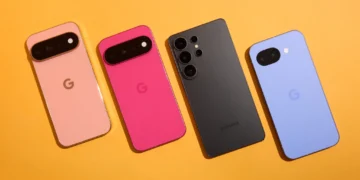
Google has officially unveiled a groundbreaking feature for its latest flagship lineup, the Pixel 10 series. While satellite connectivity has slowly made its way into smartphones in recent years, Google has now taken it a step further. Beginning August 28, when the Pixel 10, Pixel 10 Pro, and Pixel 10 Pro XL arrive in stores, users will be able to make voice and video calls on WhatsApp via satellite networks, a global first for mobile communications.
Until now, satellite connectivity on smartphones has been largely limited to emergency text messages. Apple’s iPhones, for example, introduced Emergency SOS over satellite, while Google previously allowed satellite-based texting only through Google Messages.
But Google’s latest move represents a leap forward: enabling real-time communication, both audio and video on one of the world’s most popular messaging platforms. For comparison, T-Mobile’s T-Satellite service, one of the most talked-about U.S. carrier offerings in this space, still only supports SMS and MMS functionality.
The Pixel 10 therefore sets a new industry benchmark, turning what was once an emergency-only feature into a tool for everyday global communication.
Why WhatsApp?
The decision to partner with WhatsApp makes strategic sense. With over 2.7 billion users worldwide, the app has become the de facto communication tool in many regions. While WhatsApp dominates markets in Europe, Latin America, Africa, and Asia, its presence in the United States has traditionally lagged behind iMessage and SMS.
By offering WhatsApp calls over satellite, Google not only strengthens the Pixel’s value proposition but also gives WhatsApp a powerful push into the U.S. market. Users in remote areas without cellular coverage will still be able to call friends and family, making WhatsApp indispensable in scenarios where other services fail.
One of the key unanswered questions is whether this functionality will come to older Pixel devices. Technically, the feature simply involves unlocking data access via satellite, which means that Google could extend it to previous models such as the Pixel 9 or Pixel Fold.
For now, however, it appears Google is using the feature to differentiate its new flagship lineup. In a highly competitive smartphone market, satellite-enabled WhatsApp calling could serve as a decisive selling point for the Pixel 10 series.
Texting Remains Tied to Google Messages
Interestingly, Google has clarified that text messaging over satellite will remain exclusive to Google Messages. This suggests a strategy of keeping the messaging ecosystem under its control while opening up calls and video to third-party apps like WhatsApp.
This division may frustrate some users who would prefer to use WhatsApp for all satellite-based communications. However, it also ensures that Google maintains a unique advantage for its own messaging platform while still boosting the Pixel’s appeal with WhatsApp calling.
As with most cutting-edge technologies, there are caveats. In its announcement, Google noted that the feature will be available only through participating carriers, and that additional charges may apply.
Currently, Google has not named the carriers that will support the service. Given the technical and financial challenges of satellite integration, it’s likely that only major carriers such as Verizon, AT&T, and T-Mobile will be early adopters. Pricing will also play a key role: if costs are high, adoption could be limited to niche users such as hikers, sailors, and travelers who frequently venture beyond coverage zones.
Despite these limitations, the move underscores the tech industry’s ambition to eliminate dead zones once and for all. For years, satellite phones were bulky, expensive, and limited to specialized markets like military, maritime, and emergency response. The Pixel 10’s integration of WhatsApp calls over satellite shows how this technology is now becoming mainstream.
More importantly, it signals a future where global connectivity is seamless. Whether deep in the mountains, offshore at sea, or in disaster zones where traditional networks fail, users will have a reliable way to communicate.
The Pixel 10 announcement could spark a wave of competition. Apple, which currently limits its satellite services to emergency texting, may face pressure to expand into voice and data services. Similarly, Samsung and other Android manufacturers will likely accelerate their own satellite partnerships to avoid falling behind.
For carriers, the shift represents both a challenge and an opportunity. While some fear losing control to apps like WhatsApp, satellite connectivity also allows operators to offer premium services and potentially reduce churn among customers who live or travel in areas with weak coverage.
While the Pixel 10’s WhatsApp satellite calling feature will not launch until August 28, the announcement has already set off excitement in both the tech and telecom industries. If successful, the move could usher in a new era of smartphone communication, where satellite networks are not an emergency backup but an integral part of daily connectivity.
Whether Google eventually expands the feature to older devices or keeps it exclusive to the Pixel 10 series, one thing is clear: this is no longer just about texting in emergencies. It’s about bridging digital divides and ensuring that no matter where users are on the planet, communication remains possible.
The Google Pixel 10 series is shaping up to be a landmark device in mobile history. By enabling WhatsApp voice and video calls over satellite, it goes beyond incremental upgrades and redefines what users can expect from their smartphones.
While questions remain about carrier participation, pricing, and future expansion, Google has once again positioned its Pixel lineup as an innovator rather than a follower. For consumers, this could mean the difference between silence and connection in life’s most critical moments.