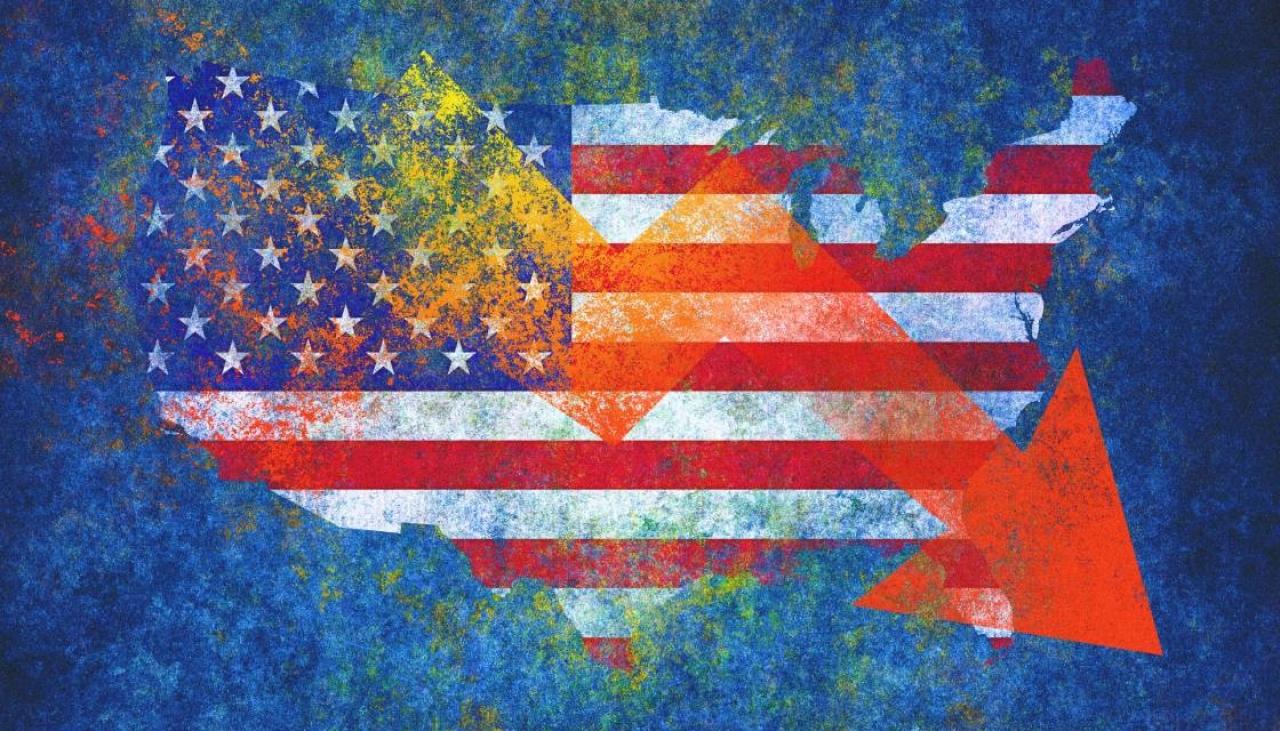
The American economy, which has remained resilient through inflation, interest rate hikes, and geopolitical uncertainty, may be heading towards a new phase of slowdown. Warnings from Jamie Dimon, the CEO of JPMorgan Chase, and data from Moody’s Analytics suggest that parts of the United States are already feeling the weight of economic contraction. While official numbers still point to moderate national growth, the lived experience of millions of Americans tells a different story. The question now being raised by economists and global markets alike is whether the United States is heading toward a recession, and how that will affect economies around the world.
Recent analysis by Moody’s chief economist Mark Zandi shows that 22 states across the United States are already in recession or on the edge of one. According to him, half the country is “hanging on by their fingertips.” Despite national GDP growing by 3.8% last quarter and unemployment staying near 4.3%, the economic picture across regions is uneven. Many working-class families are struggling to manage rising costs, heavy debts, and stagnant wage growth. While coastal states like California, New York, and Texas continue to buoy national figures, much of the Midwest and South are in economic decline.
Zandi explains that this divide is widening between wealthy households, who have investments in stocks and property, and lower-income families, who are burdened by loans and higher living costs. He said that many Americans “have jobs but are still struggling,” pointing out that their situation is fragile. The lack of savings and the presence of debt, especially auto loans, student loans, and mortgages, make many households vulnerable to even a small economic shock.
Moody’s findings reveal that most of the contraction is concentrated in areas dependent on agriculture, manufacturing, and federal employment. States like Georgia, Illinois, Iowa, and South Dakota are seeing reduced activity due to trade restrictions and tariffs, while Virginia and Maryland are affected by government job cuts and reduced spending. The District of Columbia is among the worst hit, owing to large-scale federal layoffs and a prolonged government shutdown. In many of these regions, local economies are experiencing what Zandi calls “a silent recession.”
Meanwhile, large states like California and New York are described as “treading water.” Their economies are not shrinking but are showing little momentum. Zandi warns that if these two states start to weaken, it could drag the national economy into a recession. California’s technology sector and New York’s financial industry have become key indicators for the overall health of the country. If these sectors falter, the impact will be felt across America.
Adding to these concerns, Jamie Dimon of JPMorgan Chase has repeatedly cautioned about the growing risks to the U.S. economy. In his 2025 annual letter to shareholders, Dimon said that recent tariff measures and trade disputes are raising inflation and creating conditions that could lead to a recession. Although he acknowledges that the economy has shown resilience, he believes the balance between growth and risk is now fragile.
Throughout 2025, Dimon’s tone has remained cautious. In April, he warned that tariffs and high government spending could push inflation higher and dampen business confidence. By May, he admitted that while the immediate risk of a downturn had eased, recession odds were still around 50%. By June, he remarked that economic conditions could “deteriorate soon,” pointing to weaker job growth and slower consumer spending.
Dimon has also raised alarms about stagflation, a situation where slow growth and rising prices occur at the same time. He highlighted that large U.S. fiscal deficits, renewed trade barriers, and global geopolitical tensions are pushing the country toward that risk. His view has been echoed by other analysts, including JPMorgan’s chief economist, who estimated a 40% chance of a recession before the end of 2025.
If a recession does hit the U.S., economists expect it to be mild to moderate but worsened by high debt and trade restrictions. JPMorgan projects that GDP growth will slow to around 0.25% in the second half of 2025. Unemployment could rise from 4.2% to around 5%, leading to tens of thousands of job losses, especially if the government shutdown continues. Consumer confidence is already weakening due to higher prices and interest rates. Many households are cutting back on non-essential spending, which will, in turn, slow retail and service sectors.
Inflation is another major factor in this uncertain picture. Tariffs and trade policies are driving up costs for imported goods, and the Federal Reserve may need to keep interest rates higher for longer to manage inflation. This, however, makes borrowing costlier for families and small businesses, increasing financial strain. Analysts at Deloitte believe that if rates remain elevated, the U.S. could face a recession by late 2026, with only modest recovery afterward.
Sectors like manufacturing, housing, and construction are among those most at risk. The housing market has already cooled due to high mortgage rates, while manufacturing faces reduced export demand because of tariffs and disrupted global supply chains. Technology and AI sectors might continue to perform better than others, but even they face volatility from global uncertainties. A prolonged government shutdown could further reduce national output, as each week of closure can shave off 0.1% of GDP growth.
The consequences of a U.S. slowdown would not stop at its borders. The country contributes about one-fourth of global GDP, meaning any decline in its growth will ripple across the world. A recession in America could bring down global growth rates and strain trade-dependent economies. The World Bank and IMF have both raised their estimates of U.S. recession risk to around 40% for late 2025 or early 2026.
If this happens, regions tied closely to U.S. trade would suffer the most. In Asia, exports of electronics, automobiles, and machinery to the U.S. would fall sharply. China, which has already seen its property market struggle, could experience slower external demand but might offset it through domestic stimulus measures. Europe would also feel the shock through weaker exports and higher inflation caused by energy market instability.
Latin America, especially Mexico, would face direct pressure as its economy is deeply connected with U.S. manufacturing and trade flows. Commodity exporters such as Brazil could see falling prices, while other emerging markets could struggle with capital flight if global investors shift funds to safer assets like the U.S. dollar or gold.
In South Asia, including India, the effects would likely be milder but still noticeable. Slower demand from American consumers could hurt the IT and outsourcing sectors, while remittances might decline. India would remain one of the fastest-growing major economies, but trade barriers and global uncertainty would likely reduce its growth rate slightly.
Africa and the Middle East would experience mixed effects. Oil exporters might initially benefit from price volatility but could later face declining global demand. Countries dependent on imported goods and food would see inflation rise again if global supply chains tighten.
Globally, analysts predict that a severe U.S. downturn could reduce worldwide GDP by 0.5% to 1%, depending on how long it lasts. Stock markets could fall between 10% and 20%, and emerging markets could face debt challenges if the dollar strengthens. Yet, some resilience remains in the system. Coordinated policy actions, such as fiscal stimulus from China and higher defense or infrastructure spending in other countries, could help cushion the impact.
For now, the U.S. economy remains in a delicate balance. Strong headline numbers mask uneven realities across states and income groups. Wealthier regions and individuals continue to spend and invest, keeping national GDP positive, while lower-income households are already experiencing what feels like a recession. The coming months will reveal whether the American economy can maintain its fragile stability or if the warnings from Jamie Dimon and Mark Zandi will soon prove correct.