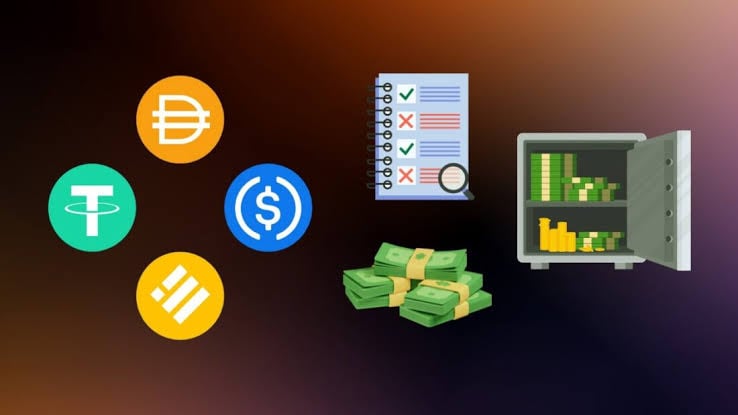
The emergence of stablecoins has been viewed as a vital part of the cryptocurrency marketplace by providing users with blockchain advantages, whilst avoiding extreme price fluctuations that are common with many digital assets. Stablecoins can be used for trading, international payment remittance, decentralized financial products (DeFi), or preserving the value of currency, they all share one common element which is trust from the user base; the belief and assurance by users that every single token in circulation is actually backed by real funds in reserve.
The method by which reserve auditors can be used is vital; all issuers of stablecoins will periodically receive independent verification reports based on a third party auditor’s review of their reserves to ensure that there are sufficient reserves to cover the stablecoins issued. These reports and the corresponding attestations help to improve transparency within the marketplace, help to establish investor confidence, and provide evidence that an issuer can meet any requests for redemption by the holder of their issued stablecoin. This article will outline how will stablecoin reserves be audited, why this is an important process, and what an investor should consider when evaluating the use of a specific stablecoin.
What Are Stablecoin Reserves?
Stablecoin reserves refer to the underlying asset that is used to back the value of a stablecoin. A stablecoin that is backed by fiat (USD specifically) will usually have an issuer that maintains reserve amounts equal to or greater than the total number of stablecoins currently in circulation.
The reserves are generally comprised of cash held at regulated financial institutions, short-term US Treasury bills, US Treasury funds, or other low-risk, highly liquid investments. Variety will be provided through how the reserve is composed by different issuers; however, all players in this market have the same goal of allowing users to redeem their stablecoins for the reserve currency whenever they choose.
Why Reserve Audits Are Important
The degree to which any given stablecoin has a reliable backing will depend on both the level of quality of those assets and how transparent they are about having them. Without an independent third-party verifying the assets that a stablecoin issuer has claimed it has, users would have no way of knowing if a stablecoin issuer is being truthful.
A reserve audit serves to validate to users that the underlying assets that support the stablecoins are valid and within the reserve(s) needed to support each outstanding stablecoin issued. The fact that there will be an independent party who will validate the reserve requirements supports a reduction of fraud risk, increases investor confidence in the market, and provides incentives for the stablecoin issuer to manage the reserve appropriately.
Following the failure of a few high-profile companies in the cryptocurrency space, many experts are looking for significant amounts of information regarding the transparency of reserves prior to endorsing a particular stablecoin.
How the Audit Process Works
Usually, a reserve audit begins when a stablecoin issuer submits their financial statements to an independent auditor for examination. Once the auditor has matched the total number of outstanding circulating stablecoins against the total value of reserve assets held, they will reconcile all bank deposits, investment account balances, and other relevant financial documents to ensure there is enough underlying assets backing all issued stablecoins.
For that reason, it is the aim of the auditor to review that the total number of all underlying assets held in reserve (the amount of underlying assets) is at least equal to the amount of circulating stablecoins outstanding at any point in time. Once the audit is complete, the auditor will issue an audit report that contains a summary of the auditor’s findings.
Audits vs. Attestations
Audits and attestations are not synonymous even though auditors often use those words interchangeably.
A full audit provides the auditor with a complete picture of an organization’s financial statements, internal controls, accounting systems and overall financial condition. Such an audit allows the auditor to assess the overall financial health of the company.
Unlike attestations which verify some information (like reserve asset values and the amount of a stable coin in circulation), auditors will usually test a broader scope of potential fraud that auditors expect possible misstatements might occur in financial statements. The primary purpose of providing set amounts of assets will differ from the purpose of providing an attestation that verifies whether or not the company has assets (or has been removed from the company).
Because both types of reporting provide useful information about how much money is available for issuing new stablecoin; understanding the differences will allow investors to provide input and ideas for developing better methods of organizing their investments compared to traditional accounting practices such as book keeping or by checking accounts for proof of liquid assets and the use of third party trust accounts where all funds are currently being held.
Assets Commonly Included in Stablecoin Reserves
An auditor will determine which assets to review based on the issuer’s reserve policy; thus, the auditor will review different types of assets depending on what type of issuer they are auditing. Cash deposits are the simplest asset type for an auditor to verify; banks can provide confirmation directly to the auditor for amounts in an issuer’s account. Short-term government securities are commonly used as audit assets because of their high liquidity and low risk. Additional assets that many issuers may maintain include money market funds, reverse repurchase agreements, or other cash equivalent investments. When determining the supportability of stablecoin redemptions, auditors will evaluate the quality, liquidity and values of these cash-equivalent assets. The stronger and more liquid the reserve assets are, the more confidence that users of the stablecoin can have in the value and stability of the stablecoin.
The Importance of Independent Auditors
Audit firms serving clients should demonstrate honesty towards clients and uphold credibility through an independent audit process of reserves.The location of independent audit firms that provide objective third parties with independent evaluations for stable coins will provide sufficient justification for independent auditors’ assessments.
Independent auditors will provide an unbiased evaluation of reliable and accurate calculations and ample testing backup for their conclusions according to applicable laws, rules, and standards.
Independent auditors will give investors additional peace of mind that the data included in the reserve reports are from verified and audited financial records and are not only from marketing area or advertising claims. Independent auditors contribute significantly to the transparency and accountability of the cryptocurrency industry in its entirety.
Limitations of Reserve Audits
Although reserve audits improve transparency, they are not perfect.
Each reserve report shows the balances of each reserve as of the date of the report, rather than providing a continuous record of reserve balances. A reserve balance may change after the date of the report, so the amount shown in the report will be only the issuer’s position as of the date of the report.
An independent attestation showed reserves were present when the audit was performed; however, the independent attestation does not evaluate other aspects of the issuer’s condition that may affect the issuer’s financial stability, such as operational risks, liabilities outstanding, and obligations due.
Therefore, reserve audits should be used in conjunction with other indicators of the issuer’s financial health, including compliance with regulatory requirements, governance practices, and the issuer’s general reputation.
How Investors Can Evaluate Reserve Reports
These are tips that will allow you to see what other analysts see when evaluating stablecoin reserves.
First, review your stablecoin reserves disclosure with a critical mind and not based only upon what’s being reported within news media outlets.
Next, analyze the frequency at which the reports are published and find out if those reports are compiled by professional third parties who independently verify the information contained within them.
Additionally, determine whether or not there is an adequate explanation of the total amount of stablecoins currently in circulation as well as how that amount relates to the reported value of reserves versus the total amount of stablecoins outstanding. Transparency gives users more confidence about their choice of which stablecoin to hold onto at any given time.
The Future of Stablecoin Reserve Transparency
The rise of stablecoin popularity has created an increased demand for stablecoins to provide transparency regarding their reserves.
Regulators are implementing legislation to ensure that stablecoin issuers provide enhanced disclosures on their reserve management, frequency of disclosure and reporting. Moreover, improvements in blockchain technology may create the technical capacity to verify the stability of reserves in real time, while providing both traditional financial audits and transaction records via blockchain.
Together these efforts are expected to bolster the public’s confidence in stablecoins and spur new institutional uses of stablecoins for payment and settlement as well as their use in the digital economy.
Conclusion
An essential component of establishing trust within the stable coin ecosystem are reserve audits. Reserve audits independently verify that stable coin issuers hold a sufficient amount of high-quality assets to support all stable coins currently in circulation, and as such provide an added layer of assurance to the user regarding the reliability of their digital dollar or other fiat-backed tokens.
Although reserve audits/attestations have limitations, they are the most important tool available to promote transparency, accountability, and responsible financial management. Understanding how stable coin reserves are audited is crucial for all potential investors and everyday users who wish to make informed choices as this segment of the cryptocurrency industry continues to evolve rapidly.