• Send Us A Tip
  • Calling all Tech Writers
  • Advertise
Friday, October 9, 2026
  • Login
TechStory
  • News
  • Crypto
  • Gadgets
  • Memes
  • Gaming
  • Cars
  • AI
  • Startups
  • Markets
  • How to
No Result
View All Result
  • News
  • Crypto
  • Gadgets
  • Memes
  • Gaming
  • Cars
  • AI
  • Startups
  • Markets
  • How to
No Result
View All Result
TechStory
No Result
View All Result
Home How to

How to amend a tax return

by Shivya Sethi
April 10, 2023
in How to, Tech
Reading Time: 3 mins read
0
How to amend a tax return
TwitterWhatsappLinkedin

Documenting your expenses is one of those activities that might feel overpowering. It tends to be practically scary when you get as far as possible and need to squeeze that last button to record your return. Here is a data to assist with reassuring you on the off chance that you commit an error. For practically any sort of blunder, know this: it is fixable. You can document a revised expense form to address blunders despite everything return three years to guarantee an extra discount on the off chance that you missed a credit or derivation.
You might also like

How Businesses Use Mobile Proxy Servers for Localized Data Collection

Navi Eyes $40 Mn Funding as IPO Plans Take Shape

Ola Electric Eyes ₹1,000 Cr Rights Issue at 26% Discount

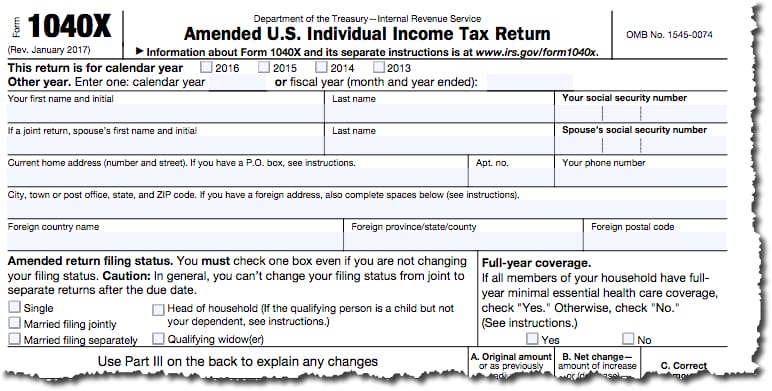
Wondering How To Amend Your Tax Return? - Picnic Tax
Source: Picnic Tax

What Is a Corrected Assessment form?
A changed return is an IRS structure that can be utilized to fix data on a yearly assessment form you’ve previously documented.

Around 3 million changed returns are documented every year, as per IRS information.

You ought to utilize an altered assessment form just to address your recording status, pay, derivations, credits or expense risk. There’s compelling reason need to revise a return for any numerical or administrative blunders.

What is a corrected tax document?
Most individual assessment forms can be revised via mailing in a Structure 1040X. This structure corrects a formerly documented Structure 1040, Structure 1040A, or 1040EZ Structures.
You can utilize this Structure 1040X in the event that there are changes in your documenting status, pay, credits or allowances. (Peruse more about normal slip-ups citizens make, and how to keep away from them.) The IRS suggests that you hold on until you have a fair amount of money returned before you present a change. Relax – the revised return cutoff time is liberal, so you ought to have a lot of chance to look out for your discount yet document your change. Typically, you have three years to record a revised return.
How and when might I at any point correct my assessment form?
You’ll have to send a corrected return via mail. You can get to the Structure 1040X on the IRS site. Really look at the Structure 1040X Guidelines to find your state’s IRS Administration Center location. Or on the other hand, obviously, H&R Block charge experts can assist you with documenting a corrected return. Find an office near you to get everything rolling.
With respect to when to correct your assessment form, that part is simple. Assuming you’ve proactively recorded your 2022 return, you’ll have the option to document a revised return. Assuming you documented your unique return on time (generally April 15) and find a mistake that would get you owe more cash-flow, you should hustle. Assuming that you document your correction before the typical assessment due date, you can stay away from punishments and interest.
Make no increments or alters to your ongoing return. You’ll require the data entered in your unique re-visitation of complete Structure 1040X.
The most effective method to Record a Revised Return
Afterward, you can actually look at the situation with your revised return by going to the expense organization’s Where’s My Corrected Return? online device, or by calling 866-464-2050.

You can follow the situation with corrected returns for the ongoing year and up to three earlier years. At the point when you check on the web or call, you’ll have to demonstrate your personality by entering data, including your citizen ID number (this could be your Federal retirement aide number) alongside your date of birth and Postal district.

There are three handling phases of your return: got, changed and finished.

You can revise your return by going on the web to create a Structure 1040-X, which can address structures 1040, 1040-A, 1040-EZ, 1040-NR or 1040-NR EZ. The web-based structure allows you to include your information and download it for accommodation to the IRS.

Assuming that you utilized one of the present best assessment programming projects to document your unique return, you ought to have the option to utilize a similar item to present your correction.

For what reason Do I Have To Record a Corrected Assessment form?
You might have to document a revised re-visitation of guarantee a greater discount — or on the grounds that you owe the IRS surprisingly cash.

Individuals frequently document assessment form corrections since they neglected to report some pay, or have acknowledged they ought to or shouldn’t have guaranteed specific credits or that they erroneously asserted wards, says Curtis, the bookkeeping educator.

Other normal purposes behind documenting an altered government form incorporate tax documents like W-2s or 1099s showing up later than expected after you have previously recorded your return. A changed return is important to report any pay that was left off your most memorable return.

Charge regulations frequently change — tax reductions and allowances are frequently extended or removed, notes Daniel Fan, overseeing chief, head of abundance arranging at First Establishment Consultants, an Irvine, California-based monetary foundation.

For instance, at the level of the pandemic, in 2021, the youngster tax reduction briefly expanded to $3,600 and included kids ages 17 and under.

Tags: amend a taxamend a tax returnfinancetaxtax return
Tweet54SendShare15
Previous Post

Tesla to launch a big new software update with new features and UI upgrades

Next Post

How To Play Croquet

Shivya Sethi

Shivya Sethi is an aspiring advocate. She is an assertive and outspoken young lad. She channelizes her energy into writing. Tech is what keeps her brain gear oiled for what comes on her plate every other day. Writing and helping tech - tortured people gets her adrenaline rush.

Recommended For You

How Businesses Use Mobile Proxy Servers for Localized Data Collection

by Rohan Mathawan
October 9, 2026
0
Engineering teams building market intelligence pipelines frequently deal with rate limits and manipulated pricing data. Target platforms actively manage incoming traffic using security tools like Web Application Firewalls and TLS fingerprinting. Relying on commercial server nodes for data extraction often leads to interrupted sessions. To solve this, businesses are moving their infrastructure toward authentic cellular networks. Using mobile proxy servers allows them to collect accurate, localized web data reliably. TL;DR: Core benefits of mobile proxy servers for data extraction Carrier-grade trust: Mobile networks use CGNAT, masking your automated traffic alongside thousands of real smartphone users, resulting in maximum IP trust scores. Organic IP shifts: Security systems are adapted to mobile networks where IP addresses routinely change across local cell towers. A dynamic IP is completely natural, provided your geographic region and device footprint remain consistent. Dedicated vs. shared hardware: Dedicated modems allow manual IP rotation via API but require a 5 to 10-second pause while the physical hardware reboots. Shared proxies offer fixed-interval rotation without interrupting active users. Maintaining stable access: Premium infrastructures use the VLESS protocol to route proxy connections as standard HTTPS browsing. This helps maintain connections in environments with strict local ISP filtering. Why localized data extraction requires authentic connections Companies extract localized web data to see information exactly as it appears to a regular user in a specific region. Pricing and availability change based on the viewer's location. A consumer searching a travel aggregator from London sees different flight options than a user querying the exact same route from Tokyo. Teams historically built scraping infrastructure on data center IPs. Today, anti-fraud engines maintain strict databases of commercial cloud subnets. When a firewall detects consumer-level requests coming from a corporate server, it ruins the connection's trust score. Real users do not browse from cloud data centers. The target platform simply responds with CAPTCHAs or HTTP 429 errors. How mobile proxy servers maintain stable access To ensure stable data collection, automated traffic needs to match the normal network patterns of genuine human users. Mobile proxy servers accomplish this by routing requests through real 4G LTE or 5G modems equipped with authentic SIM cards. This works through Carrier-Grade NAT (CGNAT). Mobile carriers do not assign a unique public IP to every smartphone. Instead, they push the data streams of thousands of subscribers onto the internet through a single shared IP address. Banning a CGNAT mobile IP means disconnecting hundreds of real retail consumers in that area. To avoid this collateral damage, security engines treat mobile carrier ASNs with extreme leniency, granting them trust scores between 90% and 99%. Infrastructure Type Network Source CGNAT Shielding Average Trust Score Algorithmic WAF Reaction Data Center Commercial Cloud Providers No (1:1 routing) 20% - 40% Immediate block, CAPTCHA, or rate-limit for consumer endpoints. Static Residential Home Internet Providers Rare (Usually 1:1) 70% - 85% Reliable for steady sessions, but flagged during abrupt traffic spikes. Mobile (LTE/5G) Real Cellular Carrier Networks Yes (Thousands to 1) 90% - 99% High tolerance; blocking is mathematically prohibitive due to collateral damage. IP rotation: Why dynamic addresses are natural for mobile proxy servers Many operators believe that keeping a static, unchanging IP address is the only way to maintain a healthy session. They assume an IP rotation during a collection task immediately triggers security algorithms. In reality, the internet is heavily adapted to a mobile-first world. When genuine consumers browse on their smartphones, they commute across a city and experience brief signal drops. These physical events force their hardware to re-authenticate with the network. The mobile carrier then assigns the device a brand-new IP address from the regional pool. Target platforms inherently expect this behavior. Consequently, an IP address changing within the bounds of a specific city or county is not an automatic red flag. What actually triggers anti-fraud systems is inconsistency in the digital footprint. As long as the regional origin and the device identity remain synchronized, the session remains valid. Modern automation relies entirely on consistent device and location profiles rather than rigid IP addresses. Choosing the right mobile proxies: Dedicated vs. Shared hardware When integrating cellular infrastructure into a pipeline, engineering teams must decide between two distinct types of mobile proxies. This choice directly impacts hardware control and session persistence. Dedicated proxies Dedicated mobile proxies provide an operator with exclusive, single-tenant access to a specific physical modem and SIM card. This grants unrestricted bandwidth and absolute programmatic control over the connection. Operators can trigger an IP change precisely when their workflow demands it via an API call integrated directly into their Python or Node.js scripts. Developers need to handle the rotation delay. When the API command executes, the physical modem drops its connection to the local cell tower and renegotiates a new one. This reset takes 5 to 10 seconds. Scripts require deliberate pauses (e.g., time.sleep(10)) during this window. Sending payloads before the modem re-authenticates causes timeout errors. Shared proxies Shared mobile proxies allow multiple independent users to route their traffic through the same physical 5G/LTE modem simultaneously. Because the connection is multiplexed, the IP address on a shared port rotates at a strict, automated interval typically every 5 or 30 minutes. Manual rotation is disabled because resetting the network would drop the connection for everyone sharing the hardware. Shared ports provide cost-effective CGNAT trust for stateless tasks. Shared networks provide excellent, cost-effective CGNAT trust for stateless tasks where session persistence is irrelevant. Handling deep packet inspection with VLESS While mobile proxy servers manage external routing, businesses sometimes face interference from their own local Internet Service Provider (ISP). Some local ISPs use Deep Packet Inspection (DPI) to monitor outbound traffic. Standard proxy protocols have recognizable cryptographic handshakes that DPI systems often restrict. To resolve this, premium mobile infrastructure supports the VLESS protocol. Rather than generating a custom proxy certificate, VLESS borrows the cryptographic signature of a highly trusted, unrelated domain during the TLS handshake. Local DPI tools analyze this outbound data flow and see standard HTTPS web browsing. This allows data teams to work without local network interruptions. Digital identity and environment setup High-trust IP addresses lose their value if a script logs into an account using a flagged VoIP phone number. The same happens if a localized payment uses a card that mismatches the proxy's geographic location. Operators pair dedicated mobile IP connections with clean browser profiles. They use tokenized payment cards matching the proxy's billing region and real residential phone numbers for SMS verifications. Sourcing these components from different providers slows down infrastructure deployment. Platforms like CyberYozh App consolidate these tools. Teams deploy dedicated mobile IPs, issue virtual cards, and rent local ISP numbers from a single ecosystem. Checking the complete setup through a built-in fraud scorer ensures a highly trusted profile before data extraction begins. Real-world application A market intelligence firm monitored retail pricing across European e-commerce platforms using data center proxies. Within days, the target platform recognized the commercial subnets, applied rate limits, and served manipulated HTML. The firm restructured its pipeline. They replaced their data center nodes with CyberYozh dedicated mobile proxies physically located in the target countries. Because the requests originated from genuine 4G/5G mobile gateways shielded by CGNAT, the firewall perceived the traffic as authentic mobile shoppers. The Python script held a single mobile IP for a persistent session, extracting the localized pricing data. Once a geographic sweep was complete, the script fired an API rotation call, paused operations for 10 seconds while the physical modem reset its radio link to the local cell tower, and seamlessly resumed collection on the next batch of URLs. By aligning their geographic footprint and accounting for the physical realities of hardware rotation, the firm restored stable access to their target data. Final thoughts on mobile proxy infrastructure Basic data collection methods struggle against modern traffic analysis. Because international platforms look closely at connection behavior to protect their localized data, relying on commercial server networks often leads to unstable access. Authentic LTE and 5G cellular hardware solves this problem. Carrier-Grade NAT and API rotation align the traffic with natural network behavior. This approach secures high IP quality and enables reliable data extraction at scale. As businesses rely more on location-specific data, the technology behind reliable web access is becoming an important part of modern data collection. For more practical guides on emerging technology, online infrastructure, and digital tools, explore Kemotech.

Engineering teams building market intelligence pipelines frequently deal with rate limits and manipulated pricing data. Target platforms actively manage incoming traffic using security tools like Web Application Firewalls...

Read more

Navi Eyes $40 Mn Funding as IPO Plans Take Shape

by Ishaan Negi
October 8, 2026
0
Sachin Bansal Steps Down as CEO, Takes on Executive Chairman Role at Navi

Navi, the financial services company led by Flipkart co-founder Sachin Bansal, is looking to raise around $40 million from Elevation Holdings as it strengthens its finances ahead of...

Read more

Ola Electric Eyes ₹1,000 Cr Rights Issue at 26% Discount

by Ishaan Negi
October 8, 2026
0
Ola Electric Eyes ₹1,000 Cr Rights Issue at 26% Discount

Ola Electric is looking to raise ₹1,000 crore through a rights issue, offering new shares at ₹27 apiece as the electric vehicle maker seeks fresh funds to strengthen...

Read more
Next Post
How To Play Croquet

How To Play Croquet

Please login to join discussion

Techstory

Tech and Business News from around the world. Follow along for latest in the world of Tech, AI, Crypto, EVs, Business Personalities and more.
reach us at info@techstory.in

Advertise With Us

Reach out at - info@techstory.in

Aviator Game India 2026

BROWSE BY TAG

#Crypto #howto 2024 acquisition AI amazon Apple Artificial Intelligence bitcoin Business China cryptocurrency e-commerce electric vehicles Elon Musk Ethereum facebook funding Gaming Google India Instagram Investment iPhone IPO Market Markets Meta Microsoft News OpenAI samsung Social Media SpaceX startup startups tech Tech news technology Tesla TikTok trend trending twitter US

© 2025 Techstory.in

No Result
View All Result
  • News
  • Crypto
  • Gadgets
  • Memes
  • Gaming
  • Cars
  • AI
  • Startups
  • Markets
  • How to

© 2025 Techstory.in

Welcome Back!

Login to your account below

Forgotten Password?

Retrieve your password

Please enter your username or email address to reset your password.

Log In
Are you sure want to unlock this post?
Unlock left : 0
Are you sure want to cancel subscription?