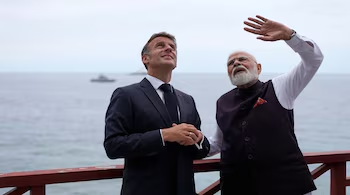
Prime Minister Narendra Modi and French President Emmanuel Macron used their talks in Nice on June 14, 2026 to chart an ambitious economic and strategic roadmap for the two countries. India and France on Sunday unveiled an ambitious agenda to deepen their strategic partnership, with one of the major outcomes being the announcement of a high-level mechanism aimed at doubling bilateral trade within five years. Current trade between the two countries stands at around USD 16 billion.
India and France on Sunday set a five-year target to double their annual bilateral trade from the current USD 16 billion and unveiled an innovation roadmap and a joint artificial intelligence framework to expand ties in critical sectors following talks between Prime Minister Narendra Modi and President Emmanuel Macron. The talks between the two leaders yielded 13 outcomes, including a high-speed railway cooperation declaration, a security pact for classified data, and an agreement to expand India’s UPI payment network to the Paris and Nice airports. Modi landed in this Mediterranean French city on Saturday night as part of his week-long tour of France and Slovakia.
“Heureux de vous retrouver à Nice, mon ami le Président Macron. Je vous remercie d’avoir participé à « Bharat Innovates », alors que nos deux nations célèbrent « l’Année de l’innovation ».”~Narendra Modi
A “Special Global Strategic Partnership”: What The Leaders Agreed On
Foreign Secretary Vikram Misri said the Modi-Macron discussions covered the entire range of bilateral relations, including civil nuclear energy, defence, security, space, trade and investment, technology, innovation, education, mobility and people-to-people ties. “A key focus of the discussions was strengthening and diversifying bilateral cooperation in economic growth, technology and innovation,” Misri said. The two nations also agreed to establish a separate dialogue mechanism on economic security, reflecting a growing emphasis on resilient supply chains and strategic economic cooperation.
Under the India-France Innovation Roadmap 2030, both countries will deepen collaboration in critical and emerging technologies, support startup and incubator ecosystems, and strengthen industry-academia linkages. A key focus of the discussions was also on strengthening and diversifying bilateral ties in the fields of economic growth, technology and innovation. This is especially relevant in view of the conclusion of negotiations earlier this year on the India-EU free trade agreement.
“Today’s talks with my friend, President Macron were exceptionally productive. Considering the longstanding friendship between our nations, we have decided to elevate our ties to a Special Global Strategic Partnership. Our talks covered ways to deepen cooperation in key sectors — space, security, counter terrorism, innovation and more.”~Narendra Modi
Defence Push: Rafale, Local Manufacturing, And The MRFA Framework
Defence cooperation occupied a central place in the talks, with both sides framing future deals around domestic production capability. “There were talks on Rafale and other issues in today’s discussions but I will say the underlying theme was that in case of any defence platform we will move forward on the basis that there should be maximum local content, local manufacturing and our cooperation should be designed keeping this in mind,” Misri said.
The plan under MRFA includes around 50 per cent indigenous content for aircraft made in India. This framework signals that future fighter jet and defence platform acquisitions from France will increasingly be tied to manufacturing commitments within India, aligning with the government’s broader push toward self-reliance in defence production while still leveraging French technological expertise.
The economic backdrop to these talks reflects steady but underwhelming growth in the relationship to date. The India-French relationship hit an inflexion point in February 2026, when French President Emmanuel Macron visited India for the AI Impact Summit, elevating bilateral ties to a “Special Global Strategic Partnership” expanding defence, nuclear, AI, space, and Indo-Pacific cooperation. The bilateral trade between the two nations has more than doubled over the last decade to $15.81 billion.
Civil Nuclear Cooperation: Jaitapur, Small Modular Reactors, And The Shanti Legislation
Nuclear energy emerged as one of the most substantive areas of discussion between the two leaders. Civil nuclear energy cooperation was another major part of the talks, including the Jaitapur project. Misri said discussions continued between EDF, Electricite de France and the Nuclear Power Corporation of India Limited. The talks covered technical issues and financial terms.
Misri also said both sides discussed small modular reactors and advanced modular reactors. “There was a discussion on nuclear cooperation. And the Prime Minister in particular underlined the recent developments on the Indian front in terms of the enactment of the Shanti legislation in India,” Misri said.
The reference to the Shanti Act is crucial because it refers to recent Indian regulatory revisions targeted at making it easier for foreign nuclear technology providers such as EDF to participate in India’s civil nuclear programme, which has long been a source of contention in the Jaitapur project’s progress. Modi also stated on social media that “the India-France partnership will keep scaling new heights.” With the trade target, innovation roadmap, defense manufacturing framework, and nuclear cooperation all moving in tandem, the Nice talks represent one of the most comprehensive bilateral agendas the two countries have set in years though the true test will be how quickly these commitments translate into signed contracts and operational projects over the next five years.