The Indian government has taken one of its most drastic steps yet to protect the integrity of a national examination. The Indian government has temporarily banned Telegram until June 22, 2026, to prevent cheating syndicates and fake paper leak scams ahead of the high-stakes NEET-UG re-examination. In a major regulatory intervention, the Government of India has invoked Section 69A of the Information Technology Act, 2000, to temporarily restrict access to the Telegram messaging platform across the country.
The intervention has two distinct components. The first measure restricts access to Telegram in India until June 22, covering the day of the NEET (UG) 2026 re-examination and its immediate aftermath. The second requires the platform to disable its message-editing feature for already posted messages in India until June 30. According to the NTA, the move is aimed at tackling a specific problem that has emerged in relation to national examinations.
“NEET retest 2026: Govt bans Telegram app until June 22. The app has been ordered to disable its message editing feature for all previously posted messages in India till June 30, 2026.”~Business Today
Why Telegram’s Message Editing Feature Was The Specific Target:
The editing feature restriction is not a general solution; rather, it addresses a specific tactic that cheating networks have been using. The agency claimed that some parties used Telegram’s editing capability to change old conversations after a test had taken place, providing false “evidence” that question papers had been leaked in advance.
The mechanics of this fraud are clear. Prior to an exam, a Telegram channel posts a vague or unconnected message. Once the paper is completed, the operators alter the old message to make it look as if they had leaked the actual question paper hours before the exam began, establishing a false track record of successful leaks to extort money from worried candidates ahead of future exams. By limiting the editing feature until June 30, the government is putting an end to this particular misleading strategy.
Channels such as “PAPER LEAKED NEET”, “Re-NEET 2026”, “Private Mafia” and “REE NEET MAFIAA” openly shared access to the exam paper and also demanded payments from a few thousand to several lakh rupees from candidates and their families. The NTA described banning Telegram as a “measure of last resort” taken only after individual channel takedowns failed to sufficiently contain the spread of fraudulent content.
“Centre blocks Telegram till June 22 ahead of NEET-UG retest, disables message editing till June 30. The government invoked Section 69A of the IT Act. NTA says the ban is a measure of last resort after channel-level takedowns proved insufficient.”~Moneycontrol
The NEET-UG Controversy That Led Here: A May 3 Exam Cancelled After A Month
The context behind this extraordinary action is a year-defining examination scandal. The 2026 NEET controversy is a large-scale paper leak and irregularities in the National Eligibility cum Entrance Test (Undergraduate) 2026 examination, conducted by India’s National Testing Agency. The exam, held on 3 May 2026 for over 2.27 million aspirants seeking admission to undergraduate medical and dental courses, was cancelled on 12 May 2026 following investigations that revealed overlaps between a pre-circulated guess paper and the actual question paper.
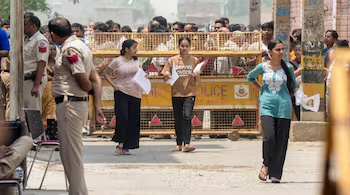
The re-test is scheduled to be held on June 21. Union Home Secretary Govind Mohan on Monday reviewed the preparedness of the states for the NEET (UG) re-examination. Chairing a meeting that was also attended by top officials of various government departments, Mohan reviewed the preparations, with a special focus on “student convenience, security arrangements and the integrity of the examination process.”
Reports also verified that the Indian Air Force was deployed to airlift question papers to examination centers around the country, a first for any civilian examination in India, showing how seriously the government is taking the security of this retest following the May 3 disaster.
“Telegram banned in India till June 22 ahead of NEET-UG 2026 retest. NTA says groups exploited Telegram’s message editing feature to create fake ‘evidence’ of paper leaks. Measures described as calibrated and bounded in time.”~WION
What NTA Said: No Paper Outside The Secured Chain Exists
Beyond the platform restrictions, the NTA used this moment to directly address what it called the central fraud being perpetrated on students. Describing the measures as “calibrated and bounded in time”, the NTA said that the steps were taken only after other remedies, including a takedown of channels and groups, failed to address the problem.
The NTA reiterated that no such paper exists outside the secured exam chain. “NTA has placed on the record, and reiterates, that there is no such paper available outside the secured examination chain. The promise of any such material is, in every instance, a fraud,” the agency said.
For approximately 2.27 million students whose medical futures were hampered by the May 3 cancelation, the June 21 retest marks a second chance in one of India’s most competitive and high-pressure exams. The government’s willingness to apply Section 69A of the IT Act, which was used to prohibit TikTok and dozens of Chinese apps in 2020, indicates that examination integrity is now being considered as seriously as national security. For Telegram, the temporary suspension marks an important turning point in the company’s relationship with Indian authorities, coming only months after the platform’s founder Pavel Durov faced separate legal procedures in France.