India’s decision to ramp up Russian oil purchases in the last three years has saved billions in energy costs. But a new State Bank of India (SBI) report warns that a sudden halt in these imports could leave the country staring at a massive increase in its crude import bill — up to USD 12 billion.

Credits: Financial Express
The SBI Warning
According to the SBI study, if India were to stop buying Russian crude for the remainder of FY26, the fuel bill could rise by USD 9 billion in the current fiscal year and by USD 11.7 billion in FY27.
The reason is simple: without Russia’s discounted barrels, India would have to rely more heavily on higher-priced supplies from other sources.
SBI’s analysis comes at a time when global oil markets are delicately balanced and geopolitical tensions remain high.
Why Russia Matters to India’s Oil Strategy
Before the Ukraine conflict in 2022, Russia accounted for just 1.7% of India’s total crude imports. Fast forward to FY25, and that share has skyrocketed to 35.1%, making Russia India’s largest oil supplier.
The turnaround happened after Western nations imposed sanctions on Moscow and capped the sale of Russian crude at USD 60 per barrel. Indian refiners seized the opportunity to secure cheaper supplies, importing 88 million metric tonnes (MMT) from Russia in FY25 out of total imports of 245 MMT.
These savings have been critical for a country that imports more than 80% of its crude needs.
The Ripple Effect on Global Prices
The SBI report also flagged a broader concern:
Russia currently accounts for 10% of global crude supply. If all countries were to stop importing Russian oil without other producers stepping up, global prices could spike by around 10%.
That would hit India twice — not only losing the discounts but also paying more for every barrel bought elsewhere.
Alternative Sources: Old Allies and New Friends
India’s oil basket is far more diverse than it was a decade ago. The country now sources crude from around 40 nations, giving it some cushion against sudden supply disruptions.
Historically, Iraq, Saudi Arabia, and the UAE have been the primary suppliers. These relationships are maintained through annual contracts, which allow refiners to request extra supplies if needed.
Beyond the Middle East, Indian refiners have tapped into new markets including the United States, West Africa, Azerbaijan, Guyana, Brazil, and Canada. These additional sources, while costlier than Russian crude, provide flexibility and energy security.
How the Shift Could Play Out
If Russian supplies were cut off, India would likely revert to its traditional suppliers in the Middle East under existing contracts.
While this would ensure no disruption in physical supply, it wouldn’t fully shield India from higher costs — especially if global crude prices surge due to reduced Russian exports.
SBI notes that the impact on the import bill would be “significant but manageable”, given India’s diversification strategy and long-term supply arrangements.
Balancing Energy Security and Cost
The challenge for policymakers will be striking a balance between energy security, cost efficiency, and geopolitical considerations.
In recent years, India has demonstrated a pragmatic approach — buying from the most economical sources while expanding its network of suppliers to avoid overdependence on any single country.
But if the discount advantage from Russian barrels disappears, refiners may have to absorb higher costs or pass them on, potentially impacting inflation and the broader economy.
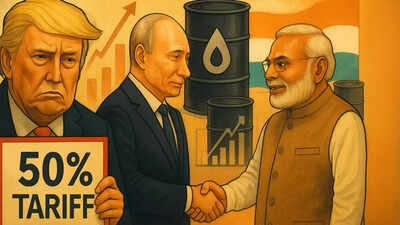
Credits: Times of India
The Road Ahead
For now, Russia remains a cornerstone of India’s oil strategy, delivering both affordability and steady supply. However, SBI’s findings are a reminder that the global energy landscape can shift rapidly, and the financial consequences of such changes can be substantial.
In an interconnected oil market, India’s ability to leverage its diversified supply chain will determine how well it weathers any future shocks. The lesson is clear — energy diplomacy is as crucial as energy economics.