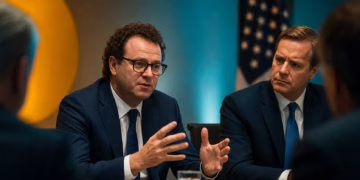
Fresh regulatory disclosures have revealed that Affinity Partners, the private equity firm founded by Jared Kushner, is backing Paramount’s hostile $108 billion takeover attempt of Warner Bros. Discovery (WBD). This connection was not disclosed when Paramount first publicly announced its bid, raising new questions about the true structure and political weight behind the deal.
The revelation came through tender offer filings, which showed that the investor group supporting Paramount is broader and more influential than initially presented. The discovery adds another layer of complexity to what has already become one of the most closely watched corporate battles in the global media industry.
Paramount Promotes Its Bid as Easier to Approve
Paramount has told WBD shareholders that its proposal offers a smoother path through U.S. regulatory scrutiny compared with rival bidder Netflix. The company argues that the structure of its offer is designed to reduce antitrust concerns and lower the risk of delays or rejection.
The presence of Affinity Partners strengthens this argument in the eyes of some market observers, given Kushner’s close ties to former U.S. President Donald Trump. While regulators operate independently, political familiarity can shape perceptions of how deals may be received in Washington.
Paramount has not publicly explained why Affinity Partners’ involvement was left out of the initial announcement, and has offered no official comment on the strategic thinking behind its inclusion.
David and Larry Ellison Add Financial and Political Weight
The bid is being spearheaded by David Ellison, head of Paramount, with strong backing from his father, billionaire Larry Ellison. Larry Ellison is widely known for his political donations and support for Republican causes, including backing Donald Trump.
The financial power of the Ellison family gives Paramount formidable resources to pursue such a large transaction. At the same time, the political associations of both the Ellisons and Kushner have drawn attention from lawmakers and industry watchdogs who are closely following the deal’s development.
Gulf Sovereign Funds Quietly Support the Offer
In addition to Affinity Partners, regulatory documents confirmed that sovereign wealth funds from Saudi Arabia, Abu Dhabi, and Qatar are also financially supporting the bid. These state-backed investors were not named in Paramount’s public statement when the offer was first unveiled.
According to the tender documents, these funds have agreed to hold non-voting equity stakes and have formally waived any rights to:
- Board membership
- Voting influence
- Direct management involvement
This structure appears designed to reduce concerns that foreign governments could exert influence over a major U.S. media company, which could otherwise trigger national security and foreign investment reviews.
Tencent’s Exit Reshapes the Investor Group
Tencent, the Chinese technology giant, was part of Paramount’s earlier attempt to acquire WBD in December but has since withdrawn from the consortium. The departure reduces potential geopolitical sensitivity surrounding the bidding group, particularly in light of ongoing U.S.–China tensions.
While Tencent’s exit changes the makeup of the investor alliance, market analysts believe the remaining backers are still financially capable of sustaining the full value of the bid.
Paramount vs. Netflix: Competing Visions for WBD
Paramount’s hostile offer was launched as a direct challenge to Netflix’s competing deal with Warner Bros. Discovery. The two proposals differ significantly:
Paramount’s bid includes:
- A full-company acquisition
- A cash offer of roughly $30 per share
- Control of studios, streaming, and traditional cable networks
Netflix’s proposal:
- Offers a lower per-share value
- Focuses mainly on studios and streaming platforms
- Leaves legacy cable assets out of the transaction
Paramount argues that its approach delivers greater value and certainty for shareholders, while Netflix maintains that its narrower focus is strategically stronger.
Structure Designed to Reduce Political and National Security Risk
A key feature of Paramount’s offer lies in the way outside investors are structured. Affiliates such as Affinity Partners and Gulf sovereign funds have no governance rights and no formal control over decision-making at the combined company.
Legal experts say this approach is aimed at limiting scrutiny from bodies such as:
- The U.S. Department of Justice
- Federal antitrust regulators
- National security and foreign investment review panels
By preventing foreign and politically connected investors from directly influencing operations, Paramount is attempting to present the transaction as a primarily commercial move.
Kushner Expands His Footprint in Major Global Deals
The potential WBD transaction would represent the second major takeover linked to Kushner in 2025. Earlier in the year, Affinity Partners played a role in a major deal to take Electronic Arts private, showing how quickly the firm has expanded its reach.
Since leaving public office, Kushner has built Affinity into a global investment platform with strong connections to Middle Eastern capital and U.S.-based financial institutions. His involvement in large media and technology deals has increasingly attracted attention across political and financial circles.
Warner Bros. Discovery Takes a Cautious Approach
Despite the aggressive nature of Paramount’s move, Warner Bros. Discovery’s board has not abandoned its earlier support for Netflix’s deal. However, the board has confirmed it is reviewing Paramount’s offer, as required by its duties to shareholders.
Industry analysts expect the process to be lengthy as shareholders, regulators, and political stakeholders all weigh the risks and potential rewards.