For years, one of the biggest concerns surrounding electric vehicles has been battery life. Many potential buyers worried that the battery pack would lose its capacity within a few years, leaving owners with expensive replacement bills long before the rest of the car reached the end of its life.
Fresh real-world data is now challenging that perception. Evidence from high-mileage EVs, combined with industry research, suggests today’s electric vehicle batteries are lasting much longer than originally expected. The findings could help remove one of the biggest hurdles slowing EV adoption.
High-mileage EVs are proving battery durability
A report by The Wall Street Journal highlights several real-world examples that demonstrate how far battery technology has evolved. One standout case is a UK-based used EV dealer whose five-year-old Tesla Model 3 has travelled more than 247,000 miles while continuing to deliver reliable long-distance performance.
Such examples are no longer considered rare. Researchers say modern battery packs are retaining most of their original capacity even after years of heavy use, thanks to major improvements in battery chemistry, cooling systems and intelligent battery management software.
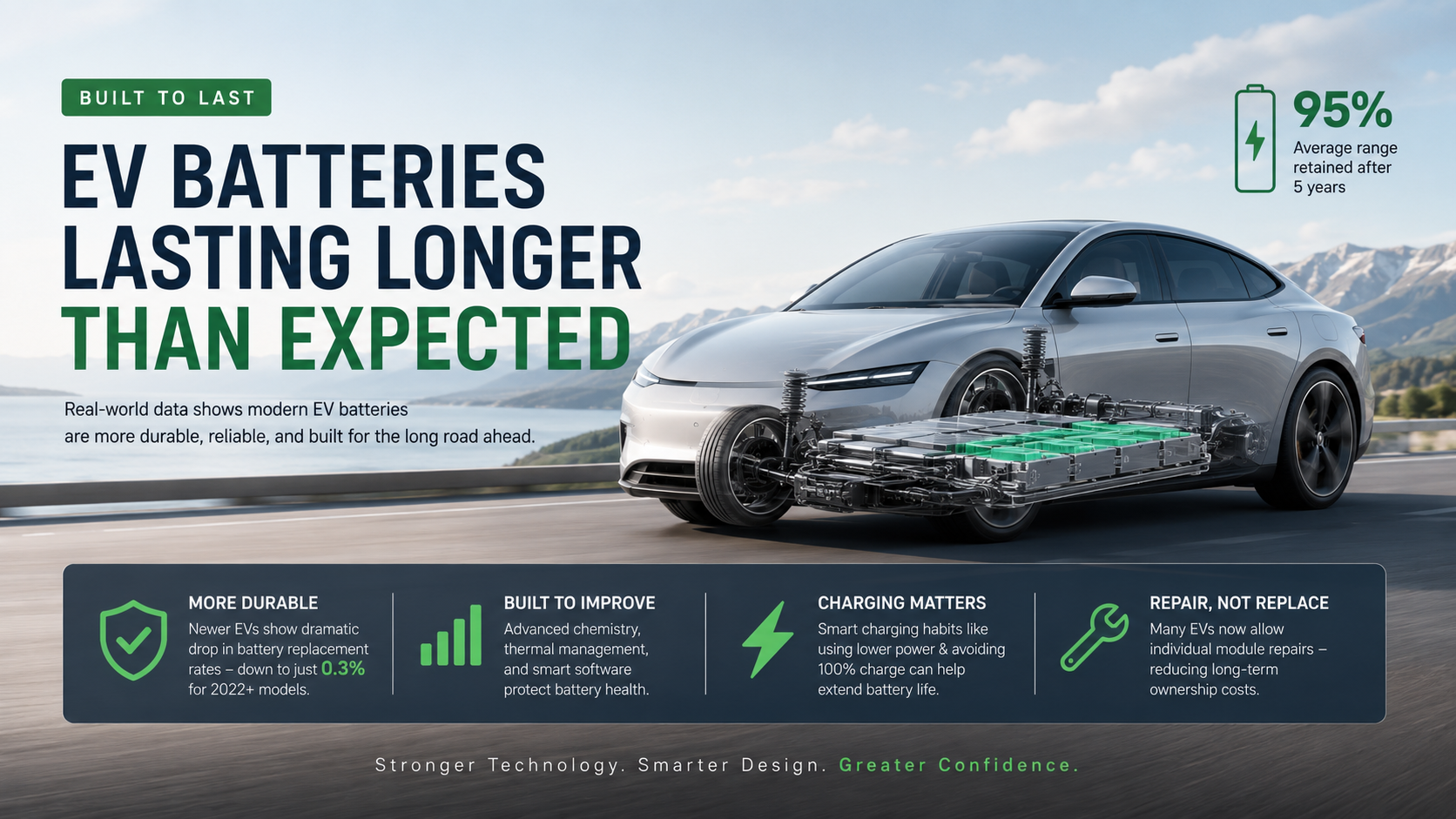
Battery analytics company Recurrent estimates that the average electric vehicle still retains around 95% of its original driving range after five years of ownership. This is considerably better than many early forecasts that predicted rapid battery degradation.
Technology has significantly improved battery health
Battery performance has advanced rapidly over the past decade. Earlier electric vehicles often lacked sophisticated thermal management systems, making them more vulnerable to heat-related degradation.
Modern EVs are designed differently. Improved cooling technologies help maintain ideal battery temperatures, while advanced software carefully manages charging and discharging cycles to reduce long-term wear.
The improvements are also reflected in repair statistics. According to Recurrent, about one in every 12 electric vehicles built between 2011 and 2016 eventually required a battery replacement. For models produced from 2022 onwards, that figure has dropped dramatically to just 0.3%.
Charging habits still play an important role
Although today’s batteries are far more durable, experts say owners can still influence long-term battery health through everyday charging habits.
Frequent use of high-power DC fast chargers tends to accelerate battery degradation compared with slower AC charging. Research from fleet management company Geotab shows vehicles that rely heavily on fast charging generally retain slightly less battery capacity over time than those charged more gradually.
Regularly charging to 100%, leaving a battery completely drained for long periods and exposing the vehicle to extreme temperatures can also contribute to faster degradation.
Fortunately, many manufacturers now allow damaged battery modules to be repaired individually rather than replacing the entire battery pack. This can significantly reduce repair costs if problems arise outside the warranty period.
Confidence in EV ownership continues to grow
Despite the encouraging data, battery replacement remains one of the biggest concerns for prospective EV buyers. Industry surveys continue to show that many consumers overestimate the likelihood of needing a new battery.
As more electric vehicles cross the 200,000-mile mark while maintaining strong performance, those concerns may gradually fade. With battery technology improving year after year and failure rates continuing to decline, modern EVs are increasingly proving they are built not just for the future, but for the long road ahead.