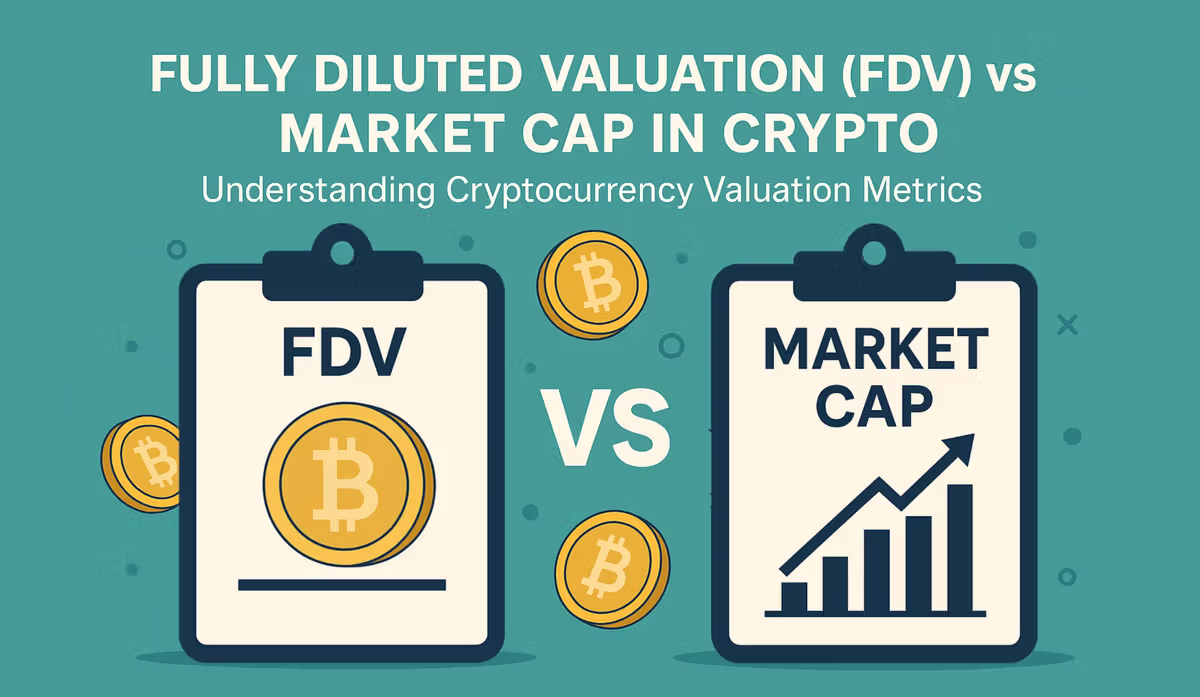
Cracking the Crypto Valuation Code
If you just joined the universe of cryptocurrency investments, you might feel lost, as entering into this realm appears to be walking into another planet entirely. The cryptocurrency jargon and constant use of charts, graphs and other stats can puzzle any new investor and make him/her feel confused. Market Capitalization and Fully Diluted Valuation (FDV) are among the most crucial, but little understood ideas in this field. It’s vital for anyone wishing understood the difference between these two numbers if he/she wants to invest in this investment sphere wisely and not just follow the speculation.
Many novice traders based on their predictions about potential prices of tokens that cost pennies hoping it will rise up and reach one dollar. On the contrary, seasoned players know that price per token does not bring any necessary information and knowledge about the future of the project. In order to find out what is the true size of the cryptocurrency, one has to look at its valuation. The story of FDV vs. Market Cap begins.
Each of these indicators provides a different and important view of the value of a cryptocurrency at the given moment, as well as its theoretical potential cost in the future. Only focusing on one of these metrics while disregarding the other will lead you straight into a valuation trap. Upon reading this guide, you will understand what these concepts are, how they relate to each other, and why it is beneficial for you to learn how to use them.
What is Market Capitalization in Crypto?
When it comes to cryptocurrency, Market Capitalization (also known as market cap) is arguably the most important metric to consider. Market capitalization refers to the current total value of all coins or tokens (that are in circulation) in a particular cryptocurrency. This means that when you look at the market cap, you are effectively looking at the price of the entire system right now based on the coins or tokens that people can buy and sell.
Determining the market capitalization is an easy process. All that is required is for you to multiply the current price of one coin by the total amount of coins that are circulating. In case the valuation of a certain cryptocurrency is 2 dollars while there are 50 million coins in circulation, then the market capitalization is equal to 100 million dollars. The amount indicated varies continuously depending on the prices available on the transaction platforms used in the trading, giving the traders an update regarding the state of affairs in the market.
Investors tend to base their decisions on market cap in order to classify various Investing opportunities as corresponds to different levels of risks involved. For instance, large capitalization coins such as Bitcoin and Ether are viewed as safer and less risky ventures compared to other types of crypto currencies because of their considerable market cap. On the contrary, micro-cap coins have presented an opportunity for a fast market growth despite the serious risks involved. Thus, market cap can help you have realistic expectations regarding the price of a cryptocurrency and understand that there is no way in which the price of Bitcoin can be achieved by cryptocurrencies with low circulating supply like micro-cap coins.
What is Fully Diluted Valuation?
While market cap tells you the story of today, Fully Diluted Valuation, or FDV, attempts to tell the story of tomorrow. FDV is a theoretical figure which indicates the amount of market capitalization of a particular cryptocurrency if every possible token exists in the market today. The Fully Diluted Valuation gives an idea about the maximum potential of any project based on the market capitalization.
The FDV is calculated by multiplying the current price of the cryptocurrency with its supply limit. For example, suppose a coin has a maximum supply limit of five hundred million tokens but there are only fifty million tokens currently in existence. In such a case, the FDV of the coin would be one billion dollars. The significance of FDV lies with the difference in the market capitalization and FDV which may present hidden dangers of investment in the cryptocurrencies.
FDV is essentially the valuation that venture capitalists and early private investors use when they fund a project before it launches to the public. When a project hits the open market, only a tiny fraction of its total tokens might be unlocked and available for retail traders to buy. The rest are held back, locked in smart contracts, destined to be distributed to the team, early investors, or the community over months or years. FDV forces you to acknowledge the existence of these hidden tokens and value the project as if they were already flooding the market.
The Key Differences Between FDV and Market Cap
There is an important distinction between the two metrics in question due to the ideas of time and supply. According to market cap, the current price is based on the available supply and what orders exist in the market books at the moment. On the other hand, Fully Diluted Valuation literally forecasts the future price by multiplying today’s price with a potential maximum supply of the tokens.
This distinction becomes incredibly important when you are trying to figure out if a project is overvalued. A cryptocurrency might boast a very modest market cap, making it look like a prime candidate for a massive growth spurt. However, if its FDV is astronomical, it means the market has priced the token extremely high relative to the actual, long-term scarcity of the asset. You are effectively paying a premium for a token that is destined to become far less rare as time goes on.
Traders use market cap to understand current liquidity and to compare the present size of one network against another. FDV, conversely, is used as a risk management tool. An effective method for investors to understand the theoretical maximum for a project is offered by it. As an illustration, if the FDV of an innovative, untested decentralized finance protocol exceeds that of well-known legacy banks, logic would point out that it has to do more with speculative demand rather than true demand.
The Danger of Low Float and High FDV Tokens
Tokens with low float and high FDV represent one of the biggest dangers in today’s cryptocurrency world. Float represents the proportion of the entire number of tokens that is actually in circulation. When a project only launches with five to ten percent of tokens in circulation, a situation with a lack of tokens comes into being. Since there are very few tokens available to buy or sell, even a moderate amount of buying behavior can make token prices take off.
The situation looks very attractive on a price graph, bringing retail investors who think they have found the next golden egg. However, this illusion of prosperity is incredibly fragile. The high FDV hanging over the project reveals that ninety percent of the tokens are waiting in the wings. The current price is being sustained exclusively by the fact that the vast majority of the supply is temporarily restricted from being sold.
When those restricted tokens eventually become available, the market dynamics shift violently. The initial investors and development team members, who likely acquired their tokens at a fraction of a cent, now have the ability to sell them at the inflated market price. This brings unending and extensive selling pressure that can’t be sustained. For the token price to remain the same, newbies should keep on adding money to the markets to absorb the freshly unlocked tokens which is impossible to happen over a long period of time.
How Token Unlocks and Vesting Schedules Shape Valuations
A high FDV can be better understood with the help of an understanding of token vesting. Just like the stock option system in traditional finance, where corporate employees are given stock options that get vested over a specific period so that they remain in the company and help the company become successful over time. In the case of cryptocurrencies, a similar thing happens again. A large percentage of a token’s supply is locked up in smart contracts and can only be released in a gradual fashion over a specific number of years.
Many people use the term “token unlock” to describe the authorization of tokens to be transferred into the market. When a token unlock occurs, this means that the number of tokens in circulation will increase. According to the laws of economics, an increase of a supply implies a drop in price according to supply and demand principles. This process helps to close the difference between the market capitalization and FDV close to one another.
Professional investors pay close attention to vesting schedules of tokens on the subjects that are not very well-known in the cryptocurrency world. Those who know how to take advantage of different platforms can learn the date of token’s entrance into circulation in advance. Understanding when and how a project intends to reach its Fully Diluted Valuation is arguably just as important as understanding the technology behind the project itself.
Strategic Ways to Use the Market Cap to FDV Ratio
To make better informed decisions about a particular token, it is important to examine the proportion between its Market Cap and Fully Diluted Valuation. This ratio is an almost foolproof indicator of the inflation risk of a given token, as it makes it possible to see how much of available currency is already in circulation. Just divide market cap by FDV and you will learn the percentage of money that is currently circulating.
For example, one comes across a ratio very close to 1. This is true for Bitcoin and other major cryptocurrencies, where the ratio of these two indicators is similar, because there are almost no coins to be printed anymore (it is limited). In that case, people have nothing to worry about; there will be no sudden increase in the supply of coins, causing significant drops in the price of tokens.
Conversely, a ratio that is incredibly low should immediately trigger warning bells. If a project has a market cap of fifty million dollars but an FDV of two billion dollars, the ratio highlights that an enormous wave of supply is destined to flood the market eventually. While these tokens can occasionally offer short-term trading opportunities, they represent terrible long-term holds. Holding an asset with a massive disparity between its market cap and FDV is essentially betting that retail demand will outpace relentless insider selling for years on end.
Common Misconceptions to Avoid
The entire industry of cryptocurrency consists of echo chambers where many people give bad financial advice. Among the most popular misconceptions is the idea that low market cap means a huge jump in value of the token. People think of the ten million dollar project and believe that it can reach one billion dollars as ten million dollars is a small amount. In reality, however, they never check the FDV and they don’t know that the project value is calculated in billions of dollars on the fully diluted basis.
Another misunderstanding is treating the FDV just like a guaranteed target. One cannot say that the project will be worth five billion dollars just because the project candidate says so. The FDV is just a formula that tells how much money people want to invest in the project today. If the project fails to deliver on its technological promises, or if a severe bear market takes hold, both the current price and the FDV will collapse simultaneously.
Finally, it is a grave mistake to look at valuation metrics while completely ignoring trading volume. You might find a token with a perfectly balanced ratio between its market cap and its FDV, making it look like a highly secure investment. However, if that token only trades a few thousand dollars a day in total volume, the valuation metrics are essentially meaningless. Without liquidity, you will not be able to sell your investment when the time comes, trapping your capital in an illiquid asset.
Making Smarter Crypto Investment Decisions
The volatile environment of cryptocurrencies involves more than learning what is trending on social media and purchasing trending tokens. Instead, it calls for a more analytical and logical outlook. To clearly understand how Market Cap and FDV have an impact on your portfolio, you will then understand that this combination enables you to separate the wheat from the chaff in a market where shallow marketing hype prevails.
Market cap gives you real-time information regarding any cryptocurrency asset’s total capital market value and liquidity. On the other hand, FDV sheds light on future supply-risk exposures. Hence, you should hardly rely on the advice of world-famous financial advisers when making any decision with respect to cryptocurrencies trading because you may create your own judgment based on the two concepts outlined above.
As time progresses, the cryptocurrency business is becoming more robust as it embraces the best practices of finance. This means that any project which insists on sound tokenomics today stands to last through the competitive challenges facing the industry. Hence, always choose cryptocurrencies, which exhibit a good balance between circulating supply and theoretical max supply as this approach will minimize your exposure to cryptocurrency losses.