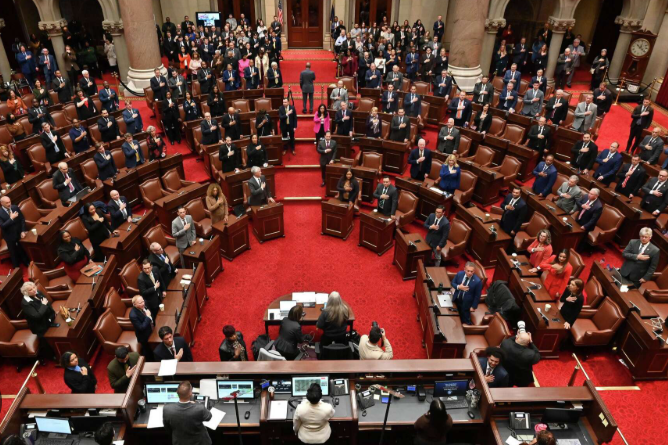
The balance between artificial intelligence advancement and traditional journalistic integrity is facing strict government intervention. Following months of debate, the New York State Legislature passed a landmark, first-in-the-nation bill targeting the rise of automated media content. Officially titled the Fundamental Artificial Intelligence Requirements in News Act, this New York FAIR News Act AI disclosure law establishes aggressive transparency guidelines for every publisher operating inside the state.
Consequently, the bipartisan legislation shifts how media organizations can deploy automated writing tools. By forcing corporate executives to clearly label non-human content, the New York FAIR News Act AI disclosure framework attempts to protect consumer trust and preserve editorial standards at a time when the journalism industry faces an influx of synthetic articles and deepfake media assets.
The new legislative framework, championed by Senator Patricia Fahy and Assemblymember Nily Rozic, introduces a double-edged compliance system that affects both internal newsroom operations and public-facing content channels.
Publishers must comply with four structural guidelines:
- Public Content Labels: Any news story, article, broadcast segment, or graphical asset that was “substantially composed” by generative AI must feature a prominent, clear disclaimer.
- Internal Workplace Audit Trails: Media bosses are legally required to disclose to their staff exactly when, where, and how automated writing or tracking tools are deployed in the workspace.
- Mandatory Human-in-the-Loop Reviews: The statute bans the publication of purely automated content feeds; a human employee with direct editorial control must review and sign off on all AI-assisted materials before release.
- Source Shielding Regulations: To preserve investigative privacy, the act introduces technical walls prohibiting news platforms from feeding confidential whistleblower documents or raw interview material into external corporate machine learning models.
The Legal and Economic Friction: Compliance vs. Commercial Insolvency
While major newsroom unions including the NewsGuild of New York and the Writers Guild of America East (WGAE) have celebrated the bill as a historic worker victory, digital media executives are sounding the alarm over its economic fallout. This bill targets local journalism at a time when medium-size and community newspapers are closing at an unprecedented pace.
Traditional Media Downturn Metric Trends
| Operational Health Indicator | Industry Performance Baseline | Impact on Local Infrastructure |
| Top 46 News Site Revenue | Plunged 56% over the past decade | Forces reliance on aggressive digital asset monetization |
| National Journalist Workforce | Lost nearly two-thirds of active staff | Creates acute, severe newsroom labor gaps |
| Newspaper Shutter Rate | Over 3,500 publications closed since 2005 | Leaves vast geographic regions as total news deserts |
Corporate advocacy groups, including think tanks like the R Street Institute, argue that the strict New York FAIR News Act AI disclosure requirements could unintentionally bankrupt independent publishers. For smaller newsrooms that depend on automated transcription tools to cover local town hall meetings or basic data analysis scripts to summarize public record documents, the cost of managing these reporting frameworks could exhaust their remaining cash reserves.
Anti-Displacement Mandates Challenge Market Realities
While mere labeling issues are important to people, the most controversial aspect of the bill is its outright prohibition of displacement of workers. The statutory language explicitly blocks media entities from using machine learning efficiencies to reduce editorial hours, cut baseline salaries, or eliminate existing newsroom roles. This strict provision sets up a major constitutional showdown. Opponents argue that compelling commercial newsrooms to label their own reporting or forcing them to maintain specific staffing levels violates First Amendment protections against compelled speech.
Furthermore, by preventing publishers from realizing the direct cost-saving benefits of modern technology, the mandate may inadvertently speed up the collapse of vulnerable companies. As the bill lands on Governor Kathy Hochul’s desk for signature, New York is setting up a high-stakes legal precedent that will determine whether a free press can survive by adopting autonomous systems or collapse under the weight of legislative oversight.