The global networking landscape is entering a period of massive data scaling. For years, consumer and enterprise spaces managed their growing hardware ecosystems by relying on iterative upgrades to the classic Wi-Fi standards. However, the modern explosion of high-density smart home devices, multi-gigabit fiber internet, real-time cloud computing, and uncompressed 8K streaming has pushed legacy routers to their absolute limits. To keep wireless infrastructure from becoming a major digital bottleneck, the Wi-Fi Alliance officially rolled out the 802.11be standard. Getting Wi-Fi 7 explained down to its core mechanics reveals that this technology is not just a standard speed bump; it is a fundamental shift from simple data collection to real-time, low-latency traffic management.
Unlike the modest improvements brought by Wi-Fi 6 and 6E, this next-generation standard introduces unique physical layer (PHY) modifications designed to treat wireless data with the speed and stability of a physical Ethernet cable. By exploring Wi-Fi 7 explained across its core technical pillars, network engineers, technology enthusiasts, and enterprise administrators can see exactly how the standard scales throughput up to a staggering 46 Gbps. This advancement effectively solves the wireless congestion issues that have plagued modern smart homes and crowded corporate offices for over a decade.
1. Opening the Superhighways: The 320 MHz Channel Width
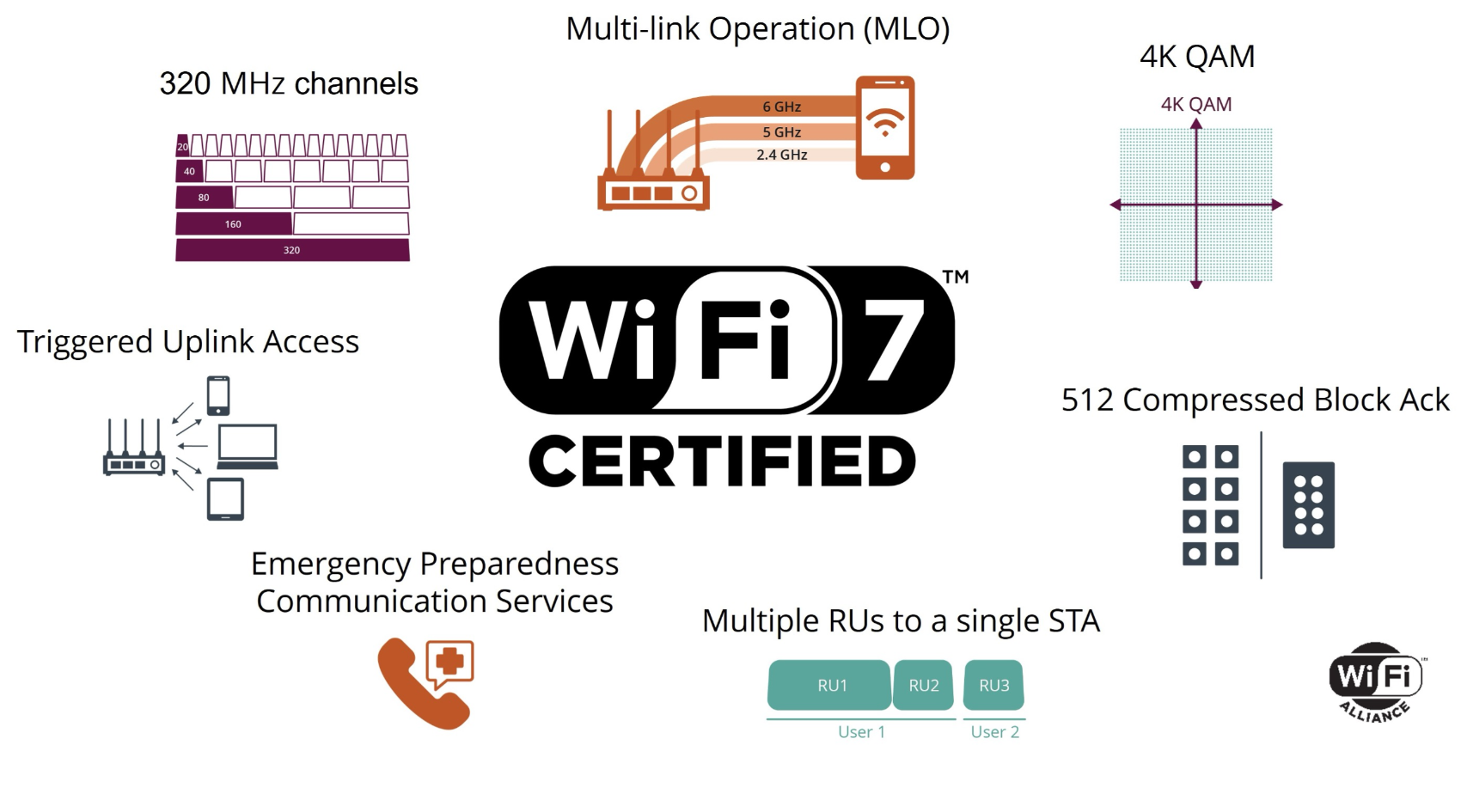
To explain how the protocol achieves its blistering top speeds, we have to start with channel width. If wireless frequencies are like a public highway, channel width determines how many lanes are open for traffic. Legacy generations maxed out at 80 MHz or 160 MHz channel structures within the 5 GHz spectrum block.
Wi-Fi 7 utilizes the ultra-wide 6 GHz frequency band to double the maximum channel width to a massive 320 MHz.
| Spectral Layer / Metric | Wi-Fi 6 Architecture (5 GHz) | Wi-Fi 7 Architecture (6 GHz) |
| Maximum Channel Width | Limited to 160 MHz lanes | Expanded to 320 MHz ultra-wide lanes |
| Spectral Crowding Profile | Highly prone to radar interference and legacy device crowding | Operating in a clean, pristine spectrum block with zero overlap |
| Throughput Ceiling Capacity | Lower overall headroom due to narrower lane allocations | Doubles total raw data transmission capacity at the physical layer |
By opening up these massive 320 MHz lanes, a compatible router can pack twice as much data into a single transmission loop. Think of it like swapping out a standard delivery box truck for an ultra-capacity commercial freight vehicle. This massive space allows multi-gigabit fiber connections to beam straight across a home or office without running into internal data walls, ensuring heavy file transfers or high-resolution video streams don’t choke secondary devices on the network.
2. Dense Data Packaging: Mastering 4096-QAM Modulation
Opening up wider lanes is only half the battle; you also need to pack data into those lanes as efficiently as possible. This efficiency is dictated by Quadrature Amplitude Modulation (QAM) the digital language routers use to translate raw radio frequencies into binary bits.
While Wi-Fi 6 and 6E maxed out at 1024-QAM, this new standard advances straight to 4096-QAM (frequently referred to as 4K QAM).
| Encoding Parameter | Wi-Fi 6 Modulation (1024-QAM) | Wi-Fi 7 Modulation (4096-QAM) |
| Bit-to-Symbol Packaging | Encodes exactly 10 bits of data per individual symbol wave | Encodes exactly 12 bits of data per individual symbol wave |
| Payload Density Rating | Standard baseline payload capacity configuration | Advanced ultra-dense payload configuration |
| Overall Efficiency Trajectory | Serves as the historical baseline for gigabit data streaming | Delivers an immediate 20% boost in overall structural data weight |
By shifting to a 4K QAM matrix, the signal can embed 12 bits of data inside every individual symbol wave, compared to the 10-bit limit of previous systems. That extra 2 bits per symbol yields an immediate 20% increase in total throughput efficiency. This density upgrade means that every single wireless transmission carries a heavier, more optimized data payload, allowing connected devices to complete complex downlinks in a fraction of the time.
3. Eradicating Connection Drops via Multi-Link Operation (MLO)
While the raw speed increases capture the headlines, the real operational superpower of the new standard is a game-changing protocol called Multi-Link Operation (MLO). Historically, wireless routers functioned as single-band interfaces; even if your home network broadcasted across 2.4 GHz, 5 GHz, and 6 GHz options, your smartphone could only lock onto one of those bands at a time. If you walked into a back bedroom and the 5 GHz signal dropped, your device had to disconnect and renegotiate a connection down to the slower 2.4 GHz band, causing immediate lag spikes or buffering wheels.
MLO completely rewrites this rule by enabling devices to connect to multiple frequency bands simultaneously.
| Network Link Characteristic | Legacy Single-Band Connection Model | Modern Multi-Link Operation (MLO) |
| Active Band Utilization | Restricts client device to one radio band at a time (e.g., 5 GHz or 6 GHz) | Connects client device to multiple frequency bands simultaneously |
| Real-World Speed Trajectory | Capped by the isolated bandwidth limits of the active channel | Aggregates individual band speeds into a single, high-capacity pipe |
| Inherent Link Redundancy | Low (device disconnects and re-negotiates when a channel drops) | High (instantly drops a noisy band while maintaining uninterrupted flow on secondary bands) |
| Packet Latency Performance | Prone to spikes and jitter due to mid-session channel switches | Delivers rock-solid, single-digit millisecond latency profiles |
Under an active MLO link, a device can bundle the 5 GHz and 6 GHz bands together into a single, high-speed connection pipe. This structure unlocks two massive advantages:
- Aggregated Throughput: By utilizing multiple bands at the exact same moment, your actual real-world download speeds skyrocket past what a single band could handle.
- Inherent Link Redundancy: If physical interference like a heavy concrete wall or a microwave suddenly blocks the 6 GHz frequency, the device drops that specific channel instantly while continuing to stream data over the 5 GHz path seamlessly. This channel hopping happens in microseconds without dropping a single packet, dropping connection latency down to near-zero levels.
4. Operational Metrics: How Wireless Generations Compare
To show how these massive architectural modifications translate into actual network performance improvements, we can compare the core operational metrics across the three most recent wireless generations.
Generative Comparison of Wireless Protocol Metrics
| Technical Parameter Base | Wi-Fi 6 (802.11ax Standard) | Wi-Fi 6E (Extended Band) | Wi-Fi 7 (802.11be System) |
| Supported Frequency Bands | 2.4 GHz / 5 GHz | 2.4 GHz / 5 GHz / 6 GHz | 2.4 GHz / 5 GHz / 6 GHz |
| Maximum Channel Width | 160 MHz | 160 MHz | 320 MHz |
| Signal QAM Modulation | 1024-QAM | 1024-QAM | 4096-QAM |
| Theoretical Top Speed | Up to 9.6 Gbps | Up to 9.6 Gbps | Up to 46.1 Gbps |
| Multi-Link Routing (MLO) | Not Available | Not Available | Native Multi-Band Bundling |
| Resource Allocation Style | Single RU Per Account User | Single RU Per Account User | Multi-RU Puncturing Active |
5. Cleaning the Noise: Preamble Puncturing and Multi-RU
In legacy networks, wireless interference was an all-or-nothing game. If a router tried to use a wide 160 MHz channel, but a baby monitor or a neighbor’s network was causing noise on a tiny 20 MHz slice right in the middle of that block, the router was forced to disable the entire upper half of the channel, cutting its data capacity in half.
The new standard solves this problem by using a clever technique called Preamble Puncturing, enabled by flexible Multi-Resource Unit (Multi-RU) allocation.
| Operational Scenario | Legacy Block Rejection (Pre-Wi-Fi 7) | Modern Puncturing Pattern (Wi-Fi 7) |
| Interference Impact | A single 20 MHz slice of noise compromises a wide data channel | A single 20 MHz slice of noise is detected inside a wide data channel |
| Spectrum Utilization | Forces the router to completely abandon the entire adjacent 140 MHz block | Programmatically punches out the isolated noisy spectrum slice |
| Throughput Preservation | Cut in half instantly, dramatically slashing local data speeds | Routes data frames around the missing gap cleanly and continuously |
| Network Efficiency | High friction; results in dropped data packets and lag spikes | Maximizes total available bandwidth in heavily congested areas |
Instead of abandoning a wide channel when it hits interference, a Wi-Fi 7 router can surgically punch out the specific noisy slice of spectrum, stitch the remaining clean blocks back together, and continue using the rest of the lane. This granular traffic control keeps your network highly efficient even in congested apartment complexes or dense business parks where hundreds of competing wireless signals are constantly clashing.
6. Real-World Use Cases: Who Needs This New Scale?
Because the theoretical maximum speed sits at a staggering 46 Gbps, a common question is whether everyday consumers actually need to invest in a hardware upgrade. While simple web browsing or scrolling through social media won’t saturate these limits, several high-growth tech sectors rely heavily on the standard to function smoothly:
- Next-Gen Virtual Reality (VR/XR): Immersive, high-resolution headsets require massive amounts of uncompressed data with ultra-low latency to prevent motion sickness. The standard’s near-zero lag loops allow these devices to stream desktop-grade virtual environments wirelessly without requiring thick, heavy link cables.
- Smart Homes with Massive Device Counts: Standard routers frequently choke when trying to manage more than 50 connected devices simultaneously, resulting in dropped connections for smart lights, security cameras, and appliances. Multi-RU and optimized scheduling frameworks let a single access point talk to hundreds of smart home devices at the exact same time without breaking a sweat.
- Competitive Cloud Gaming: For online multiplayer gaming, a low ping is far more important than raw download speeds. By using MLO to bypass environmental interference, the protocol delivers rock-solid, single-digit millisecond latency profiles, letting gamers ditch long Ethernet cables without sacrificing competitive responsiveness.
Summary Analysis: Reorganizing Core Features
To wrap things up, we can look at how these technical features group into clean, distinct pillars that summarize the leap forward in wireless engineering.
The Bandwidth Capacity Jump
- Doubled Maximum Width: Moving from 160 MHz channels up to 320 MHz lanes immediately doubles the physical space available for high-speed data transfers.
- 6 GHz Optimization: Capitalizes on a clean, wide open frequency spectrum block far away from the noisy, overcrowded lanes of older 2.4 GHz legacy networks.
The Data Density Multiplier
- 4K QAM Integration: Upgrades signal encoding from 1024-QAM to 4096-QAM, squeezing 12 bits of data into every symbol wave for an instant 20% efficiency boost.
- Streamlined Packet Payloads: Drastically cuts down on the overhead airtime required to move massive file structures, opening up network capacity for secondary devices.
The Latency and Reliability Shield
- Active Multi-Link Operation (MLO): Allows connected devices to use multiple radio bands at the exact same moment to aggregate speeds and ensure continuous connection redundancy.
- Surgical Preamble Puncturing: Prevents localized channel noise from taking down wide data lanes, routing traffic around interference to maintain high uptime in crowded areas.
Ultimately, this wireless generation represents a major milestone in networking history. By tackling congestion, latency, and data density head-on through smart hardware protocols, the standard successfully transforms wireless connections into an ultra-reliable, invisible cable. As multi-gigabit fiber connections become common across residential and corporate hubs, investing in a next-gen routing framework ensures your internal local area network is fully scaled, optimized, and ready to anchor the next decade of digital innovation.