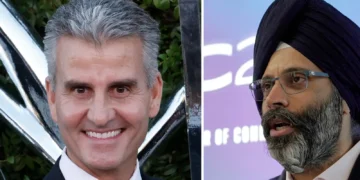
Nvidia CEO Jensen Huang has had enough of the negativity surrounding artificial intelligence. The leader of the world’s most valuable company recently took aim at what he calls the “doomer narrative”, the increasingly common warnings that AI could devastate employment or even pose existential threats to humanity.
Speaking on the No Priors podcast, Huang didn’t mince words about his frustration with prominent voices raising alarms about AI’s potential dangers.
“I think we’ve done a lot of damage with very well-respected people who have painted a doomer narrative, end of the world narrative, science fiction narrative,” he said.
Jensen Huang of NVIDIA Slams “AI Doomerism” as Threat to Innovation
According to Huang, the constant drumbeat of AI pessimism could actually become a self-fulfilling prophecy by discouraging the very investments needed to make AI safer and more beneficial.
“When 90% of the messaging is all around the end of the world and the pessimism, I think we’re scaring people from making the investments in AI that makes it safer, more functional, more productive, and more useful to society,” Huang argued.
While Huang acknowledged that dismissing either optimistic or pessimistic views entirely would be “too simplistic,” he clearly believes the scales have tipped too far toward fear-mongering.

He described the clash between AI optimists and skeptics as “the battle of the narratives” and called it one of his biggest takeaways from 2025.
The Nvidia chief has tangled with other tech leaders over these issues before. Last June, he publicly disagreed with Anthropic CEO Dario Amodei after Amodei predicted that AI could eliminate roughly half of all entry-level white-collar jobs within five years, potentially pushing unemployment to 20%. Huang said he “pretty much disagreed with almost everything” Amodei said.
The tension between the two CEOs flared up again in May 2025 over AI Diffusion Rules that limit exports of advanced AI technology to countries like China.
Anthropic pushed for stricter controls and enforcement, even highlighting cases of people allegedly smuggling chips into China using creative methods. Nvidia pushed back hard, insisting its chips have never been smuggled into China despite Chinese customs documenting such incidents.
Why Tech CEOs Are Pushing Back on AI Regulation?
During the podcast, Huang took another swipe at companies requesting more AI regulation from governments, though he didn’t name names.
“Their intentions are clearly deeply conflicted, and their intentions are clearly not completely in the best interest of society,” he said. “They’re obviously CEOs, they’re obviously companies, and obviously they’re advocating for themselves.”
Huang isn’t alone among tech executives complaining about AI criticism. Microsoft CEO Satya Nadella recently griped that discussions around AI need to move past the concept of “slop” low-quality AI-generated content flooding the internet.
Meanwhile, Mustafa Suleyman, who leads Microsoft’s AI division, called public criticism of AI “mind-blowing” back in November.
But there’s a reason the negativity persists. Estimates now suggest that more than 20% of YouTube’s content can be classified as slop.
Laid-off employees because of AI and/or automation have continued to accumulate. And worries about disinformation, copyright violations, and its effects on the environment remain far from fading away.
Indeed, to a great number of individuals, the dire predictions of “doomers” resonate not as science fiction, but as serious questions about what is already being accomplished by this technology.
Why AI Skepticism Requires Executive Empathy?
When executives in firms that can gain significantly from the adoption of AI view concerns about these issues as mere fear-mongering, it can be seen as tone deaf.
The truth is that both the possibilities and the dangers of AI should be given serious thought. One can’t simply label the naysayers as “doom-mongers” and wait for the warnings to just go away, especially when the warnings being made are about things that people are already experiencing.
Regardless of whether or not Huang likes the fact, the skepticism is far from disappearing – and is certainly not going anywhere based purely on hurting the egos of a couple of billionaire executives.