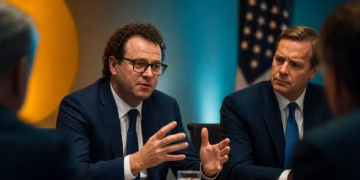
Russia dismissed US President Donald Trump’s assertion that India agreed to halt Russian oil purchases as part of a new trade deal, with Kremlin spokesman Dmitry Peskov stressing New Delhi’s freedom to source energy from any supplier. Peskov noted that Russia supplies only part of India’s oil needs and the country buys from multiple nations, seeing no change in the status quo.
Kremlin’s Response to Trump’s Announcement:
Peskov’s remarks followed Trump’s Monday claim that Prime Minister Narendra Modi had promised over the phone to cease purchasing Russian oil and instead switch to greater US and potentially Venezuelan supply. Russia is not India’s exclusive supply of oil and petroleum products, as we and all other world energy specialists are well aware. India has consistently bought certain goods from other nations. Consequently, we don’t see anything new here,” Peskov said reporters.
The Kremlin spokesperson reaffirmed on Tuesday that Moscow had not received any formal word from New Delhi regarding a reduction in Russian imports. He highlighted how much Russia values its relationship with India and how dedicated it is to strengthening the strategic alliance in spite of this.
Trump announced the trade deal on social media, highlighting slashed tariffs on Indian goods from 25 percent plus a 25 percent penalty to 18 percent. He framed the oil shift as reciprocal, tying it to broader US goals of redirecting energy flows away from Russia amid the Ukraine conflict.
India’s Position and Oil Import Realities:
In an X post, PM Modi thanked Trump on behalf of 1.4 billion Indians and acknowledged the tariff decrease, but he made no mention of oil pledges or a comprehensive trade agreement. It was a pleasure to talk to my good buddy President Trump today. With an exclusive focus on the export relief, Modi said, “I’m delighted that Made in India products will now have a reduced tariff of 18%.”
No Indian official statement backs Trump’s claim on stopping Russian crude buys. Russia supplies 1.5 to 2 million barrels per day to India about one-third of total imports with volumes dipping recently to around 1.1 million barrels per day in early January per tracking firm Kpler.
Experts like Igor Yushkov from Russia’s National Energy Security Fund argued a full switch impractical. US shale oil is light like gas condensate, unlike Russia’s heavier, sulfur-rich Urals grade favored by Indian refineries, requiring costly blending and adjustments.
Yushkov estimated America couldn’t match Russia’s 1.5-2 million barrels daily volume quickly. “Russia typically exports 1.5 million to 2 million barrels per day to the country. America won’t be able to cover that volume,” he said, suggesting Trump’s words aim to project US negotiation wins.
Challenges in Switching Oil Suppliers:
Indian refineries geared for Urals crude face retooling hurdles for lighter US grades, hiking costs without simple substitution. Russia remains a top discounted supplier since Western sanctions post-2022 Ukraine invasion, alongside buyers like China and Turkey.
Trump has long put pressure on India over Russian energy, imposing 25% tariffs in August as a means of reducing Moscow’s earnings and advancing peace negotiations with Ukraine. His agreement brings that strategy back to life, but Russia’s reaction highlights the limitations of controlling India’s energy decisions.
Kommersant FM noted that Modi’s silence on oil contradicts Trump’s story and raises concerns about the extent of the agreement. Given the economic consequences, analysts doubt a total halt is possible because Russia provides crucial cheap barrels that stabilize India’s import bill.
India prioritizes consumer interests in volatile markets, with policies driven by affordability over geopolitics. Kremlin values the partnership, eyeing continued energy and defense collaboration despite US overtures.
Future of India-US-Russia Energy Ties:
The episode highlights tensions in triangular dynamics, with US pushing de-risking from Russia while India balances ties. No signs point to abrupt Russian cutoff; volumes persist via shadowy tanker networks defying sanctions.
Tariff cuts boost Indian exports, but oil pledge ambiguity leaves room for continuity. Russia eyes strategic partnership growth, undeterred by rhetoric. As global energy shifts, New Delhi charts pragmatic course safeguarding supplies.