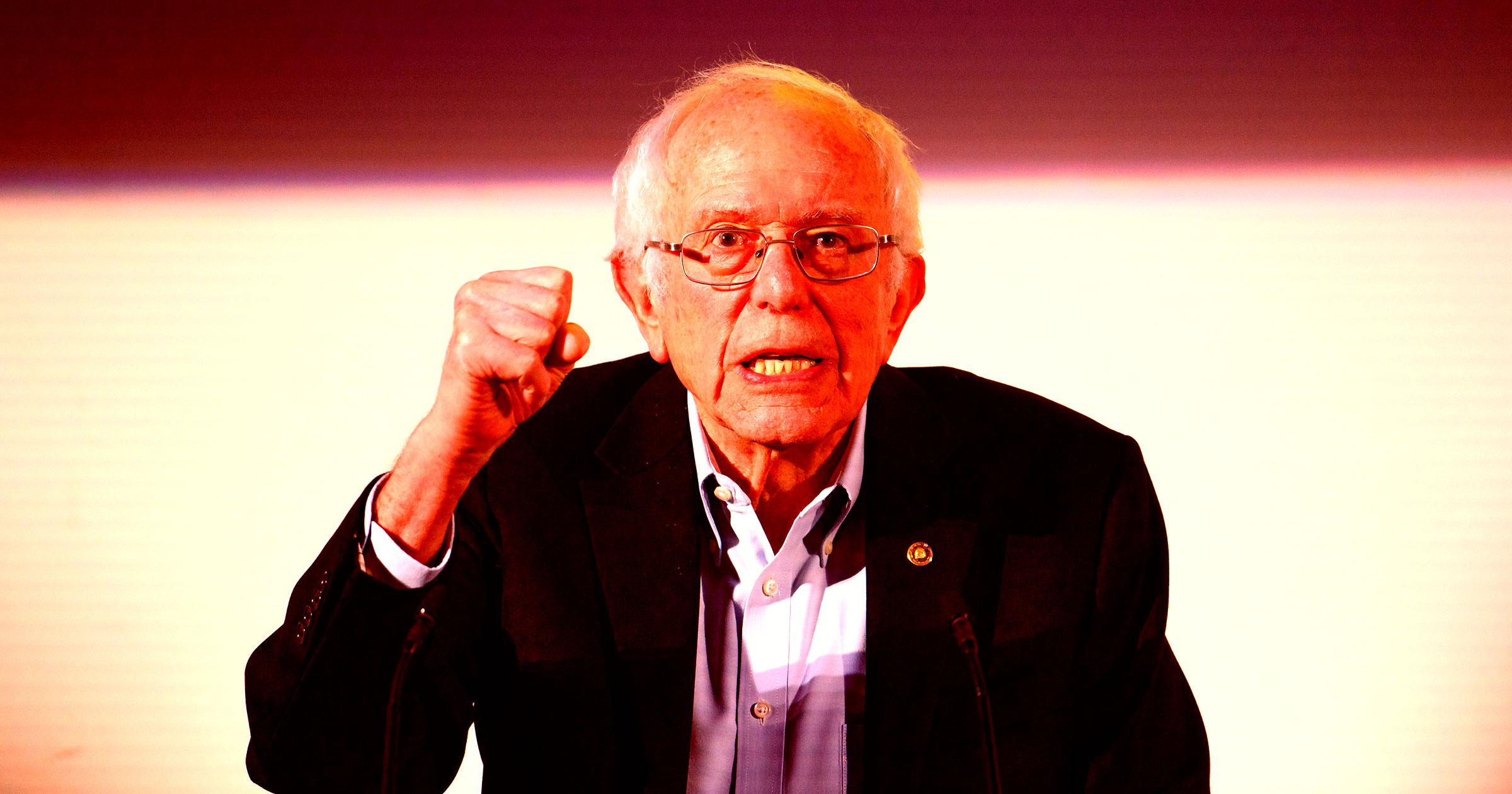
Senator Bernie Sanders has been a vocal critic of artificial intelligence, asserting that OpenAI must be broken up since the technology has the potential to overhaul America’s job market and social fabric.
The independent senator from Vermont didn’t hesitate when asked by Axios if the creator of ChatGPT needs antitrust action. “I do, but it’s a more profound issue than that,” Sanders told an interview published Friday. “We have to take a deep breath and realize it’s like a meteor heading our way. We’ve got to be ready to meet all of its complexity.”
Sanders’ concerns revolve around what he describes as the “enormous transformational impact” AI will have on working Americans. The senator sketched a bleak vision of an economy in which technological progress leaves employees in the dust, warning of “massive” job losses as AI and robotics advance.
“I would like to see us bringing manufacturing back to America, but it won’t do any working person any good if that manufacturing labor is being performed by robots,” Sanders elaborated.
He applied this concern to the next generations of workers coming into the workforce, adding that first-step jobs on the career ladder, historically the beginning place for entry-level workers, may not exist anymore. “I would like to see small businesses grow. I would like to see the economy is creative. Ain’t going to help the young folks if the entry level positions are being done by AI.”
Sanders Slams Tech Titans, Including OpenAI, Over AI’s Threat to Jobs and Human Connection
The senator also named America’s richest tech leaders, implying that their AI investments don’t serve employees’ interests. “I’ll tell you Mr. Musk and Mr. Bezos and Mr. Ellison, the richest men in this world, are investing enormous amounts of money in AI and robotics,” Sanders stated. “And if you think they care about the needs of working people, you would be wrong.”
The argument about the effect of AI on jobs continues to be contentious, with estimates ranging widely. Anthropic CEO Dario Amodei has put forward the possibility of the tech wiping out much of entry-level white-collar work in mere years.
Labor economists, however, note that available employment statistics have not yet reflected the wholesale job loss induced by AI, leaving the real timeframe and extent of disruption in doubt.
Aside from economics, Sanders expressed more profound apprehensions regarding AI’s impact on human relationships. He quoted new devices that actually substitute human interaction with man-made equivalents. “There are products now being marketed as ‘You don’t have to relate to a human being anymore. You will have someone hanging around your neck as your AI buddy,” the senator explained.
His remarks seem targeted at offerings such as Friend, a wearable AI friend whose recent New York City subway system advertising campaign generated widespread public discussion of technology supplanting real human connection.
“In a nation where there is so much emotional pain, I am deeply concerned about that. How we treat one another as human beings,” Sanders said, referring to fears that AI might feed America’s loneliness crisis and mental illness epidemic.
Breakneck Pace of AI Development Spurs Political Backlash and Calls for a Ban
The senator also addressed fears about superintelligent AI technology that would surpass human cognitive abilities. This concern isn’t unique to Sanders.
Several luminaries in the tech world, including AI pioneers Geoffrey Hinton and Yoshua Bengio, along with Apple co-founder Steve Wozniak, recently signed a statement advocating for a ban on developing superintelligence until scientists reach “broad scientific consensus that it will be done safely and controllably.”
Sanders’ demand to dismantle OpenAI is among the most brazen political challenges yet to the company that launched the current AI frenzy with ChatGPT’s launch in late 2022. OpenAI has yet to respond to requests for comment on the senator’s statement.
The senator’s stance is an expression of increasing dismay among lawmakers regarding AI’s super-accelerated pace of development and the concentration of power in the hands of just a few technology firms.
Whether Sanders’ demand to split up OpenAI takes hold will be seen, but his words indicate that Washington is finally starting to seriously engage with artificial intelligence’s social consequences rather than its remarkable technical prowess.
As AI keeps on accelerating at a breakneck pace, Sanders’s caution regarding the need to prepare for a “meteor coming” reflects the sense of urgency felt by a few policymakers to put in place guardrails before the technology becomes increasingly ingrained in US life.