SoftBank, one of the earliest and biggest investors in Lenskart, has come forward to defend the eyewear giant’s valuation after its subdued debut on Dalal Street. umer Juneja, Managing Partner and Head of EMEA & India at SoftBank Investment Advisers, said that the listing should be viewed in the broader context of a weak and uncertain global equity market.
“On the first day of listing, given where the markets are soft, given where the Nifty has been for the last couple of months, and given the global uncertainty, I think it’s a good listing,” Juneja remarked, downplaying the disappointment among retail investors.
Lenskart’s shares, priced at ₹402 apiece in the IPO, opened at a 3% discount and slipped as much as 11% intraday before recovering to close with modest 0.32% gains — a performance many termed underwhelming for a highly anticipated consumer-tech debut.
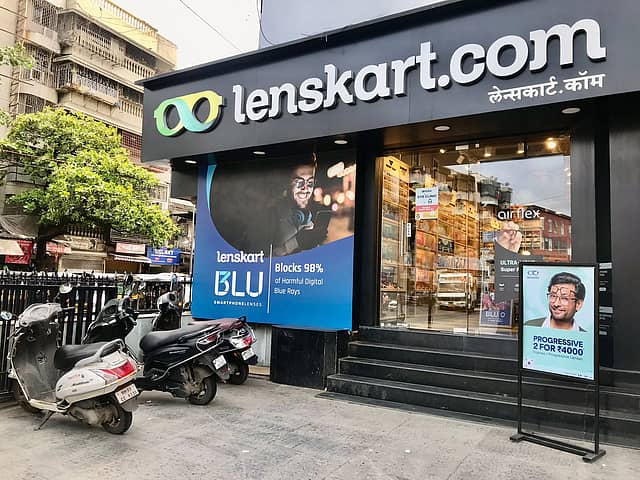
Credits: NDTV Profit
SoftBank’s Partial Exit Brings Big Gains
SoftBank trimmed its stake in Lenskart through its SVF II Lightbulb fund, selling about 2.55 crore shares in the IPO. The transaction fetched the Japanese investor approximately ₹1,005 crore in gains at the issue price, according to estimates.
Before the share sale, SoftBank held around 15% in the company; the divestment reduced its ownership by roughly 1.5%. Despite the partial exit, Juneja emphasized that SoftBank remains a long-term believer in Lenskart’s business fundamentals.
“The thesis of why we have sold such a small stake in the IPO and remain long-term investors is simple — many have tried to compete with Lenskart but have not been successful,” Juneja said, underscoring the company’s strong market moat.
Valuation Debate and Market Disconnect
Lenskart’s ₹70,000 crore (approximately $8 billion) valuation has been a lightning rod for criticism on social media, with many retail investors calling it inflated compared to its peers. However, Juneja dismissed the chatter, clarifying that valuation is determined by market dynamics, not by the company or its board.
“It is not Lenskart or Peyush who sets the valuation. We do our fundamental analysis of what the company could generate two or three years down the line,” he explained.
When asked about the apparent disconnect between investor enthusiasm and public sentiment, Juneja pointed to the strong demand from institutional investors. “Why was there such a disconnect between such a high-quality anchor book — QIB, retail, and HNI investors, all oversubscribed — versus social media? I don’t know,” he said, suggesting that perception often lags behind fundamentals.
A Lesson in Market Psychology
Juneja admitted that the episode offered SoftBank a valuable learning. “For our next IPO, we should definitely make sure that the quality of the book and the social media should be in sync,” he quipped, highlighting the growing influence of public perception in shaping IPO sentiment.
SoftBank has been one of the most prominent investors in India’s new-age ecosystem, with stakes in companies such as Paytm, Oyo, and Delhivery — many of which have struggled to sustain their IPO valuations. Juneja acknowledged this pattern but insisted that post-listing underperformance doesn’t necessarily indicate weak businesses.
“If the performance has not been there post-IPO, it’s because expectations have not been met. But that doesn’t mean they will remain there forever,” he said, adding that some businesses take longer to prove profitability and competitive strength.

The Road Ahead for Lenskart
Despite the lukewarm listing, analysts and investors see long-term promise in Lenskart’s omnichannel model, global expansion, and vertically integrated supply chain. With strong brand recall, a profitable business, and growing international presence — including in Southeast Asia and the Middle East — the company remains one of India’s rare consumer internet players with consistent earnings.
For SoftBank, the message is clear: short-term stock movements won’t dictate long-term conviction. As Juneja summed it up, Lenskart’s story is far from over — it’s simply adjusting its lens to the realities of the public market.