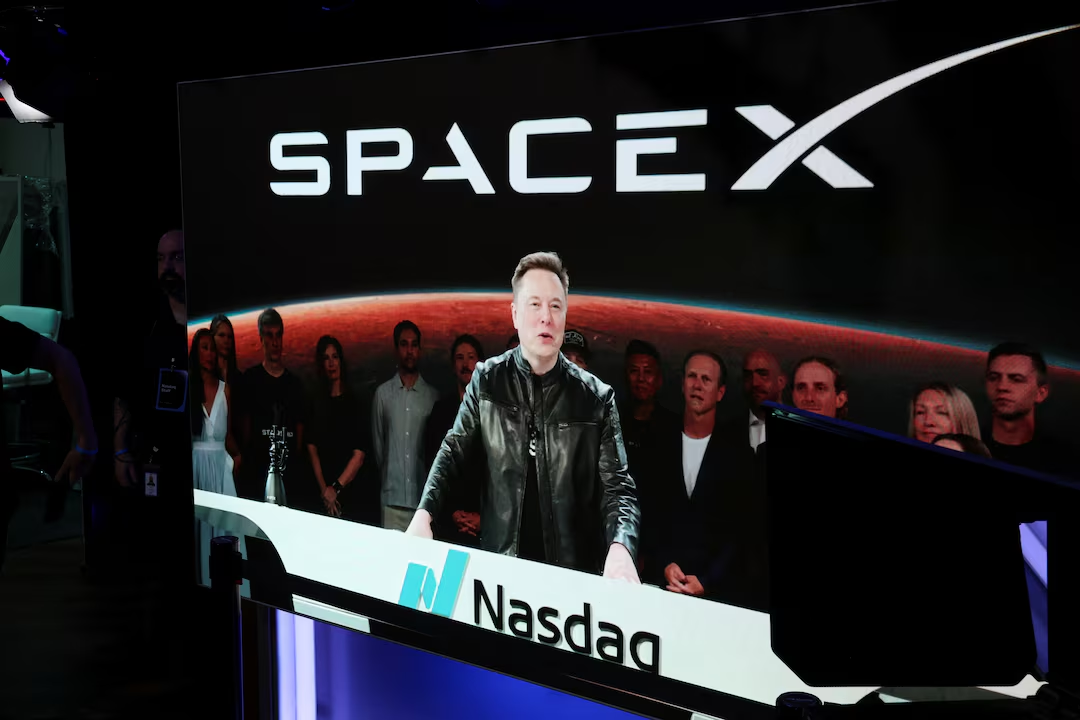
The president of SpaceX, Gwynne Shotwell, would not completely write off a potential merger between her company and Tesla at some point in the future, further fuelling speculations of a stronger connection between these two big ventures owned by Elon Musk.
Addressing CNBC on the day when SpaceX started trading on the Nasdaq stock exchange, Shotwell explained that the companies have much in common in terms of their future plans and could eventually merge.
“There’s no question that there are synergies between Tesla and SpaceX in our futures,” Shotwell pointed out. “There’s a convergence of what we’re all trying to accomplish in the future.”
This statement was made right after SpaceX went public during an initial public offering that was long-awaited. SpaceX managed to raise a whopping $75 billion, becoming a $1.77-trillion company – the largest-ever IPO.
Although Shotwell did not hint that a merger between the companies may be soon to happen, she did admit that merging SpaceX and Tesla would make Elon Musk’s work less challenging.
“Right now I’m focused on keeping the lights on here, keeping rockets in production, flying rockets, flying people, getting to the International Space Station, and critically providing broadband to folks that don’t have access,” she said.
Analyzing the Potential Merger of SpaceX and Tesla
This development comes amid investor scrutiny of how Musk’s various ventures integrate into each other. SpaceX, Tesla, and xAI currently have business relations, research projects, and common business goals.
The idea of merging has been further stimulated by SpaceX, which stated in its amended filing for its upcoming IPO that it would use its stock for future acquisitions. Shotwell added that SpaceX could be engaged in more mergers and acquisitions, given the growing role of artificial intelligence in many industries.
It goes without saying that the relationship between SpaceX and Tesla is significant. Tesla is SpaceX’s shareholder, and SpaceX works with Tesla on a joint project called Terafab that involves chip production. As stated in SpaceX’s IPO documents, the aerospace company purchased $131 million worth of Cybertrucks from Tesla in 2025.
Besides being a supplier of vehicles, Tesla has been selling its vehicles and batteries for the amount of almost $890 million since 2023 to SpaceX and xAI.
Additionally, earlier this year, SpaceX made another acquisition, which saw xAI incorporated into its operations. The deal brought in Grok, an AI chatbot, together with the X social media network. This further bolstered the CEO’s ambition of incorporating transport, space tech, communication, and artificial intelligence into his corporate portfolio.
On whether these two companies will eventually be merged, opinions of analysts remain split.
Dan Ives of Wedbush Securities is among those who have come out strong in favor of the merger. According to him, there is around an 80-90 percent chance of such a deal coming to fruition by 2027. To him, a combination of these two firms would be considered the “holy grail” in achieving Musk’s objective of utilizing AI.
However, other analysts are not so sure.
The Strategic Debate Over Independence vs. Synergy
In the view of analysts at Oppenheimer, allowing for independence may actually help in realizing Musk’s vision. Each of these businesses, according to them, works in its unique market, and it makes sense for them to continue operating independently. Nevertheless, the possibility of eventual merger was not denied.
Whereas for the company’s stakeholders, the question is if this move will yield higher profits or additional headaches. The combined firm will have the leadership in electric cars, reusable rockets, satellite internet, artificial intelligence, and advanced manufacturing. On the other hand, it might face new regulations and management issues.
The SpaceX stock offer also made Musk’s situation very interesting. He manages two publicly held corporations and still is deeply involved in his ventures, like xAI.
However, despite the company’s transition to public ownership, its structure guarantees Musk full control. According to the rules described by Musk in his IPO filing, he owns over 80% of voting stock, which gives him a significant influence over all important company decisions as well as ability to approve measures that can influence company leadership and control.
In any case, currently, there were no statements about the merger of either SpaceX or Tesla. Nonetheless, the statements made by Shotwell make one point very clear. The idea of a joint venture is not being completely ruled out, especially with the growth of SpaceX’s and Tesla’s importance in transportation, artificial intelligence, communications, and space exploration.