For decades, buying a video game meant visiting a store, picking up a physical disc, and hoping it worked on your computer. Updates arrived months later—if they arrived at all—and discovering new games depended largely on advertisements or recommendations from friends. Then came Steam, a platform that quietly changed the gaming industry forever.
Today, Steam is the default destination for millions of PC gamers around the world. It has become much more than a digital storefront; it’s a social network, a gaming library, a marketplace, a community hub, and a distribution platform that powers a significant portion of the PC gaming ecosystem. While competitors like Epic Games Store, GOG, Ubisoft Connect, and EA App have emerged over the years, Steam continues to dominate because of the powerful business model Valve has built over more than two decades.
So how does Steam make money? Why do developers continue to choose it despite its commission fees? And what makes its business model one of the most successful in the gaming industry?
Credits: Business Model Analyst
What Is Steam?
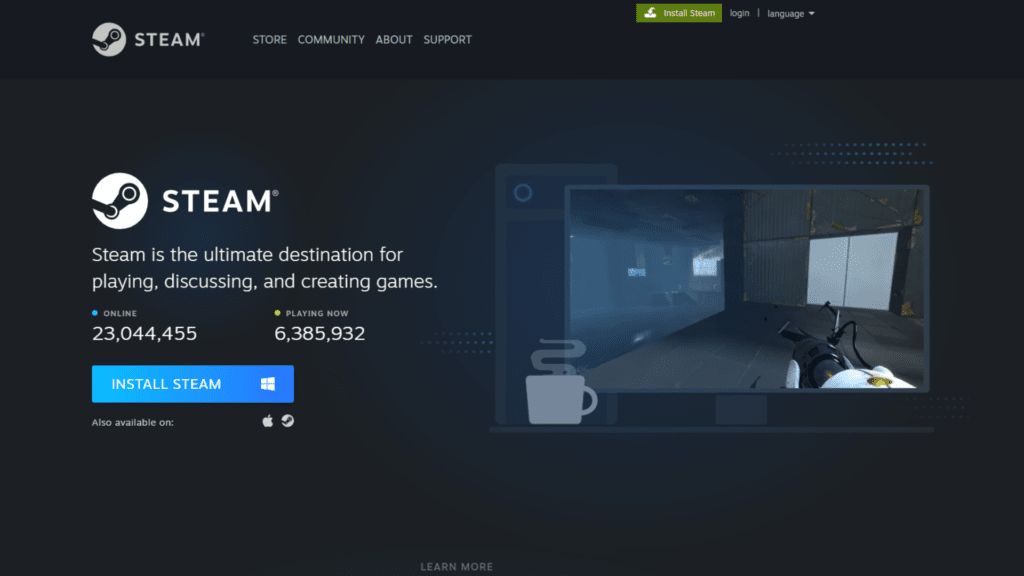
Steam is a digital distribution platform developed by Valve Corporation that allows users to buy, download, install, update, and play video games digitally. Available on Windows, macOS, Linux, and mobile devices, Steam has eliminated the need for physical game copies for millions of players.
Initially launched in September 2003, Steam wasn’t designed to become the world’s biggest gaming marketplace. Instead, Valve created it to distribute updates for its own games like Counter-Strike and Half-Life. At the time, pushing software patches to players was a cumbersome process that relied on downloads from various websites or physical updates.
Steam solved that problem by creating a centralized platform where games could automatically receive updates. Once Valve realized the potential of digital distribution, it began allowing third-party developers to publish their games on Steam, transforming it into an open marketplace.
That decision changed the gaming industry forever.
Today, Steam hosts tens of thousands of games ranging from blockbuster AAA titles to indie passion projects, serving well over a hundred million active users across the globe.
Steam’s Business Model at a Glance
At its core, Steam operates as a two-sided marketplace.
On one side are gamers looking for entertainment, while on the other are developers searching for an audience. Steam acts as the bridge connecting both groups, making money by taking a percentage of every transaction completed on its platform.
The more players Steam attracts, the more valuable it becomes for developers. Likewise, the more games developers publish on Steam, the more attractive the platform becomes for gamers. This self-reinforcing cycle creates what economists call a network effect—one of Steam’s greatest competitive advantages.
Unlike traditional retailers that manufacture products themselves, Steam doesn’t need to develop every game it sells. Instead, it provides the infrastructure, payment systems, cloud storage, matchmaking services, forums, achievements, and download servers while developers supply the content.
This asset-light marketplace model allows Steam to scale efficiently without carrying the development costs of thousands of games.
Valve’s Biggest Strength: Owning Both the Platform and Popular Games
Most digital marketplaces only operate the store.
Valve owns the store and also develops some of gaming’s most iconic franchises.
Games like Counter-Strike, Dota 2, Half-Life, Portal, Left 4 Dead, and Team Fortress have attracted millions of players over the years. These franchises helped establish Steam’s reputation during its early years when convincing players to adopt digital downloads wasn’t easy.
Having blockbuster first-party games also reduces Valve’s dependence on third-party publishers. Even if major publishers decide to launch their own stores, Valve still has exclusive intellectual property that attracts players to Steam.
This dual role—as both developer and platform owner—creates a strategic advantage that many competitors struggle to replicate.
How Steam Makes Money
Although Steam offers numerous services, its primary source of income remains surprisingly straightforward.
Commission on Game Sales
Steam earns most of its revenue by taking a share of every game sold through its marketplace.
For years, Valve charged a flat 30% commission on all game sales. However, in 2018, the company introduced a tiered revenue-sharing model designed to encourage large publishers to keep releasing games on Steam.
The current structure works like this:
- Valve keeps 30% of the first $10 million in sales.
- The commission drops to 25% for revenue between $10 million and $50 million.
- Beyond $50 million, Valve takes only 20%.
While some developers criticize these fees, many continue choosing Steam because of its enormous audience and extensive ecosystem.
For countless studios, reaching millions of potential customers outweighs paying a higher commission.
Credits: BGR
Steam Direct Submission Fees
Publishing a game on Steam isn’t completely free.
Developers pay a Steam Direct submission fee of $100 for every game they list. This fee helps reduce spam and low-quality submissions while ensuring developers are serious about releasing their games.
Although relatively small compared to development costs, these fees contribute additional revenue considering the thousands of games submitted annually.
In-Game Purchases and DLC
Steam also earns commissions on downloadable content (DLC), expansion packs, cosmetic items, season passes, and in-game purchases sold through its platform.
Many modern games continue generating revenue years after launch through additional content. Since these purchases often happen inside the Steam ecosystem, Valve receives a share of those transactions as well.
This creates recurring revenue instead of relying solely on initial game sales.
Community Marketplace
One of Steam’s most unique revenue streams comes from its Community Market.
Players can buy and sell digital items such as weapon skins, trading cards, cosmetic accessories, and collectibles obtained from supported games.
Every marketplace transaction includes a small transaction fee that goes directly to Valve.
Games like Counter-Strike have built thriving virtual economies worth millions of dollars annually, making this marketplace an important part of Steam’s business model.
Hardware Sales
Although software remains Steam’s biggest business, Valve has expanded into gaming hardware over the years.
Products have included:
- Steam Deck
- Steam Link
- Steam Controller
- Valve Index VR headset
Among these, the Steam Deck has become particularly successful by allowing players to access their Steam libraries on a portable gaming device.
Hardware generates direct sales while encouraging even greater engagement within the Steam ecosystem.
Why Developers Keep Choosing Steam
Considering alternative platforms exist, why do developers still launch their games on Steam?
The biggest reason is visibility.
Steam attracts an enormous audience of highly engaged gamers actively searching for new titles. Its recommendation algorithms, user reviews, wishlists, seasonal sales, and discovery features help games reach players organically.
Steam also provides developers with powerful backend tools through Steamworks.
These include cloud saves, multiplayer networking, achievements, anti-cheat support, game analytics, automatic updates, downloadable content management, controller compatibility, and community management tools.
Instead of building these systems independently, developers can integrate Steam’s infrastructure and focus on creating better games.
For small indie studios with limited budgets, this support significantly lowers operational costs.
Credits: OC3D
Steam’s Massive Community Creates a Competitive Moat
One reason Steam has maintained its dominance is that it evolved into much more than a storefront.
Every user profile includes friends lists, messaging, game reviews, screenshots, achievements, discussion forums, livestreams, mod support through the Steam Workshop, user guides, and trading systems.
These community features increase user engagement far beyond simply purchasing games.
When players have hundreds of purchased games, years of achievements, countless friends, and valuable inventories tied to Steam, switching to another platform becomes difficult.
This creates high switching costs that strengthen customer loyalty.
Competitors can copy digital storefronts, but recreating two decades of community engagement is much harder.
Steam’s Biggest Competitive Advantage: Network Effects
Steam benefits enormously from network effects.
More gamers attract more developers.
More developers publish more games.
More games attract even more gamers.
This cycle continually reinforces itself, making Steam stronger as it grows.
The platform’s seasonal sales further accelerate this process. Massive events like the Summer Sale and Winter Sale have become global shopping festivals where millions of players purchase discounted games.
These sales drive huge transaction volumes while keeping users engaged throughout the year.
Challenges Facing Steam
Despite its leadership, Steam isn’t invincible.
The Epic Games Store has challenged Valve by offering developers a significantly lower commission and spending heavily on exclusive titles and free game giveaways.
Subscription services like Xbox Game Pass are also changing how consumers access games by replacing individual purchases with monthly memberships.
Cloud gaming services promise another potential shift, allowing users to stream games without powerful gaming hardware.
Regulatory scrutiny around app store commissions and digital marketplaces could also impact Steam’s long-term pricing strategy.
Additionally, the explosion of AI-generated content and the growing number of game releases every year make discoverability increasingly difficult for smaller developers.
Valve will need to continue improving recommendation systems and quality control to maintain trust among both developers and players.
The Future of Steam
Valve has consistently shown that it prefers gradual innovation over radical redesigns.
Rather than chasing every industry trend, the company focuses on strengthening its ecosystem through better hardware, improved developer tools, enhanced community features, and new technologies like Steam Deck compatibility and virtual reality support.
Artificial intelligence may become the next frontier. AI-powered recommendations, automated moderation, personalized storefronts, smarter search, and developer tools could further improve the platform experience in the coming years.
Meanwhile, Steam Deck demonstrates Valve’s ambition to blur the line between PC and console gaming, expanding Steam beyond traditional desktop computers.
If successful, this strategy could unlock entirely new markets without abandoning Steam’s core strengths.
Credits: GV Wire
Conclusion
Steam’s business model is deceptively simple but incredibly powerful. By acting as the bridge between gamers and developers, Valve has built a platform that benefits from powerful network effects, recurring commissions, thriving community engagement, and a growing ecosystem of software and hardware products.
What began as a simple update service for Valve’s own games has evolved into the backbone of PC gaming. Steam succeeds not because it sells games alone, but because it has become the place where players discover new experiences, developers find audiences, and gaming communities thrive. As competition intensifies and new technologies reshape the industry, Steam’s greatest advantage remains the ecosystem it has spent more than twenty years building—an advantage that continues to make it the undisputed leader in digital PC game distribution.